
Once children begin recognising letters and their sounds, the next exciting step is putting those sounds together to make words.
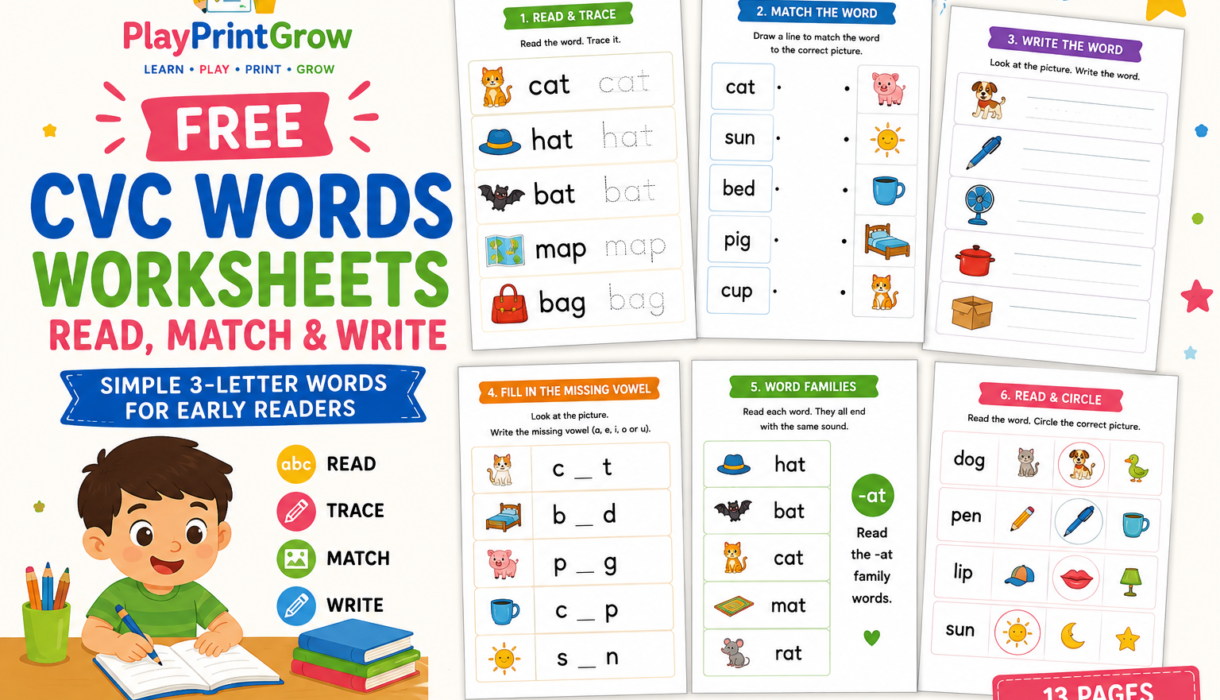
These free CVC words worksheets are designed to help young children practise reading, tracing, matching and writing simple three-letter words in a fun and manageable way.
CVC words are ideal for children who are beginning to explore phonics and early reading.
What Are CVC Words?
CVC stands for:
Consonant – Vowel – Consonant
These are simple three-letter words made using a consonant, followed by a vowel and another consonant.
Some common examples include:
- cat
- dog
- sun
- hat
- pen
- pig
- cup
- bed
- fox
- map
Because CVC words usually contain simple letter sounds, they are a great starting point for children learning how to blend sounds together.
For example:
c – a – t
Children can say each sound slowly:
/c/ /a/ /t/
Then blend the sounds together:
cat
What’s Included in the CVC Word Activities?
The printable activities can include several different ways to practise each word.
Read the Word
Children look at a simple CVC word and practise saying each sound.
For example:
DOG
d – o – g
Trace the Word
Children trace dotted letters to become familiar with the shape and order of each letter.
dog
dog
dog
Match the Word to the Picture
Children look at several words and match each one to the correct picture.
For example:
cat → 🐱
sun → ☀️
hat → 🎩
This helps children connect written words with familiar objects.
Write the Word
After tracing and reading the word, children can practise writing it independently.
CAT
Find the Correct Word
Children can also choose the correct word from several similar options.
For example:
Picture of a cat
cat
cot
cut
This encourages children to look carefully at the middle vowel sound.
Start With Short Vowel A Words
It can be easier to introduce one vowel family at a time.
Start with short a words such as:
cat
hat
bat
map
jam
bag
fan
cap
Children may begin to notice that some words sound similar.
For example:
cat – hat – bat
These are part of the -at word family.
Recognising word families can make early reading easier because children begin to see patterns within words.
Short Vowel E CVC Words
Once children are comfortable with short A words, try some short E words:
bed
hen
pen
red
leg
net
You can say each word slowly and encourage your child to listen carefully for the middle sound.
For example:
p – e – n
Short Vowel I CVC Words
Try words such as:
pig
sit
fin
lip
bin
win
Children can practise sounding out each letter before blending the word together.
Short Vowel O CVC Words
Examples include:
dog
fox
log
pot
top
cot
You can make the activity more playful by asking children to find objects or pictures that match the words.
Short Vowel U CVC Words
Some beginner-friendly short U words include:
sun
cup
bus
bug
run
hut
Practising a small group of words at a time can help children focus on the sounds without becoming overwhelmed.
How to Use CVC Worksheets
There is no need to complete several worksheets at once.
Try choosing three to five words during each learning session.
Begin by pointing to each letter and saying its sound.
For example:
s – u – n
Then slowly bring the sounds together:
ssss – uuuu – nnnn
sun
Ask the child to repeat the word.
After reading the word, they can trace it, match it with a picture and finally attempt to write it independently.
Make CVC Learning Hands-On
Worksheets are useful, but children can also practise CVC words through play.
Build Words With Letter Cards
Write letters on small pieces of paper or cards.
Give your child:
c
a
t
Ask them to arrange the letters to make cat.
Then change one letter:
c → h
Now the word becomes:
hat
This is a simple way to demonstrate how changing one sound creates a new word.
Use Magnetic Letters
Magnetic letters are another fun way to build words.
Call out a simple word such as:
dog
Ask the child to find:
d
o
g
Then arrange the letters in the correct order.
CVC Word Hunt
Write several CVC words on pieces of paper and hide them around the room.
When your child finds a word, encourage them to sound it out.
This turns reading practice into a movement activity.
What Skills Can Children Practise?
CVC word activities can support:
- Letter-sound recognition
- Phonics
- Sound blending
- Early reading
- Vocabulary
- Word recognition
- Spelling
- Handwriting
- Pencil control
- Listening skills
These foundational skills can help children become more confident as they move towards reading longer words and sentences.
Don’t Rush the Blending Process
Every child develops reading skills at a different pace.
Some children may quickly blend three sounds together, while others may need more time practising individual letter sounds.
If blending is difficult, go back to simple sound recognition.
For example:
“What sound does m make?”
“What sound does a make?”
“What sound does p make?”
Then gradually bring the sounds together:
m – a – p
map
Keep sessions short, positive and playful.
Try These CVC Words at Home
Here are some easy words to practise:
Short A
cat, bat, hat, map, bag, jam
Short E
bed, pen, hen, red, net, leg
Short I
pig, sit, fin, lip, bin, win
Short O
dog, log, fox, pot, top, cot
Short U
sun, cup, bug, bus, run, hut
Choose a few words at a time rather than trying to learn all of them in one session.
Keep Learning With PlayPrintGrow
CVC words are an important bridge between recognising letters and beginning to read independently.
Before starting CVC words, children may enjoy our A–Z Alphabet Tracing Worksheets and Letter Recognition Scavenger Hunt.
After CVC words, we’ll move on to another fun early-reading activity:
Play. Print. Learn. Grow.