
Threading and lacing activities are simple ways to help children strengthen their fingers while practising careful, controlled movements.
Children need to hold an object with one hand, guide a string with the other and coordinate both hands together.
These are useful skills for everyday tasks such as dressing, drawing, writing and using tools.
You don’t need expensive equipment either. Many threading activities can be created with materials already available at home or in the classroom.
What You’ll Need
Depending on the activity, you can use large beads, shoelaces, string, wool, pasta, drinking straws, cardboard, paper plates, buttons, cereal loops or pipe cleaners.
For younger children, choose large pieces and thick strings that are easier to hold.
Always supervise activities involving small objects.
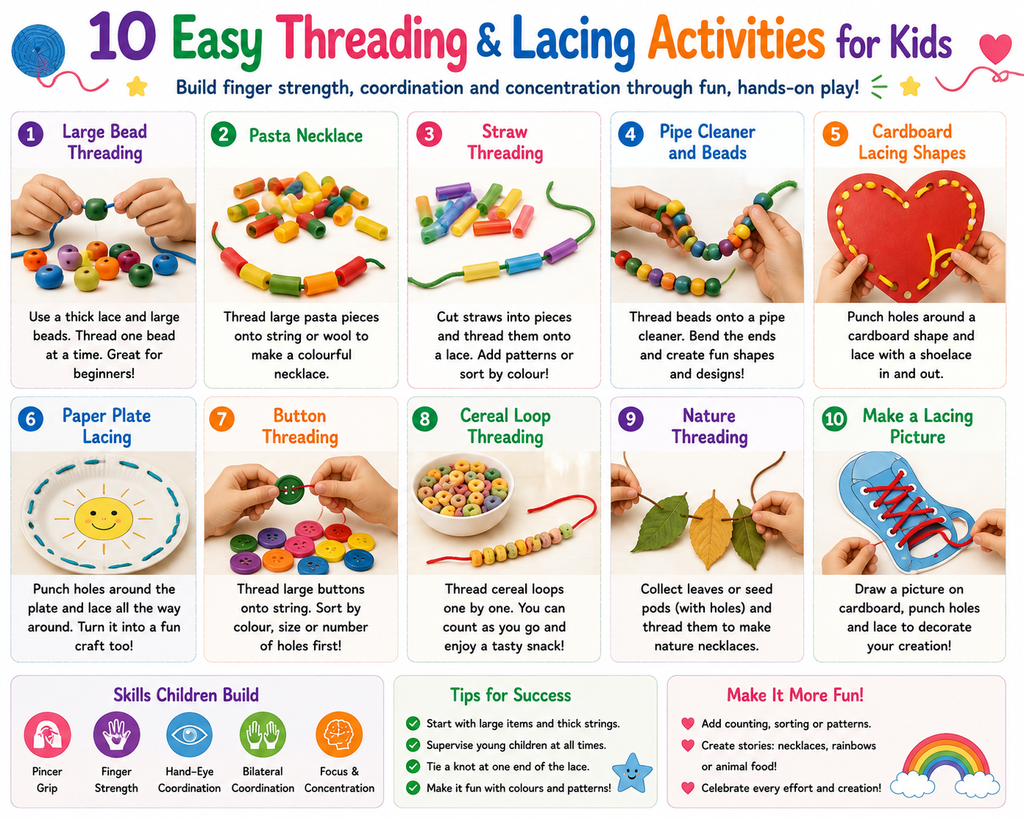
1. Large Bead Threading
Start with large beads and a thick shoelace.
Tie a knot at one end so the beads cannot fall off.
Show children how to hold the lace in one hand and push it through the hole in the bead.
Once they understand the movement, let them continue independently.
Try asking:
“Can you add five beads?”
“Can you find a blue bead?”
“Which bead will you add next?”
This combines fine motor skills with counting and colour recognition.
2. Pasta Necklace
Large tube-shaped pasta is perfect for beginner threading.
Provide a piece of string or wool and let children thread pasta pieces one at a time.
They can create a necklace, bracelet or long hanging decoration.
Children can also paint the pasta beforehand to make the activity more colourful.
For an extra challenge, create a pattern such as:
Red – Blue – Red – Blue
3. Straw Threading
Cut colourful drinking straws into short pieces.
Give children a shoelace, pipe cleaner or thick string.
Ask them to thread the straw pieces one at a time.
You can sort the straws by colour before threading or create simple repeating patterns.
4. Pipe Cleaner and Beads
Pipe cleaners are easier for beginners because they are firm and don’t flop around like string.
Children can thread beads onto the pipe cleaner and bend the ends when finished.
Try turning the finished creation into:
- A bracelet
- A caterpillar
- A flower
- A rainbow
- A simple decoration
5. Cardboard Lacing Shapes
Cut a large shape from thick cardboard.
Try a:
Heart
Star
Circle
Butterfly
Car
Punch holes around the outside.
Give children a shoelace and encourage them to thread it in and out through the holes.
This is great practice for using both hands together.
6. Paper Plate Lacing
Punch holes around the edge of a paper plate.
Tie wool or ribbon through one hole to create a starting point.
Children can lace around the plate, moving from hole to hole.
You can turn the finished plate into:
A spider web
Sun
Lion
Flower
Dream catcher
This combines lacing with an art activity.
7. Button Threading
Use large buttons with clearly visible holes.
Children can thread them onto a shoelace or thick string.
Try sorting first by:
- Colour
- Size
- Number of holes
- Shape
Then use the buttons to create a pattern.
Large buttons are best for younger children.
8. Cereal Loop Threading
Use ring-shaped cereal and a piece of string.
Children can thread one cereal loop at a time to create an edible necklace.
You can also turn it into a counting activity.
For example:
“Can you thread ten pieces?”
Or practise patterns using different cereal colours if available.
9. Nature Threading
Take the activity outdoors.
Collect large leaves and carefully make holes in them with adult help.
Children can thread leaves onto string to create a nature necklace or hanging decoration.
You could also use large seed pods or other safe natural materials with suitable openings.
This combines fine motor practice with outdoor exploration.
10. Make a Lacing Picture
Draw or print a simple picture onto cardboard.
Ideas include:
Shoe
Apple
Butterfly
Cloud
Animal
Punch holes around the outline.
Children thread the lace from one hole to another to decorate the picture.
Older children can try following a particular sequence instead of choosing the holes freely.
Why Is Threading Good for Fine Motor Development?
Threading requires several movements to happen at the same time.
Children need to grasp the string, hold the object steady, find the opening and carefully guide the string through.
This can support:
- Finger strength
- Pincer grip
- Hand-eye coordination
- Bilateral coordination
- Concentration
- Visual tracking
- Planning
- Pattern recognition
- Early maths skills
- Pre-writing control
What Is Bilateral Coordination?
Bilateral coordination means using both sides of the body together.
During threading, one hand usually holds the bead or object while the other hand controls the string.
Children use the same type of coordination when they:
- Hold paper while cutting
- Open containers
- Button clothing
- Tie shoelaces
- Write while holding the page steady
Threading gives children lots of opportunities to practise this naturally.
Start Big and Make It Smaller
For beginners, use large objects with large holes.
As children become more confident, gradually introduce smaller beads, thinner strings and more complicated patterns.
The progression might look like:
Pipe cleaner + large beads → shoelace + large beads → string + smaller beads
This allows the activity to become more challenging as control improves.
Add Colours, Counting and Patterns
Threading activities can easily include early maths learning.
Try asking children to make:
2 red + 2 blue + 2 red
or
Yellow – Green – Yellow – Green
You can also ask:
How many beads did you use?
Which colour has the most?
Can you make the same pattern again?
Keep Learning With PlayPrintGrow
Threading and lacing activities are easy to prepare, calming to complete and full of opportunities for children to develop important hand skills.
Start with large materials, keep the activity playful and gradually increase the challenge as children’s confidence grows.
Thread. Lace. Create. Grow.