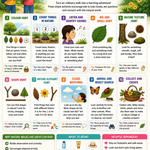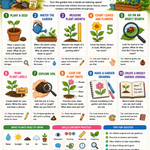

An outdoor scavenger hunt is a simple way to turn a walk, garden visit or trip to the park into a fun learning activity.
Children search for particular objects, colours, shapes or clues while moving around and carefully observing their surroundings.
Scavenger hunts can support early maths, language, science and problem-solving without feeling like a formal lesson.
These activities are suitable for children around 3–8 years old and can easily be adjusted depending on age.
What You’ll Need
You can keep the activity very simple.
Try using:
- A small checklist
- Pencil or crayon
- Clipboard
- Small basket or bag
- Camera
- Magnifying glass
Children do not always need to collect the objects. They can simply find, point to, photograph or tick them off.
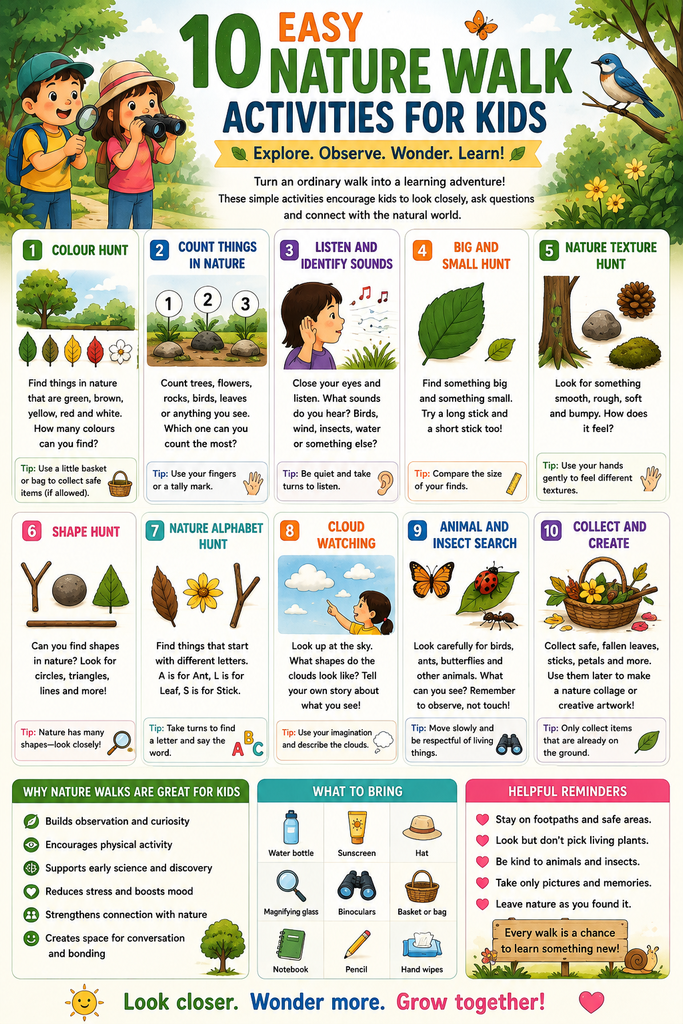
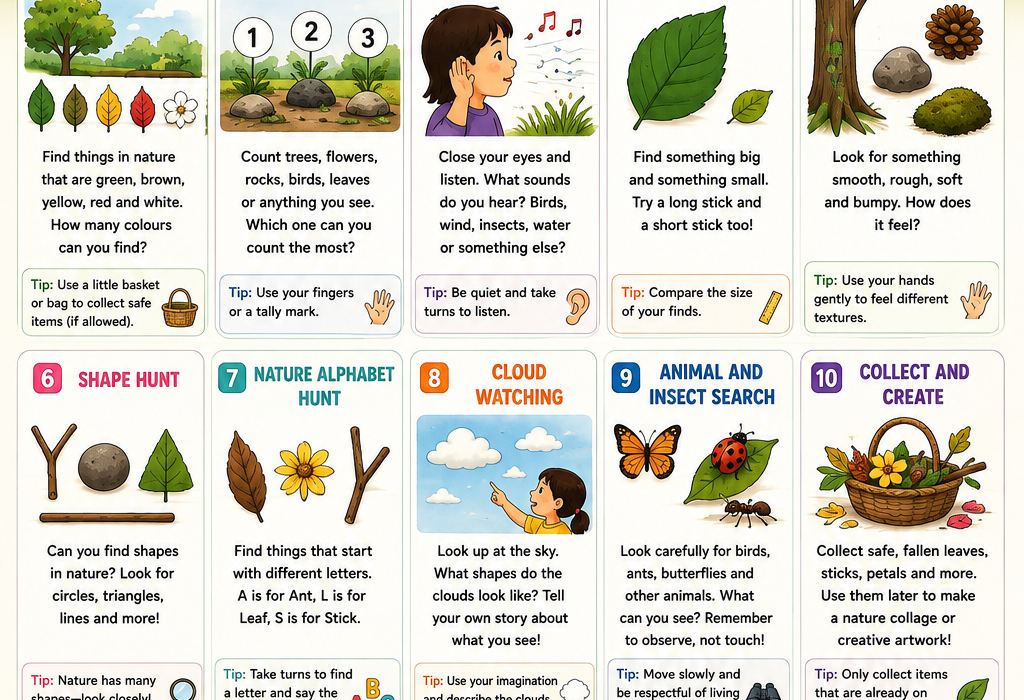
1. Nature Scavenger Hunt
Ask children to find common natural objects.
Try:
- A green leaf
- A brown leaf
- A small stick
- A flower
- A stone
- Grass
- A feather
- A seed pod
- Tree bark
- Something that smells interesting
Encourage children to observe living things without damaging them.
2. Colour Scavenger Hunt
Choose several colours.
Ask children to find something:
Red
Blue
Green
Yellow
Orange
Brown
White
The objects might be natural or human-made.
Ask:
“Can you find two things that are different shades of green?”
This encourages children to notice small differences in colour.
3. Shape Hunt
Look for shapes in the outdoor environment.
Can children find:
- A circle
- A square
- A triangle
- A rectangle
- An oval
- A straight line
- A curved line
A wheel might be a circle, a window a rectangle and a road sign a triangle.
This is a simple way to connect early geometry with real life.
4. Number Hunt
Look for numbers outdoors.
Children might find numbers on:
- Houses
- Signs
- Cars
- Letterboxes
- Sports courts
- Playground equipment
Ask:
“Can you find number 5?”
or:
“What is the biggest number you can see?”
Older children can try finding the numbers 1–10 in order.
5. Texture Scavenger Hunt
Ask children to find safe examples of different textures.
Try:
Something smooth
Something rough
Something soft
Something hard
Something bumpy
Something dry
Something wet
Encourage children to describe what they feel.
6. Sound Scavenger Hunt
This scavenger hunt uses ears instead of eyes.
Find a quiet spot and listen.
Can children hear:
- A bird
- Wind
- Leaves moving
- A vehicle
- Someone talking
- Water
- An insect
- Footsteps
Ask children to tick off each sound as they hear it.
You can also ask:
“Which sound is closest?”
“Which one is far away?”
7. Things That Move Hunt
Look for different things that move.
Children might find:
- A bird flying
- An ant walking
- A car driving
- Leaves blowing
- Water flowing
- A butterfly
- A person running
- Clouds moving
Talk about how each thing moves.
Does it fly, crawl, roll, walk or float?
8. Big and Small Scavenger Hunt
Ask children to find objects based on size.
Try:
- A big leaf
- A small leaf
- A long stick
- A short stick
- A large rock
- A tiny rock
- A tall tree
- A short plant
Ask children to place similar objects beside one another and compare them.
This introduces useful maths words such as bigger, smaller, longer and shorter.
9. Alphabet Scavenger Hunt
Choose several letters and search for something beginning with each one.
For example:
A – Ant
B – Bird
F – Flower
L – Leaf
R – Rock
T – Tree
Older children might try completing more of the alphabet.
Younger children can simply focus on the first letter of familiar objects.
10. Photo Scavenger Hunt
Instead of collecting anything, use a phone or camera to photograph discoveries.
Children might photograph:
- Something colourful
- Something tiny
- Something beautiful
- Something moving
- Something round
- Something unusual
- Something they have never noticed before
At the end, look through the pictures together and talk about what they found.
This is a good option when exploring places where natural objects should stay where they are.
Create a Simple Checklist
For younger children, use pictures alongside words.
For example:
☐ Leaf
☐ Bird
☐ Flower
☐ Rock
☐ Stick
Older children can read a longer checklist independently.
You can also leave blank spaces so children can add their own things to search for.
Don’t Make It a Race
Scavenger hunts do not need to be about finding everything as quickly as possible.
Encourage children to slow down and notice details.
If they find an interesting insect, unusual leaf or tiny flower that wasn’t on the list, allow time to investigate it.
The unexpected discoveries are often the most interesting part.
Ask Questions Along the Way
Try questions such as:
“How are these two leaves different?”
“Why do you think this rock is smooth?”
“Where do you think that bird is going?”
“What do you think made this hole?”
“What else could we look for?”
Questions encourage children to think about what they are seeing rather than only checking items off a list.
Turn It Into a Team Activity
If several children are playing, let them work together.
One child might hold the checklist while another looks for objects.
They can take turns finding different items.
This can encourage:
- Cooperation
- Communication
- Turn-taking
- Shared problem-solving
Make It More Challenging
For older children, use clues instead of directly naming the object.
Instead of:
Find a tree
try:
“Find something tall that has bark and leaves.”
Instead of:
Find a bird
try:
“Find an animal that has feathers and can fly.”
Children need to solve the clue before they begin searching.
Skills Children Can Practise
Outdoor scavenger hunts can support:
- Observation
- Concentration
- Colour recognition
- Shape recognition
- Counting
- Number recognition
- Vocabulary
- Early literacy
- Comparing
- Problem-solving
- Gross motor movement
- Environmental awareness
- Memory
Where Can You Do a Scavenger Hunt?
Almost anywhere.
Try:
- Backyard
- Garden
- Local park
- Beach
- Playground
- Walking track
- Neighbourhood
- Childcare outdoor area
You can change the items depending on the location.
A beach hunt might include shells, seaweed and footprints, while a garden hunt might focus on leaves, flowers and insects.
Keep Learning With PlayPrintGrow
A scavenger hunt encourages children to slow down, look closely and discover things they might normally walk past.
Keep the list simple, follow the child’s curiosity and enjoy exploring together.
Search. Find. Explore. Grow.