
Nature is full of colours, textures, shapes and interesting materials that children can use to create their own artwork.
A nature collage is a simple activity where children collect natural items such as leaves, flowers, grass, sticks and seed pods, then arrange them into pictures or patterns.
It is an easy craft that combines outdoor exploration with creativity.
What You’ll Need
You can keep this activity very simple.
Try using:
- Leaves
- Small sticks
- Fallen flowers
- Grass
- Seed pods
- Bark pieces
- Feathers that are safe to collect
- Paper or cardboard
- Child-safe glue
- Crayons or markers
Only collect items that have already fallen where possible, and avoid picking unknown plants.
Start With a Nature Walk
Before making the collage, take children outside for a short nature walk.
Give them a small container or paper bag and invite them to collect interesting natural materials.
You might ask:
Can you find three different leaves?
Can you find something smooth?
Can you find something rough?
Can you find something brown, green or yellow?
This turns collecting materials into part of the learning experience.
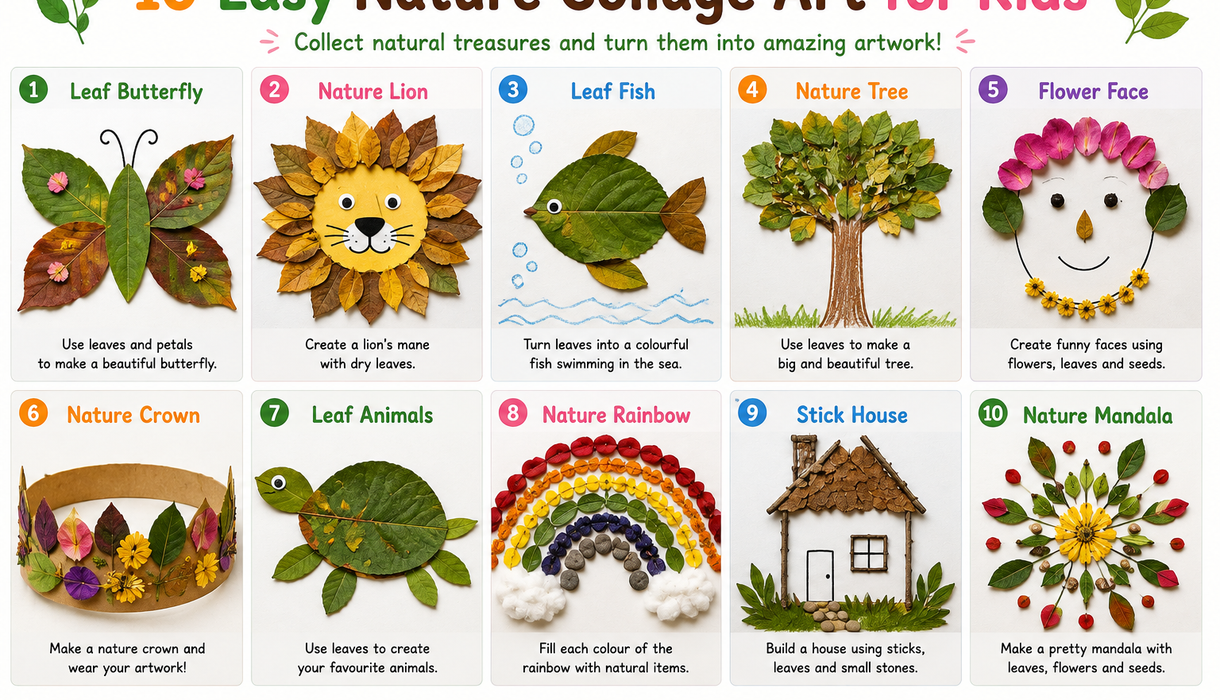
10 Nature Collage Ideas
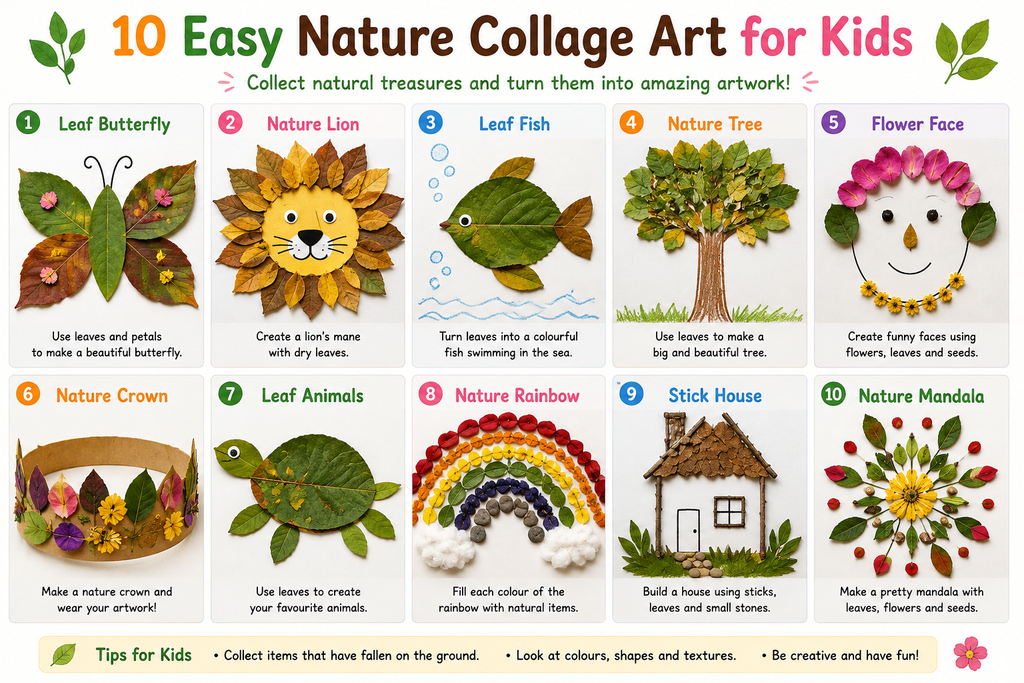
1. Leaf Butterfly
Use one long leaf for the butterfly’s body.
Place two larger leaves on each side to make wings.
Add small leaves, petals or seeds as decorations.
2. Nature Lion
Draw or cut out a simple lion face.
Arrange dry leaves around the face to create a large mane.
Yellow and brown leaves work especially well.
3. Leaf Fish
Use one large leaf as the fish’s body.
Add a smaller leaf for the tail and tiny leaves for fins.
Draw bubbles around the fish using crayons.
4. Nature Tree
Draw a tree trunk on paper.
Glue small leaves above it to create the branches and canopy.
Children can use different leaf colours to create a spring, autumn or imaginary tree.
5. Flower Face
Arrange petals, leaves and small natural objects into a funny face.
For example:
Leaves – ears
Petals – hair
Seeds – eyes
Twig – mouth
Encourage children to create different expressions.
6. Nature Crown
Cut a long strip of cardstock that fits around the child’s head.
Glue leaves, petals and small natural materials along the strip.
When it is dry, join the ends together to create a nature crown.
7. Leaf Animals
Turn different-shaped leaves into animals.
A child might see:
- A leaf that looks like a fish
- Two leaves that look like butterfly wings
- A round leaf that looks like a turtle shell
- A long leaf that looks like a bird
Add drawn eyes, legs or other details with markers.
8. Nature Rainbow
Draw a large rainbow outline.
Instead of colouring it with crayons, fill each section with natural materials.
Children might use:
Green leaves
Yellow petals
Brown bark
Red or orange leaves
The colours do not have to match a traditional rainbow.
9. Stick House
Arrange small sticks into the shape of a house.
Use leaves for the roof, grass for the garden and small stones for a path.
Children can add windows and doors with crayons.
10. Nature Mandala
Start with one flower, leaf or stone in the centre of the paper.
Arrange natural items around it in repeating circles.
Encourage children to create simple patterns using colours, shapes or textures.
Talk About What You Find
Nature collage activities provide lots of opportunities for conversation.
Ask questions such as:
Which leaf is the biggest?
Which one feels smooth?
What colours can you see?
Are these two leaves the same shape?
Where do you think this seed came from?
These conversations can support vocabulary, observation and early science learning.
Encourage Children to Design Freely
You don’t always need to provide an example.
Place the collected materials on the table and ask:
“What could you make with these?”
One child may create an animal while another makes a garden, pattern or completely imaginary picture.
There is no single correct result.
What Skills Can Children Practise?
Nature collage art can support:
- Creativity
- Fine motor skills
- Hand-eye coordination
- Sorting
- Colour recognition
- Shape recognition
- Observation
- Vocabulary
- Pattern making
- Problem-solving
- Appreciation of nature
Extend the Activity
After finishing the artwork, invite children to talk about what they created.
You could ask:
What did you make?
Which natural material was your favourite?
Where did you find it?
What would you add next time?
Older children can also write a sentence or short story about their collage.
Keep Creating With PlayPrintGrow
Nature crafts are a simple way to connect outdoor exploration with creative learning.
Every nature walk can produce different materials, which means children can create something completely new each time.
Explore. Create. Learn. Grow.