
Playdough is more than a fun sensory activity. All that squeezing, rolling, pinching and pressing gives children’s hands an excellent workout.
These simple playdough fine motor activities can help strengthen the small muscles children use for everyday tasks such as holding pencils, using scissors, buttoning clothes and feeding themselves.
The best part is that you only need a small amount of playdough and a few everyday items.
What You’ll Need
For most of these activities, you can use:
- Playdough
- Child-safe scissors
- Straws
- Buttons
- Large beads
- Craft sticks
- Cookie cutters
- Rolling pin
- Toy animals
- Plastic forks or spoons
You don’t need everything at once. Choose a few materials depending on the activity.
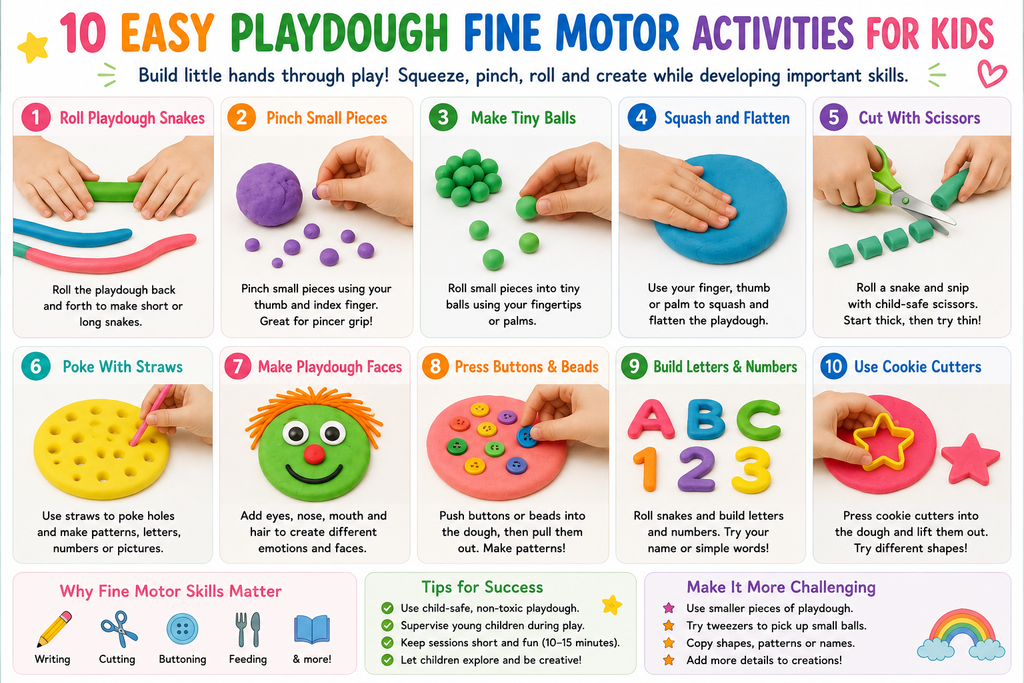
1. Roll Playdough Snakes
Give your child a ball of playdough and show them how to roll it backwards and forwards using both hands.
Try making:
- Short snakes
- Long snakes
- Thick snakes
- Thin snakes
This simple movement helps build strength in the hands, fingers and wrists.
You can also ask:
“Can you make a snake longer than your hand?”
“Can you make two snakes the same size?”
2. Pinch Small Pieces
Roll a large piece of playdough into a ball.
Ask children to pinch small pieces away using their thumb and index finger.
They can place the pieces into a bowl or use them to decorate another creation.
Pinching is particularly useful for developing the pincer grip, which children later use when holding small objects and controlling a pencil.
3. Make Tiny Playdough Balls
Give children several small pieces of playdough.
Ask them to roll each piece between their fingertips or palms to create tiny balls.
Then use the balls to make:
- Caterpillars
- Grapes
- Flowers
- Ice cream sprinkles
- Counting groups
Try counting the balls together as you make them.
4. Squash and Flatten
Make several playdough balls and invite children to flatten them.
They can use:
One finger
Their thumb
Their whole palm
Both hands
Ask:
“Which way makes it the flattest?”
This activity strengthens the hands while also encouraging children to experiment with pressure.
5. Cut Playdough With Scissors
Roll the playdough into long snakes.
Give children child-safe scissors and let them snip the snake into smaller pieces.
Start with thick pieces because they are easier to cut.
As children become more confident, make thinner playdough strips.
This is a great introduction to scissor skills because playdough is often easier to cut than paper.
6. Poke Playdough With Straws
Flatten a large piece of playdough.
Give children drinking straws and let them poke holes into the surface.
They might make:
- Dots
- Patterns
- Letters
- Numbers
- Shapes
- Faces
You can also cut straws into shorter pieces and ask children to push them into the dough like birthday candles.
7. Make Playdough Faces
Create a large flat circle of playdough.
Children can then add:
- Small balls for eyes
- A playdough nose
- A curved mouth
- Playdough hair
- Buttons or craft materials
Ask children to create different emotions:
Happy
Sad
Surprised
Silly
Angry
This combines fine motor practice with creativity and emotional vocabulary.
8. Press Buttons and Beads
Flatten a piece of playdough and provide large buttons or beads.
Children can push each object into the dough and then pull it back out.
Try making:
- Lines
- Circles
- Colour patterns
- Pictures
- Numbers
You can also ask children to sort buttons by colour or size before pressing them into the playdough.
For younger children, use only large objects and supervise closely.
9. Build Letters and Numbers
Roll playdough into thin snakes.
Use them to create letters and numbers.
Start with easy shapes such as:
O
C
L
T
1
2
Older children can try making their name.
For example, they can roll several pieces and arrange them to form each letter.
This connects fine motor play with early literacy and numeracy.
10. Use Cookie Cutters
Roll or flatten the playdough.
Give children different cookie cutters and let them press firmly into the dough.
Try:
- Circles
- Stars
- Hearts
- Animals
- Numbers
- Letters
Children need to press, grip, lift and remove the playdough from the cutter—all useful hand-strengthening movements.
Why Are Fine Motor Skills Important?
Fine motor skills involve the small muscles in the hands, fingers and wrists.
Children use these muscles when they:
- Hold a pencil
- Draw
- Write
- Use scissors
- Turn pages
- Use cutlery
- Fasten buttons
- Build with small objects
- Open containers
Activities involving squeezing, pinching and manipulating playdough provide natural opportunities to practise these movements.
Let Children Explore Freely
Not every playdough session needs instructions.
Sometimes simply placing playdough and a few tools on the table is enough.
Children may invent:
Food
Animals
People
Buildings
Vehicles
Imaginary creatures
Open-ended play encourages children to experiment and solve problems independently.
Make the Activity More Challenging
As children’s hand control improves, try:
- Making smaller playdough pieces
- Using tweezers to pick up playdough balls
- Creating repeating patterns
- Copying simple shapes
- Building their name
- Making small detailed objects
Smaller movements generally require greater finger control.
Keep Sessions Simple
Fine motor development doesn’t require long structured lessons.
Even 10–15 minutes of playdough play can give children’s hands plenty of useful movement.
Allow children to explore at their own pace and choose activities that suit their current abilities.
Keep Learning With PlayPrintGrow
Playdough provides an easy way to combine sensory play, creativity and fine motor development.
Roll it, squeeze it, pinch it, cut it and build with it—the more children use their hands, the more opportunities they have to develop control and confidence.
Squeeze. Create. Play. Grow.