
Learning to use scissors is an important fine motor skill for young children.
Cutting requires children to coordinate both hands, control their fingers, follow a direction and carefully move scissors along a line.
The best way to build confidence is to start with simple snipping activities before moving on to lines, curves and shapes.
What You’ll Need
You can use:
- Child-safe scissors
- Coloured paper
- Cardstock
- Straws
- Playdough
- Old magazines
- Paper strips
- Markers
- Glue
- Scrap paper
Always supervise young children while using scissors.
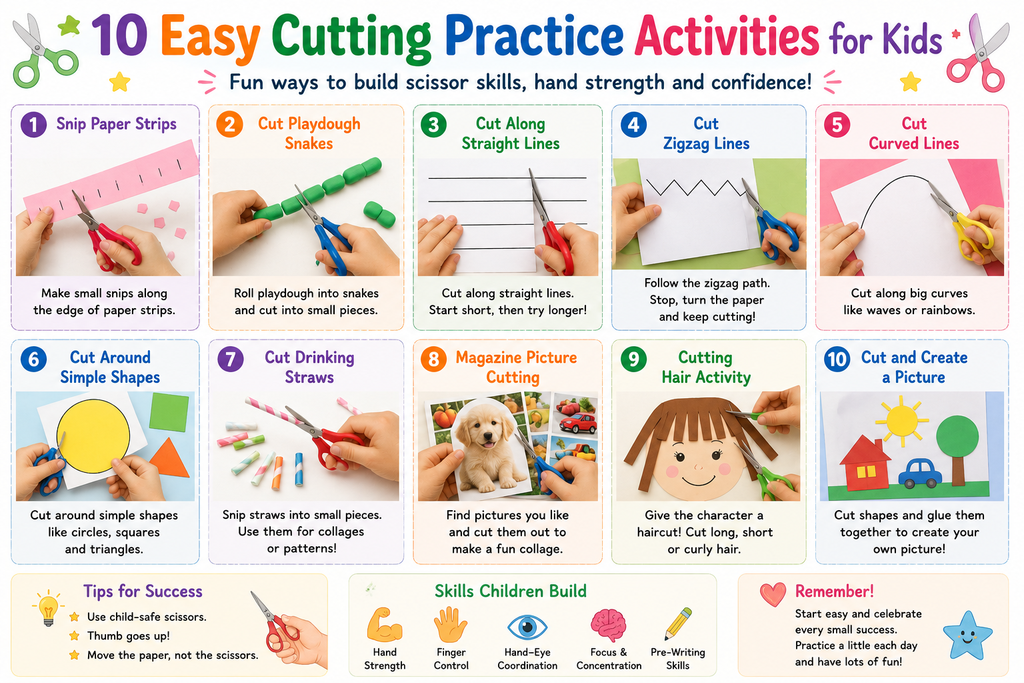
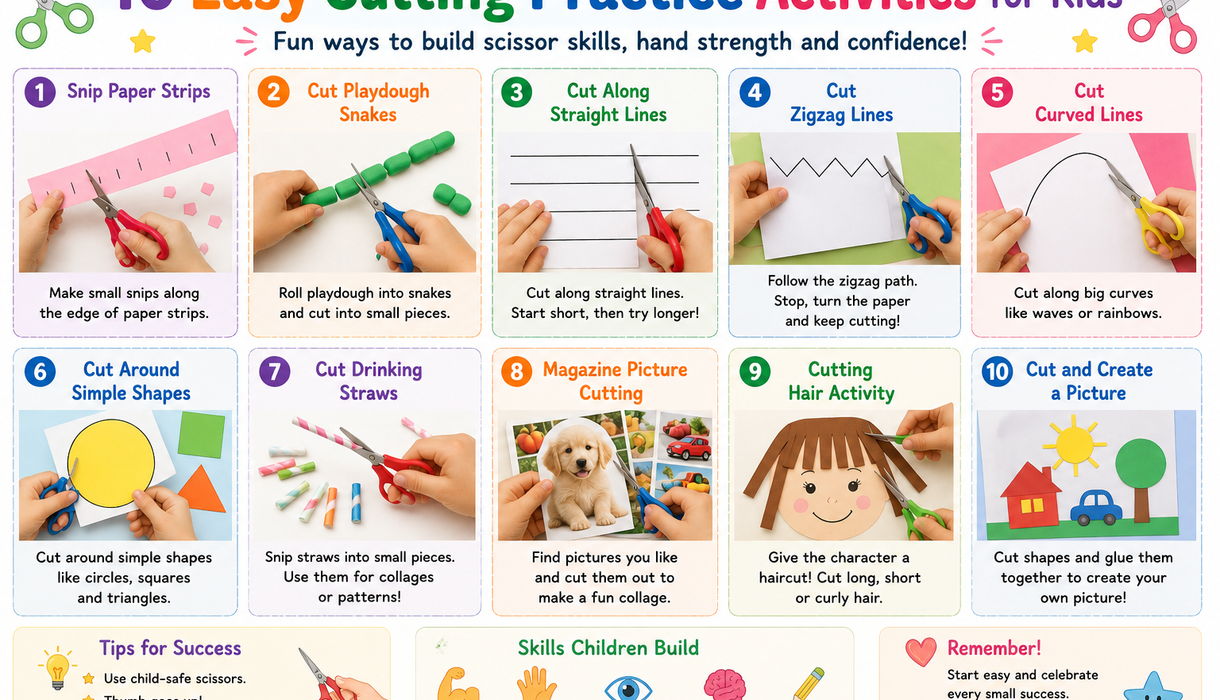
1. Snip Paper Strips
Start with short strips of paper.
Ask children to make small snips along the edge.
They do not need to cut all the way across at first.
This helps children practise opening and closing the scissors.
You can draw small marks along the edge to show where to cut.
2. Cut Playdough Snakes
Roll playdough into thick snakes.
Give children child-safe scissors and let them cut the snake into small pieces.
Playdough is often easier to cut than paper, making this a good starting activity for beginners.
Try cutting:
- Long pieces
- Short pieces
- Equal-sized pieces
- Different colours
3. Cut Along Straight Lines
Draw several thick straight lines on paper.
Start with short lines before introducing longer ones.
Encourage children to:
Open the scissors
Move forward
Close the scissors
Repeat
Remind them to move the paper with the helping hand while keeping the scissors facing forward.
4. Cut Zigzag Lines
Once straight lines become easier, introduce simple zigzags.
Draw wide zigzag paths rather than small sharp turns.
Children need to stop, rotate the paper and continue cutting.
This helps develop coordination between both hands.
5. Cut Curved Lines
Draw large gentle curves on paper.
Try:
- Waves
- Rainbows
- Spirals
- Large circles
Curved lines require more control because children need to slowly turn the paper while cutting.
6. Cut Around Simple Shapes
Draw large shapes such as:
Circle
Square
Triangle
Rectangle
Start with large shapes because they are easier to follow.
Children can use the cut-out shapes later for a collage or picture.
7. Cut Drinking Straws
Give children paper or soft drinking straws and allow them to snip them into small pieces.
The pieces can then be used for:
- Collages
- Patterns
- Counting activities
- Colour sorting
The slight resistance of the straw gives the hands a different type of cutting practice.
8. Magazine Picture Cutting
Use old magazines or catalogues.
Ask children to find pictures they like and carefully cut around them.
Younger children can simply cut the whole picture box rather than following the exact outline.
Glue the pictures onto paper to create a collage.
Try themes such as:
Food
Animals
Vehicles
Colours
Things I Like
9. Cutting Hair Activity
Draw a simple face on paper and attach long strips of paper around the top as hair.
Children can give the character a haircut.
They can cut:
- Short hair
- Long hair
- Fringes
- Zigzag hair
- Curly-looking strips
This turns cutting practice into imaginative play.
10. Cut and Create a Picture
Give children coloured paper with several simple shapes drawn on it.
Ask them to cut out the shapes and use them to create a picture.
For example:
Circle + triangles = sun
Rectangle + circles = car
Square + triangle = house
Circles + rectangle = caterpillar
Children can then glue everything onto another sheet of paper.
How to Hold Scissors
Show children how to hold scissors correctly.
The thumb goes in the smaller hole and points upwards.
The other fingers go in the larger hole.
A useful reminder is:
“Thumbs up while we cut.”
The helping hand holds and turns the paper.
Start With Easy Materials
Paper is not always the easiest material for beginners.
You can start with:
- Playdough
- Thin cardboard strips
- Paper straws
- Tissue paper
- Scrap paper
Once children understand the opening-and-closing movement, move onto more precise paper cutting.
Skills Children Can Practise
Cutting activities can support:
- Hand strength
- Finger control
- Bilateral coordination
- Hand-eye coordination
- Visual tracking
- Concentration
- Spatial awareness
- Pencil-control preparation
- Independence
These skills are also useful for drawing, writing and everyday self-care tasks.
Make Cutting Practice Fun
Instead of asking children to repeatedly cut worksheets, turn cutting into part of a creative activity.
Try:
Cutting grass for a garden picture
Giving a paper person a haircut
Cutting food pictures for a shopping collage
Making paper confetti
Cutting shapes to build a robot
When cutting has a purpose, children are often more interested in practising.
Follow the Child’s Ability
Some children may be ready to cut shapes while others are still learning how to open and close the scissors.
Both stages are completely normal.
Start with success and gradually increase the difficulty.
The goal is to help children become confident and controlled rather than rushing toward perfect cutting.
Keep Learning With PlayPrintGrow
Scissor skills develop through repeated hands-on practice.
Start with simple snips, progress to lines and curves, then let children use their new skills in creative projects.
Snip. Cut. Create. Grow.