
Before children begin writing letters and words, they need opportunities to develop control over their hands and fingers.
Pre-writing activities help children practise the movements used later for drawing, tracing and handwriting.
The goal is not perfect pencil grip or perfect lines. Instead, children gradually learn how to control a pencil, move it in different directions and coordinate what their eyes see with what their hands do.
What You’ll Need
You can use:
- Thick crayons
- Triangular crayons
- Pencils
- Washable markers
- Chalk
- Whiteboard markers
- Paper
- Cardboard
- Whiteboards
- Stickers
- Playdough
For younger children, thicker drawing tools are often easier to hold.
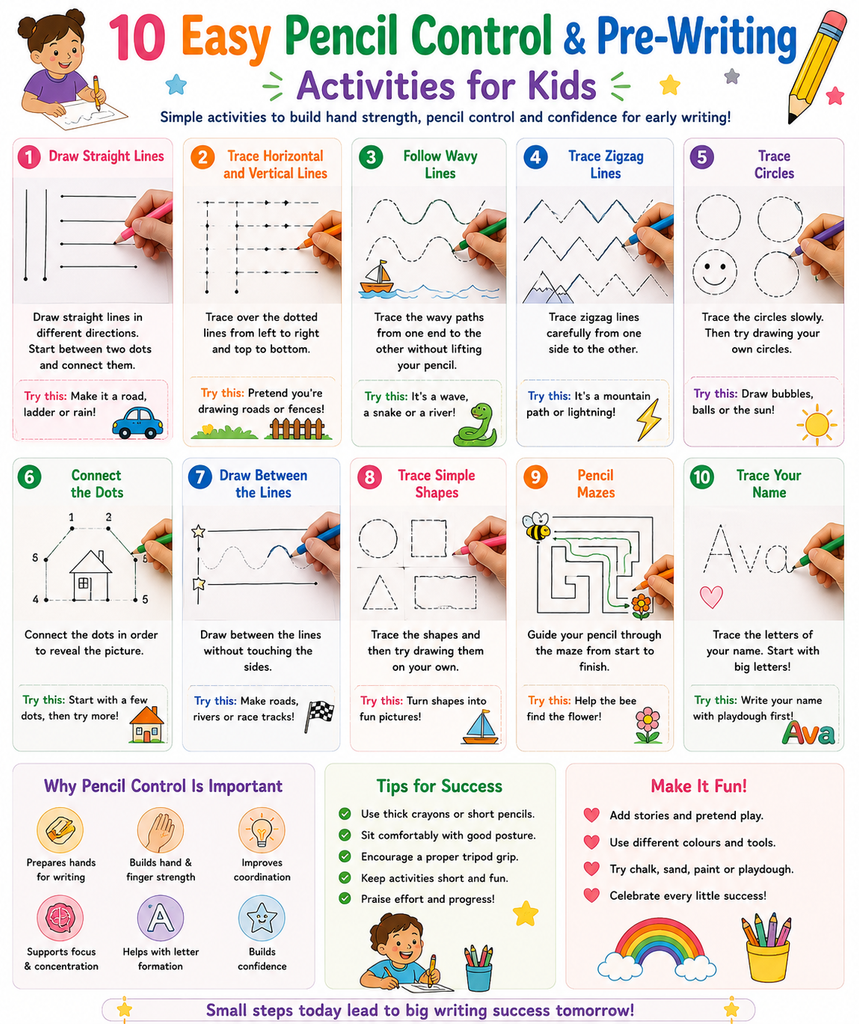
1. Draw Straight Lines
Start with simple straight lines.
Show children how to draw:
Top to bottom
Left to right
Bottom to top
Draw two dots and ask the child to connect them.
Gradually increase the distance between the dots.
This helps children practise controlled movement in a clear direction.
2. Trace Horizontal and Vertical Lines
Draw thick dotted lines across a page.
Begin with:
---------
and:
| | | | |
Ask children to slowly trace over each line.
You can make the activity more playful by saying:
“Help the car drive along the road.”
or
“Help the rocket fly to the moon.”
3. Follow Wavy Lines
Once straight lines become easier, introduce waves.
Draw large, smooth wavy paths.
Children can trace from one side to the other without lifting the pencil.
Pretend the line is:
- Ocean waves
- A snake
- A roller coaster
- A winding road
This helps prepare children for curved letter movements.
4. Trace Zigzag Lines
Create large zigzag patterns.
Ask children to follow the path carefully.
Encourage them to slow down when they reach each corner.
Start with wide zigzags before introducing smaller ones.
This activity develops direction changes and hand control.
5. Trace Circles
Draw large circles for children to trace.
Try making:
- Bubbles
- Balloons
- Wheels
- Suns
- Faces
Children can trace around the circle several times and then try drawing their own.
Circular movements are useful preparation for letters such as o, a, c, d and g.
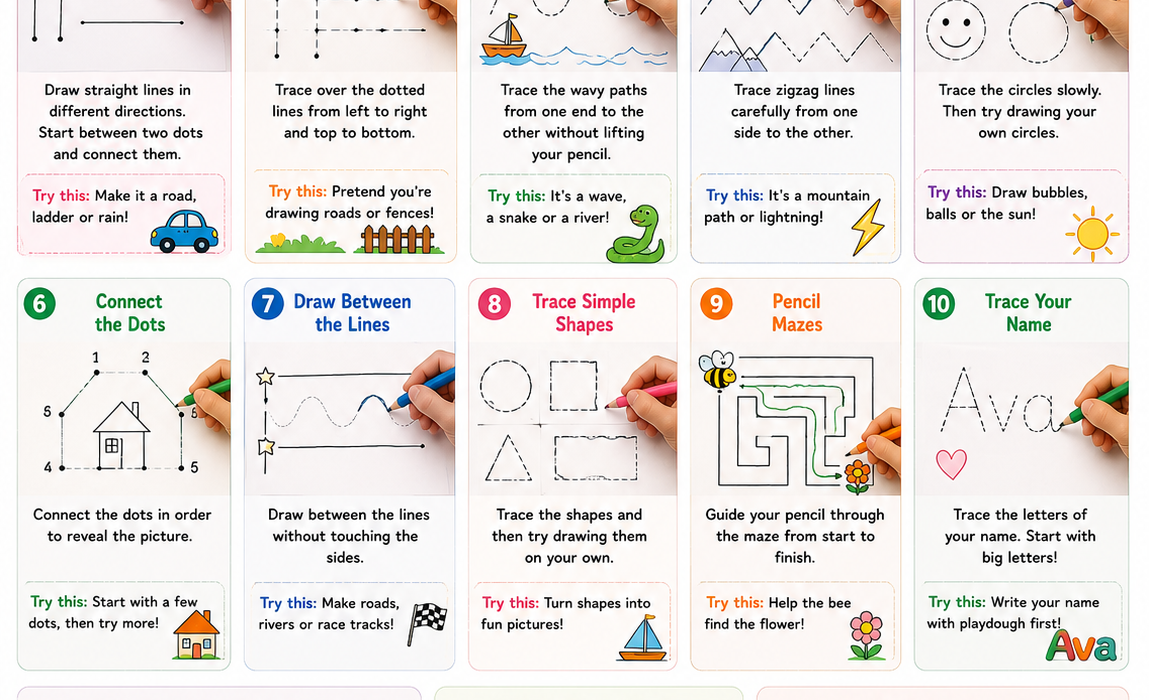
6. Connect the Dots
Create simple pictures using large numbered or unnumbered dots.
Start with only a few dots.
For example, four dots can create a square.
Three dots can create a triangle.
Later, children can connect dots to create:
- Houses
- Stars
- Fish
- Cars
- Animals
This encourages visual tracking and controlled pencil movement.
7. Draw Between the Lines
Create two parallel lines to make a path.
Ask children to draw from one end to the other without touching the sides.
Start with a wide path.
Gradually make the path narrower.
You can turn the paths into:
Roads
Rivers
Race tracks
Animal trails
This is especially useful for developing accuracy.
8. Trace Simple Shapes
Practise tracing basic shapes such as:
Circle
Square
Triangle
Rectangle
Oval
After tracing, ask children to draw the shape independently.
You can also ask:
“Can you turn this circle into a face?”
or
“Can you make this square into a house?”
This keeps the activity creative.
9. Pencil Mazes
Create very simple mazes with wide pathways.
Ask children to guide a pencil from the start to the finish without touching the edges.
Themes could include:
Help the bee reach the flower
Help the car reach the garage
Help the puppy find its bone
Help the rocket reach the planet
Start with short mazes and gradually add more turns.
10. Trace Your Name
When children are ready, begin with their own name.
Write the child’s name using large dotted letters.
Ask them to trace each letter slowly.
Start with only the first letter if the whole name feels difficult.
You can also make the activity more tactile by first creating the letters with:
- Playdough
- Finger paint
- Sand
- Craft sticks
Then move onto pencil tracing.
Try Pre-Writing Without a Pencil
Pencil control doesn’t need to start with pencils.
Children can practise the same movements by:
- Drawing in sand
- Finger painting
- Using chalk outside
- Making lines in shaving foam
- Drawing with water and paintbrushes
- Building lines with playdough
Large movements are often easier before children move to smaller pencil movements.
What About Pencil Grip?
Young children may experiment with several different ways of holding a pencil.
Instead of constantly correcting their grip, provide plenty of activities that strengthen their fingers and hands.
Short crayons can sometimes encourage children to use their fingers rather than wrapping their whole hand around the tool.
Activities involving playdough, tweezers, threading and pom-poms can also support the muscles used for pencil control.
Skills Children Can Practise
Pre-writing activities can support:
- Pencil control
- Hand strength
- Finger control
- Hand-eye coordination
- Visual tracking
- Shape recognition
- Direction awareness
- Concentration
- Early drawing
- Writing readiness
Make Practice Playful
Instead of saying:
“Trace these lines.”
Try:
“Can you help the dinosaur reach its egg?”
or:
“Drive your pencil along the road without crashing.”
Adding a story gives children a reason to complete the movement.
Keep Activities Short
Children do not need long handwriting sessions.
A few minutes of enjoyable drawing, tracing or mark-making can provide useful practice.
Stop when the child becomes tired or frustrated and return to the activity another time.
Keep Learning With PlayPrintGrow
Strong writing skills begin long before children write complete words.
Drawing lines, tracing shapes, following paths and experimenting with pencils all help children gradually develop the control needed for writing.
Trace. Draw. Practise. Grow.