
Learning to count becomes much easier when children can touch, move, sort and play with real objects.
Instead of only repeating numbers aloud, hands-on counting activities help children connect each number with an actual quantity.
These simple activities are designed for children around 2–6 years old and can be used at home, preschool, childcare or kindergarten.
Why Is Counting Important?
Counting is one of the first maths skills children begin developing.
Early counting experiences can help children understand:
- Number order
- Number recognition
- How many objects are in a group
- One-to-one correspondence
- Comparing quantities
- Simple addition and subtraction later on
When children count objects, encourage them to touch or move one object for each number they say.
For example:
1 car, 2 cars, 3 cars, 4 cars.
This helps children understand that the final number tells us how many objects there are altogether.
What You’ll Need
You can use everyday items such as:
- Toy cars
- Pom-poms
- Building blocks
- Buttons
- Stickers
- Playdough
- Small toys
- Leaves
- Stones
- Cups or bowls
- Number cards
- Chalk
You don’t need to prepare everything. Choose one activity and use whatever you already have available.
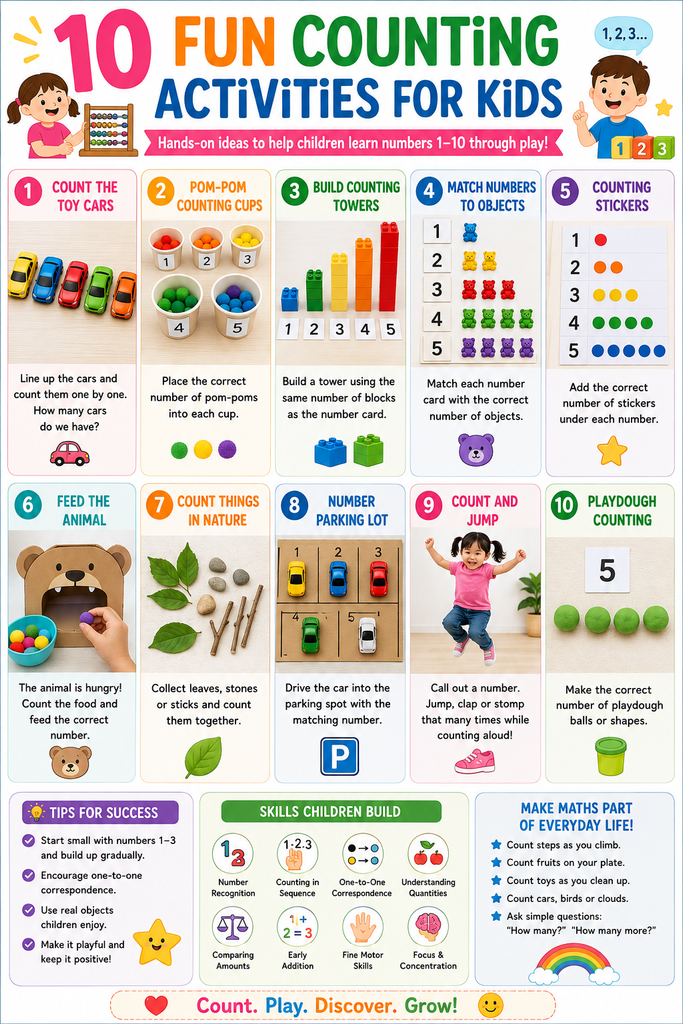
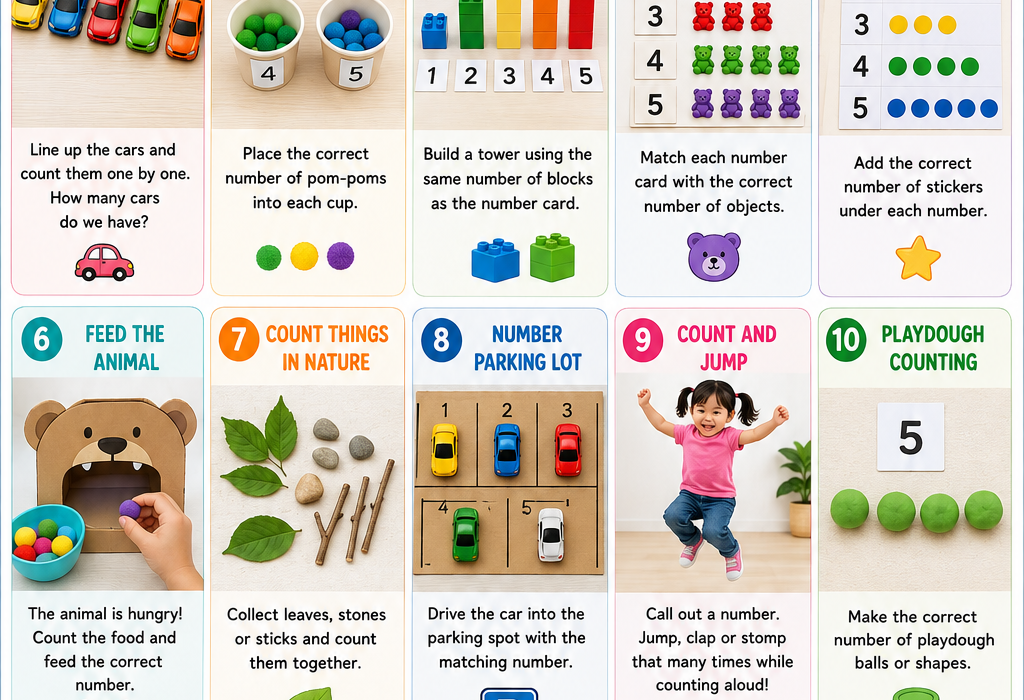
1. Count the Toy Cars
Place several toy cars on the floor.
Ask the child to move each car into a row while counting aloud.
Start with a small amount such as:
1, 2, 3
Then gradually increase the number.
You can ask:
How many cars do we have?
Can you give me four cars?
Which group has more cars?
For children who recognise numerals, place a number card beside the matching number of cars.
2. Pom-Pom Counting Cups
Label small cups with numbers from 1 to 5 or 1 to 10.
Place colourful pom-poms in a bowl.
Children pick up the correct number of pom-poms and place them into each cup.
For example:
Cup 2 → 2 pom-poms
Cup 5 → 5 pom-poms
Children can use their fingers, tweezers or tongs for extra fine motor practice.
3. Build Counting Towers
Use building blocks to make number towers.
Show the child a number and ask them to build a tower with that many blocks.
For example:
3 = three blocks
6 = six blocks
Once several towers are built, compare them.
Ask:
Which tower is tallest?
Which has fewer blocks?
How many more blocks does this tower have?
4. Match Numbers to Objects
Create number cards from 1–10.
Place the cards on the table.
Give children small objects such as buttons, blocks or toy animals.
Ask them to place the correct quantity beside each number.
For example:
4 → 🟠 🟠 🟠 🟠
This helps connect the written numeral 4 with a group containing four objects.
5. Counting Stickers
Write numbers on a large piece of paper.
Give children colourful stickers and ask them to place the correct number underneath.
For example:
1 → one sticker
2 → two stickers
3 → three stickers
Peeling and placing stickers also provides useful finger and hand practice.
Older children can create their own number cards before adding the stickers.
6. Feed the Animal
Draw an animal face on a cardboard box or container and create an opening for its mouth.
Pretend the animal is hungry.
Use pom-poms, blocks or pretend food.
Say:
“The bear wants three apples!”
The child counts three objects and feeds them into the container.
Try different numbers:
Feed the frog 5 flies.
Feed the dinosaur 7 snacks.
Feed the rabbit 4 carrots.
Turning counting into pretend play can make repetition much more enjoyable.
7. Count Things in Nature
Take counting outdoors.
Collect safe natural materials such as:
- Leaves
- Small stones
- Flowers that have already fallen
- Sticks
- Seed pods
Ask children to find a particular quantity.
For example:
Find 3 leaves.
Collect 5 stones.
Can you find 2 sticks?
Place the objects into groups and count them together.
You can also compare them by size, colour or shape.
8. Number Parking Lot
Draw several parking spaces on cardboard or paper.
Write a number inside each parking space.
Give the child toy cars.
Call out a number:
“Park your car in number 4!”
Children identify the numeral and drive the car into the correct space.
For another version, draw dots inside each parking space.
Children count the dots and match them to the correct numeral.
This is especially fun for children who love vehicles.
9. Count and Jump
Counting doesn’t always need to happen at a table.
Turn it into a movement game.
Call out a number and movement:
Jump 5 times.
Clap 4 times.
Stomp 3 times.
Spin 2 times.
Touch your toes 6 times.
Encourage children to count each movement aloud.
This combines early maths with physical activity and listening skills.
10. Playdough Counting
Make several small playdough balls.
Give the child a number card and ask them to create the matching number of balls.
For example:
5 → five playdough balls
Children can also make:
- Five playdough apples
- Three flowers
- Seven cookies
- Four caterpillar segments
- Six birthday candles
Rolling and shaping playdough gives children additional fine motor practice while they count.
Practise One-to-One Correspondence
One-to-one correspondence means understanding that each object receives one number when counting.
For example, when counting five blocks, the child should touch or move each block only once:
1 → block
2 → block
3 → block
4 → block
5 → block
If children say numbers faster than they touch the objects, encourage them to slow down.
Moving each object into a new pile while counting can make this easier.
Ask Simple Maths Questions
Once children are comfortable counting, introduce simple questions.
Try:
How many are there?
Can you give me three?
Which group has more?
Which group has fewer?
What happens if we add one more?
For example:
Start with 4 blocks.
Add another block.
Ask:
“We had four. Now we added one more. How many do we have?”
This naturally introduces early addition.
Follow the Child’s Ability
A child who is learning to count to three does not need activities involving twenty objects.
Start with a range they can manage successfully.
You might progress from:
1–3
to
1–5
then
1–10
and eventually higher numbers.
Some children may be able to say numbers in order before they understand what those numbers mean.
Hands-on activities help build that understanding.
Make Counting Part of Everyday Life
You don’t always need a prepared maths activity.
Count throughout the day:
How many strawberries are on your plate?
How many shoes do we need?
How many steps are there?
How many cars can you see?
Can you bring me three crayons?
These short everyday moments give children repeated opportunities to use maths in meaningful situations.
Skills Children Can Practise
Counting activities can support:
- Number recognition
- Counting in sequence
- One-to-one correspondence
- Understanding quantities
- Comparing amounts
- Early addition
- Sorting
- Fine motor skills
- Concentration
- Problem-solving
- Mathematical vocabulary
Keep Learning With PlayPrintGrow
Early maths doesn’t need to begin with worksheets.
Cars, blocks, pom-poms, playdough and things found outdoors can all become simple learning tools.
Keep the activities short, playful and appropriate for the child’s current ability.
Count. Play. Discover. Grow.