
Recognising written numbers is an important early maths skill.
A child might be able to count aloud:
1, 2, 3, 4, 5…
but still need practice recognising what each written number looks like.
These simple number recognition activities for kids use movement, toys and everyday materials to help children become familiar with numbers in a playful way.
What You’ll Need
Depending on the activity, you can use:
- Number cards
- Paper
- Markers
- Toy cars
- Blocks
- Pom-poms
- Playdough
- Stickers
- Chalk
- Small toys
- Cups or containers
Start with a small number range such as 1–3 or 1–5, then gradually introduce more numbers.
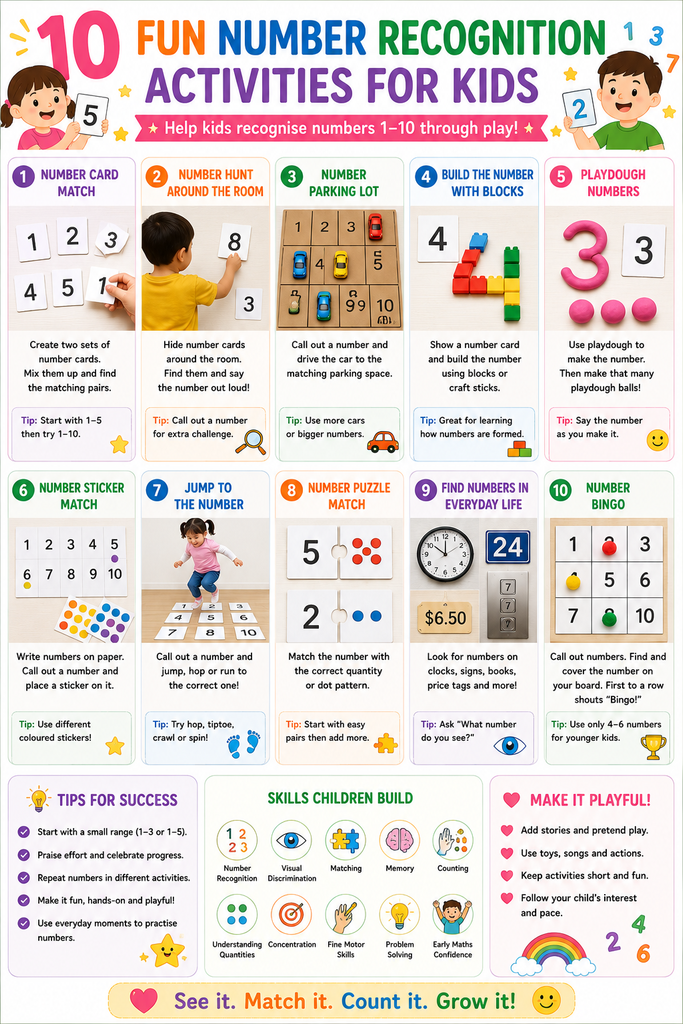
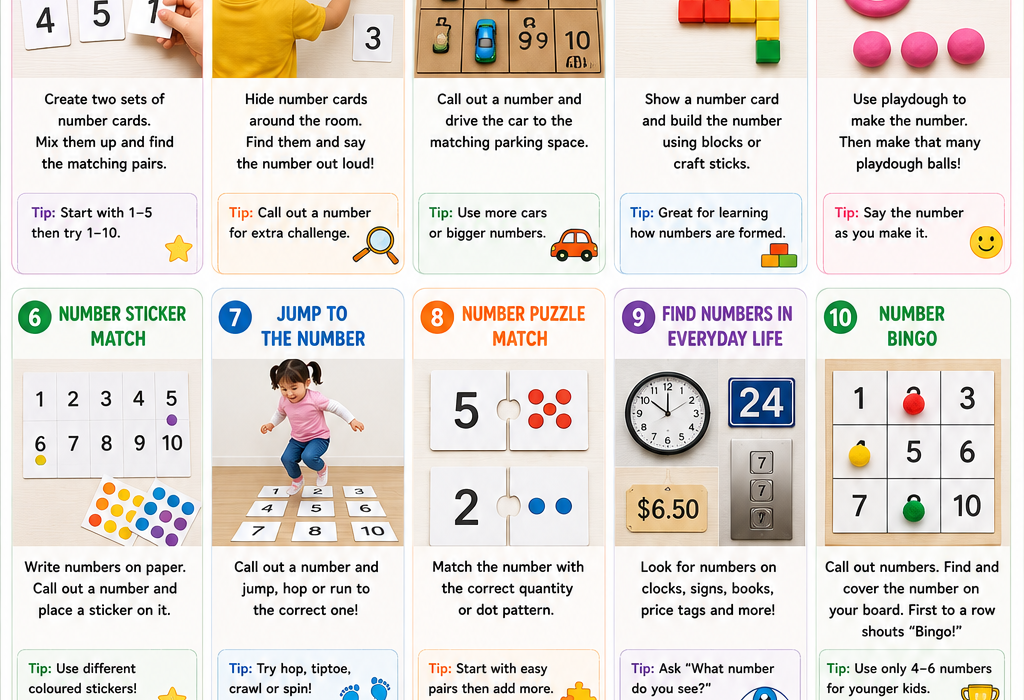
1. Number Card Match
Create two sets of number cards.
For example:
1 2 3 4 5
Mix them up and ask the child to find the matching pairs.
You can say:
“Can you find another number 3?”
Once children become confident, increase the range to 1–10.
2. Number Hunt Around the Room
Hide number cards around the room.
Ask children to search for them.
When they find one, encourage them to say the number aloud.
You can call out a specific number:
“Can you find number 6?”
This combines number recognition with movement and observation.
3. Number Parking Lot
Draw parking spaces and write a number inside each one.
Give children toy cars.
Call out:
“Drive your car to number 4.”
Children identify the correct parking space and drive the car there.
For children who love vehicles, this can make number practice much more engaging.
4. Build the Number With Blocks
Show the child a number card.
Ask them to create the shape of the numeral using blocks or craft sticks.
For example, they might build:
1
4
7
Straight-line numbers are often easiest to begin with.
This helps children look carefully at how each numeral is formed.
5. Playdough Numbers
Roll playdough into long thin snakes.
Use the pieces to form numbers.
Start by placing a number card nearby for children to copy.
Try:
1, 2, 3, 4, 5
Children can also make the matching number of playdough balls beside each numeral.
For example:
4 → four balls
This connects number recognition with quantity.
6. Number Sticker Match
Write several large numbers on paper.
Give children stickers.
Call out a number and ask them to place a sticker on it.
For example:
“Put a sticker on number 5.”
You can repeat this with different coloured stickers.
This also gives children extra fine motor practice.
7. Jump to the Number
Write large numbers on pieces of paper and place them on the floor.
Call out:
“Jump to number 3!”
or:
“Stand on number 7!”
Children need to recognise the numeral before moving to it.
You can also try:
- Hop to the number
- Run to the number
- Tiptoe to the number
- Crawl to the number
8. Number Puzzle Match
Cut number cards into simple two-piece puzzles.
One half shows the numeral.
The other half shows the matching quantity using dots or pictures.
For example:
5 matches with:
● ● ● ● ●
Children match the correct pieces together.
This helps them connect the written numeral with how many it represents.
9. Find Numbers in Everyday Life
Numbers are everywhere.
Look for them on:
- Clocks
- Calendars
- House numbers
- Elevators
- Price tags
- Books
- Signs
- Remote controls
Ask:
“Can you find a number 2?”
“What number is on this door?”
This helps children understand that numbers are useful beyond learning activities.
10. Number Bingo
Create a simple bingo board using numbers from 1–10.
Call out one number at a time.
Children find the matching numeral and cover it with a counter, pom-pom or small block.
The first child to complete a row can call:
“Bingo!”
For younger children, use only four or six numbers on each board.
Numbers That Look Similar
Some numerals can be confusing for young children.
For example:
6 and 9
or:
2 and 5
Instead of simply telling children they are wrong, encourage them to look carefully at the differences.
Ask:
“Where does the line start?”
“Which way does it curve?”
Repeated exposure helps children become more confident.
Match Numbers With Quantities
Recognising the numeral is only one part of number learning.
Children should gradually understand that:
3 means three objects
5 means five objects
For example, show number 4 and ask the child to collect four blocks.
This connects the symbol with its meaning.
Practise Numbers Out of Order
Children often learn numbers by repeating them in sequence.
Once they can recognise several numbers, mix them up.
Instead of showing:
1, 2, 3, 4, 5
try:
4, 1, 5, 2, 3
This helps you see whether the child recognises each numeral independently rather than relying on the order.
Skills Children Can Practise
Number recognition activities can support:
- Recognising numerals
- Matching
- Counting
- Understanding quantities
- Visual discrimination
- Memory
- Concentration
- Fine motor skills
- Hand-eye coordination
- Early mathematical thinking
Keep It Playful
Children don’t need to memorise every numeral at once.
Choose a few numbers and repeat them across different activities.
For example, if you’re focusing on 1–5, you might use the same numbers for:
Number hunt → parking game → playdough → bingo
Repeated exposure through different forms of play can make learning more meaningful.
Keep Learning With PlayPrintGrow
Number recognition develops gradually through seeing, touching, matching and using numbers in everyday situations.
Keep number activities simple, playful and connected to things children already enjoy.
See. Match. Count. Grow.