
Learning to write numbers takes time.
Before children can confidently write numerals on their own, they need opportunities to recognise the number, understand what it represents and practise the movements required to form it.
These number tracing activities from 1–20 combine early maths with pencil control and fine motor development.
What You’ll Need
You can use:
- Pencils
- Thick crayons
- Washable markers
- Chalk
- Whiteboards
- Paper
- Number cards
- Playdough
- Sand trays
- Stickers
For younger children, thicker crayons or markers can sometimes be easier to control.
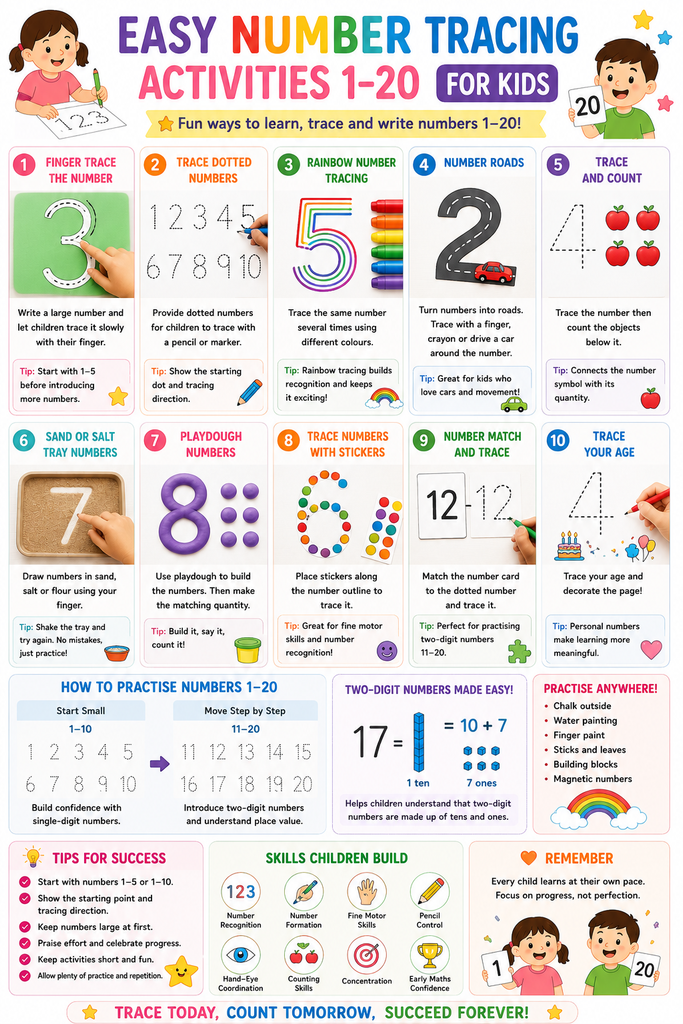
1. Finger Trace the Number
Before introducing a pencil, let children trace large numbers with their finger.
Write a large number such as:
1
Ask the child to slowly move their finger over the numeral.
Try numbers 1–5 first before introducing more.
2. Trace Dotted Numbers
Write large dotted numerals.
For example:
1 2 3 4 5
Children trace directly over the dotted lines.
Encourage them to start at the top and follow the correct direction.
Keep the numbers large when children are beginning.
3. Rainbow Number Tracing
Write one large number on paper.
Children trace over the same numeral several times using different colours.
For example:
Trace 5 in:
- Red
- Blue
- Green
- Purple
This adds repetition without making the activity feel repetitive.
4. Number Roads
Turn large numbers into roads.
Draw the number using two parallel lines.
Children can:
- Drive a toy car around the number
- Trace it with their finger
- Follow it using a crayon
For example, number 2 becomes a winding road.
This works especially well for children who enjoy vehicles.
5. Trace and Count
Write a dotted number and place pictures or dots underneath it.
For example:
4
● ● ● ●
Children first trace the number and then count the objects.
This helps connect the written numeral with its quantity.
6. Sand or Salt Tray Numbers
Pour a thin layer of sand, salt or flour into a tray.
Show the child a number card.
Ask them to draw the number using their finger.
If they make a mistake, simply shake the tray and try again.
This is a low-pressure way to practise number formation.
7. Playdough Numbers
Roll playdough into thin snakes.
Use the pieces to build numbers.
Try:
1
2
3
and gradually move towards 20.
Children can trace around the playdough numeral with their finger before attempting it with a pencil.
8. Trace Numbers With Stickers
Draw a large number outline.
Ask children to place small stickers along the line.
For example, cover the shape of 8 with colourful dots.
This supports number recognition while also giving children fine motor practice.
9. Number Match and Trace
Create number cards from 1–20.
Place one card beside a dotted version of the same numeral.
Children first match the numbers, then trace them.
For example:
12 → dotted 12
This is especially useful once children begin working with two-digit numbers.
10. Trace Your Age
Children are often very interested in numbers that relate to themselves.
Ask:
“How old are you?”
If the child is four, write a large dotted 4.
Let them trace it and decorate the page.
You can also practise:
- House number
- Birthday date
- Favourite number
- Number of family members
Learning Numbers 1–10 First
There is no need to rush straight to 20.
Start with:
1–3
then:
1–5
then:
1–10
Once children recognise and form these numbers confidently, introduce:
11–20
Numbers such as 12, 13 and 14 require children to understand that two numerals work together.
Practising Numbers 11–20
When working with larger numbers, show children both the numeral and the quantity.
For example:
12
● ● ● ● ● ●
● ● ● ● ● ●
You can also build the number using:
1 group of ten + 2 more
This begins to introduce place-value thinking naturally.
Don’t Focus Only on Perfect Writing
Children’s early numbers may be:
- Too large
- Uneven
- Reversed
- Shaky
- Written outside the lines
That’s normal while they are developing pencil control and understanding number formation.
Focus on recognising the number and practising the movement rather than expecting perfect handwriting.
Practise Without Worksheets Too
Children can form numbers using:
- Chalk outside
- Paintbrushes and water
- Finger paint
- Playdough
- Sticks
- Building blocks
- Magnetic pieces
Large movements often help children understand a numeral before they attempt smaller pencil movements.
Skills Children Can Practise
Number tracing activities can support:
- Number recognition
- Number formation
- Pencil control
- Fine motor skills
- Hand-eye coordination
- Counting
- Visual tracking
- Writing readiness
- Concentration
- Early maths confidence
Keep Practice Short
A few minutes of tracing is often enough for young children.
You might practise only two or three numbers during one activity.
Once children become tired or lose interest, move onto another form of play and return to tracing later.
Keep Learning With PlayPrintGrow
Writing numbers develops gradually through seeing, touching, tracing and eventually forming numerals independently.
Start big, keep practice playful and give children lots of opportunities to experiment.
Trace. Count. Write. Grow.