
Addition becomes much easier to understand when children can see and move the objects they are adding together.
Instead of beginning with worksheets full of number sentences, young children can first explore addition using blocks, toys, fingers, counters and everyday objects.
These simple activities are ideal for children around 4–7 years old who are beginning to understand that addition means putting groups together to find the total.
What Is Addition?
Addition means combining two or more groups.
For example:
2 apples + 1 apple = 3 apples
Children can physically move two objects and one more object together, then count the total.
You can use language such as:
“We have two. Let’s add one more. How many do we have altogether?”
The word altogether can help children understand that they are finding the total.
What You’ll Need
Most of these activities can be done with things already available at home or in the classroom:
- Building blocks
- Pom-poms
- Toy cars
- Buttons
- Dice
- Small toys
- Playdough
- Number cards
- Cups
- Counters
- Paper and markers
Start with very small numbers before moving to larger totals.
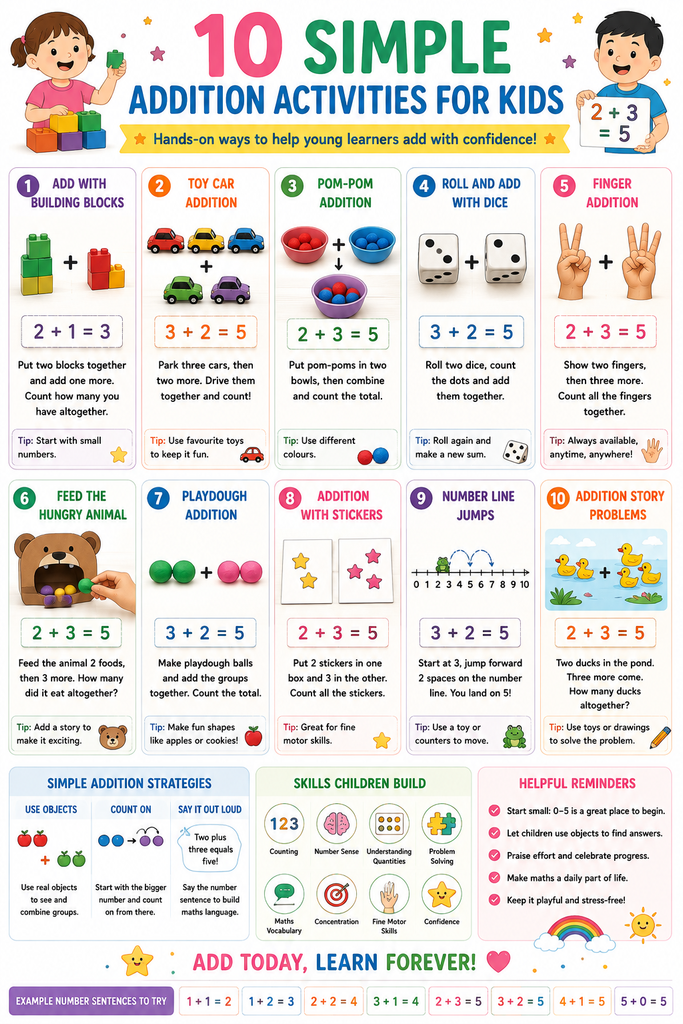
1. Add With Building Blocks
Place two blocks on the table.
Add another block beside them.
Ask:
“How many blocks do we have altogether?”
Count:
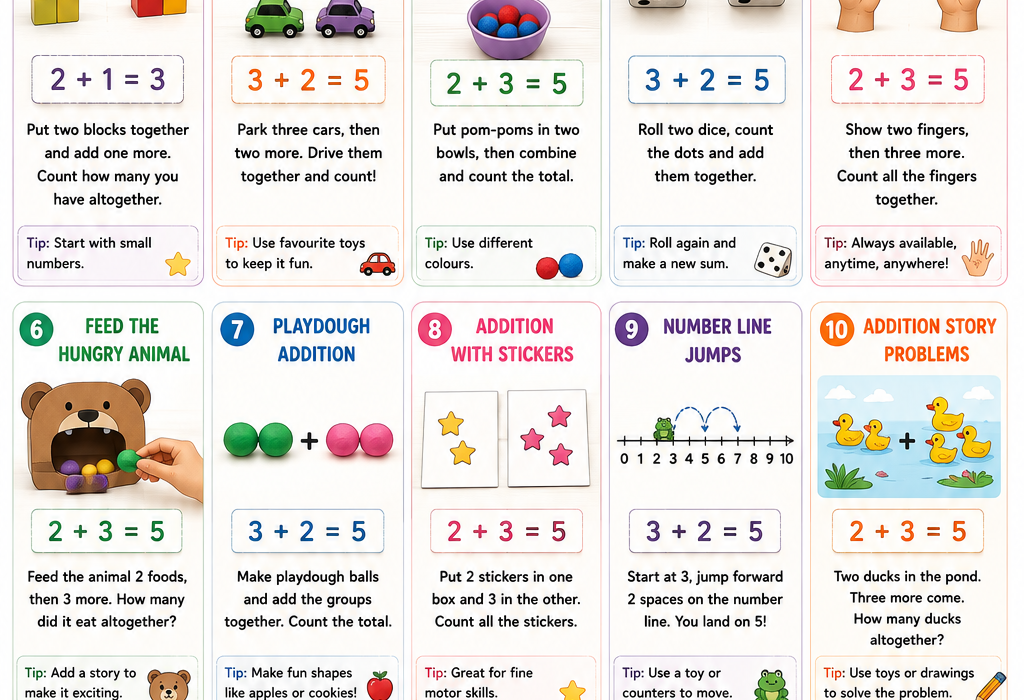
2 + 1 = 3
Try other simple combinations such as:
1 + 2
2 + 2
3 + 1
Once children understand the idea, let them create their own addition problems.
2. Toy Car Addition
If your child enjoys vehicles, use toy cars as maths counters.
Place three cars on one side of the table and two cars on the other.
Ask the child to drive all the cars together.
Then count them.
3 + 2 = 5
You could also create two small parking areas and combine the cars into one big parking lot.
3. Pom-Pom Addition Bowls
Place two bowls in front of the child.
Put a small number of pom-poms in each bowl.
For example:
2 red pom-poms
and
3 blue pom-poms
Pour them together into a third bowl and count.
2 + 3 = 5
Using different colours makes the two original groups easy to see.
4. Roll and Add With Dice
Use two dice.
Roll both.
Count the dots on the first die.
Then count the dots on the second.
Add them together.
For example:
🎲 3
🎲 2
=
5
Children can use counters or fingers if they need help finding the total.
For beginners, use dice with only small numbers.
5. Finger Addition
Hands are always available for simple maths practice.
Ask:
“Show me two fingers.”
Then:
“Show me three more.”
Count all the fingers together.
2 + 3 = 5
This is an easy activity to use anywhere, including in the car, at the table or while waiting somewhere.
6. Feed the Hungry Animal
Use the same type of cardboard animal box you might use for counting activities.
Tell children:
“The hungry bear ate two berries and then three more.”
Let them feed the container:
2 pom-poms + 3 pom-poms
Then ask:
“How many berries did the bear eat altogether?”
Adding a story can make the maths feel more meaningful.
7. Playdough Addition
Create small playdough balls.
Place:
3 balls on one side
and
2 balls on the other
Push both groups together.
Count the total.
Children can also make playdough:
- Apples
- Cookies
- Flowers
- Bugs
- Cupcakes
For example:
4 playdough cookies + 1 cookie = 5 cookies
8. Addition With Stickers
Draw two boxes on a piece of paper.
Write:
2 + 3 = ?
Ask children to place two stickers in the first box and three in the second.
Then count all the stickers.
Write:
2 + 3 = 5
This combines early addition with fine motor practice.
9. Number Line Jumps
Draw a simple number line:
0 – 1 – 2 – 3 – 4 – 5 – 6 – 7 – 8 – 9 – 10
Place a small toy on a starting number.
For:
3 + 2
start at 3.
Move forward two spaces:
4, 5
The answer is 5.
You can pretend the toy is jumping along the number line.
This helps children begin to understand that addition moves numbers forward.
10. Addition Story Problems
Use very short stories based on familiar things.
For example:
“There are two ducks in the pond. Three more ducks arrive. How many ducks are there now?”
Let children use toy animals, drawings or counters to act out the story.
Another example:
“You have three strawberries. I give you two more. How many strawberries do you have altogether?”
Story problems help children see how addition can be used in real-life situations.
Start With Numbers Children Can See
When children are first learning addition, keep totals small.
You might begin with:
1 + 1
1 + 2
2 + 2
3 + 1
Then gradually move towards totals of 5 and 10.
Children should have plenty of time to physically count objects before being expected to solve number sentences mentally.
Introduce the Plus and Equals Signs
Once children understand the action of combining groups, introduce the symbols.
Explain:
+ means add or put together
= means the same as
For example:
2 + 3 = 5
Read it aloud as:
“Two plus three equals five.”
You can also say:
“Two and three more make five.”
Encourage Children to Count On
Beginners may count every object from the beginning.
For example:
3 + 2
They may count:
1, 2, 3, 4, 5
As confidence grows, show them how to start with the larger number:
3… then 4, 5
This is called counting on.
It can make addition faster and help children develop stronger number sense.
Ask Everyday Addition Questions
Addition can be practised throughout the day.
Try:
“You have two crackers. If I give you one more, how many will you have?”
“There are three cars here and two over there. How many cars altogether?”
“We picked four leaves. If we find another leaf, how many will we have?”
Short everyday questions can make maths feel useful and natural.
Skills Children Can Practise
Simple addition activities can support:
- Counting
- Number recognition
- Understanding quantities
- Combining groups
- Number sense
- Counting on
- Problem-solving
- Mathematical vocabulary
- Concentration
- Early mental maths
Use Objects Before Worksheets
Writing:
4 + 2 = ?
can be quite abstract for a child who is new to addition.
Showing:
🍎 🍎 🍎 🍎 + 🍎 🍎
gives the child something concrete to count.
Over time, children can move from:
Real objects → pictures → number sentences
This gradual progression can make early maths easier to understand.
Keep Learning With PlayPrintGrow
Addition doesn’t need to begin with memorising sums.
Start by putting small groups together, counting the total and talking about what happened.
When children understand the meaning behind the numbers, written addition becomes much easier.
Add. Count. Discover. Grow.