
A simple walk outside can become a fun learning experience without needing worksheets, toys or special equipment.
Children can practise observation, counting, language, movement and early science just by noticing what is around them.
These nature walk activities for kids are suitable for children around 2–8 years old and can be adapted for a backyard, park, garden, beach or neighbourhood walk.
What You’ll Need
You don’t need much. You may like to bring a small bag or basket, water bottle, hat, pencil and paper, magnifying glass, camera and comfortable shoes.
If children collect natural materials, encourage them to choose items that have already fallen rather than picking living plants.
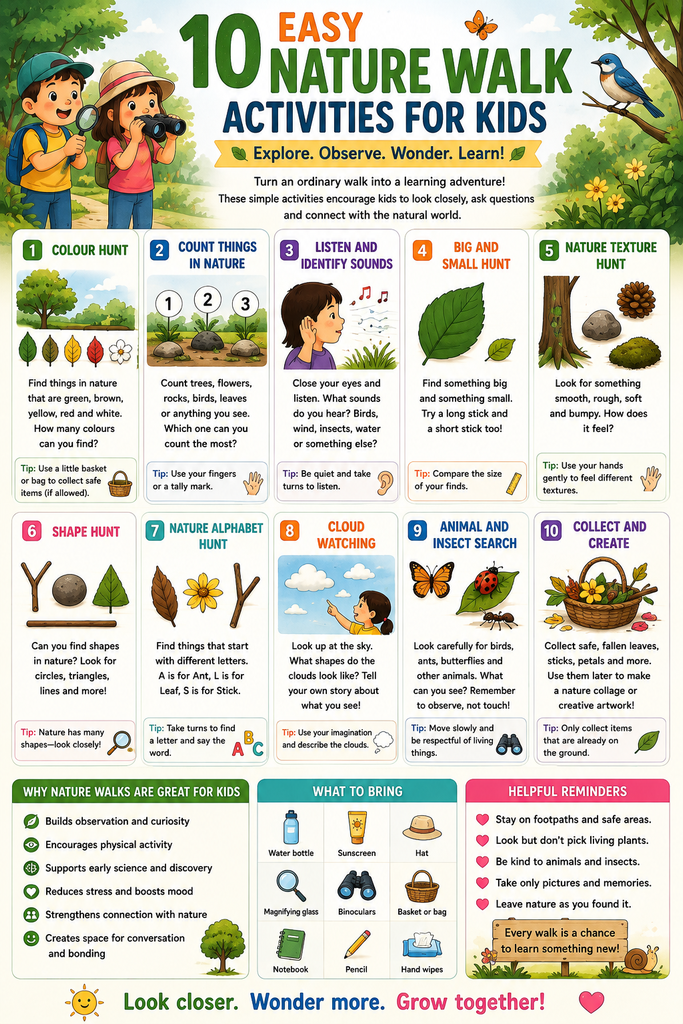
1. Go on a Colour Hunt
Choose several colours before starting the walk.
Ask children to find something:
- Green
- Brown
- Yellow
- Red
- White
They might notice leaves, flowers, rocks, signs or insects.
Try asking:
“Can you find two different shades of green?”
Older children can try finding something for every colour of the rainbow.
2. Count Things in Nature
Choose something to count during the walk.
Try counting trees, flowers, rocks, birds, leaves, benches or ants.
For younger children, keep the numbers small.
Ask:
“Can you find five rocks?”
or
“How many birds can you see?”
Using real objects helps children connect counting with actual quantities.
3. Stop and Listen
Find a safe place to stand quietly for a moment.
Ask children to listen carefully.
Can they hear:
- Birds?
- Wind?
- Leaves moving?
- Insects?
- Cars?
- People?
- Water?
Try asking:
“Which sound is the loudest?”
“Which sound is the quietest?”
“Can you hear something you can’t see?”
This encourages careful listening and concentration.
4. Find Something Big and Something Small
Ask children to compare objects around them.
Try finding:
- A big leaf and a small leaf
- A long stick and a short stick
- A large rock and a tiny rock
Introduce words such as:
Bigger, smaller, longer, shorter, taller and wider.
This is an easy way to introduce early maths vocabulary outdoors.
5. Explore Different Textures
Encourage children to look closely at safe natural objects.
Can they find something:
- Smooth
- Rough
- Soft
- Bumpy
- Hard
They might compare tree bark, leaves, stones or grass.
Ask:
“How does this feel?”
“Which one feels rougher?”
Avoid touching unknown plants, insects or anything unsafe.
6. Go on a Shape Hunt
Shapes can be found almost everywhere outdoors.
Look for:
- Circles
- Triangles
- Squares
- Rectangles
- Lines
A round stone might look like a circle, while a window might look like a rectangle.
Children can also search for shapes in leaves, signs, playground equipment and buildings.
7. Try a Nature Alphabet Hunt
Choose a letter and search for something beginning with it.
For example:
L – Leaf
B – Bird
T – Tree
F – Flower
Older children can try finding items for several letters during one walk.
You don’t need to complete the entire alphabet.
8. Watch the Clouds
Find a safe place to look up at the sky.
Ask:
“What does that cloud look like?”
A cloud might look like a dinosaur, rabbit, car, castle or dragon.
You can also talk about the weather.
Ask:
“Are the clouds moving quickly or slowly?”
“Do you think it might rain?”
Cloud watching encourages imagination and descriptive language.
9. Look for Animals and Insects
Encourage children to carefully observe wildlife without disturbing it.
You might find birds, butterflies, ants, bees, lizards, spiders or beetles.
Ask:
“How is it moving?”
“Where do you think it lives?”
“What do you think it eats?”
Remind children to look rather than touch.
10. Collect and Create
Collect a small number of safe fallen natural materials such as leaves, small sticks, petals or seed pods.
Take them home or back to the classroom and create:
- Nature collages
- Leaf animals
- Patterns
- Nature faces
- Small sculptures
This helps extend the learning beyond the walk.
Ask Open-Ended Questions
Nature walks are a great opportunity to encourage children to explain what they notice.
Try asking:
“What do you see?”
“What is different about these two leaves?”
“What do you think lives here?”
“What do you think we might find next?”
There doesn’t always need to be one correct answer. The goal is to encourage children to observe, wonder and talk about what they discover.
Let Children Lead Sometimes
Adults often decide where the walk should go and what children should notice.
Sometimes let the child choose:
“Which path should we take?”
“What would you like to investigate?”
“What would you like to find?”
A child might spend several minutes watching ants or examining one interesting leaf. That focused exploration can be valuable learning too.
Skills Children Can Practise
Nature walks can support:
- Observation
- Vocabulary
- Counting
- Comparing
- Shape recognition
- Colour recognition
- Listening
- Early science
- Problem-solving
- Gross motor development
- Curiosity
- Environmental awareness
Make Nature Walks Part of Your Routine
You don’t need to visit a national park to explore nature.
Try your backyard, a local park, childcare garden, beach, walking path or neighbourhood.
Even the same location can look different depending on the weather, season and time of day.
Ask children:
“What has changed since the last time we came here?”
Keep Learning With PlayPrintGrow
Outdoor learning can be simple.
Walk slowly, look closely, listen carefully and give children time to explore what catches their attention.
The environment around us is full of opportunities to count, compare, wonder and learn.
Explore. Notice. Discover. Grow.