
Sorting and pattern activities are simple ways to introduce important early maths concepts through hands-on play.
Children naturally notice differences between objects. They may group toys by colour, put similar animals together or arrange blocks in repeating sequences.
These everyday actions help develop early mathematical thinking.
What Is Sorting?
Sorting means placing objects into groups based on something they have in common.
Children might sort by:
- Colour
- Shape
- Size
- Type
- Texture
- Number
- Use
For example, a pile of blocks could be separated into red, blue and green groups.
What Is a Pattern?
A pattern is something that repeats in a predictable way.
A simple pattern might be:
Red – Blue – Red – Blue
This is called an AB pattern.
Children can later explore more complex patterns such as:
Red – Red – Blue – Red – Red – Blue
or:
Circle – Square – Triangle – Circle – Square – Triangle
What You’ll Need
Try using:
- Building blocks
- Pom-poms
- Buttons
- Toy animals
- Toy cars
- Coloured paper
- Beads
- Leaves
- Stones
- Stickers
- LEGO-style blocks
- Household objects
You don’t need to buy special maths materials. Everyday objects work perfectly.
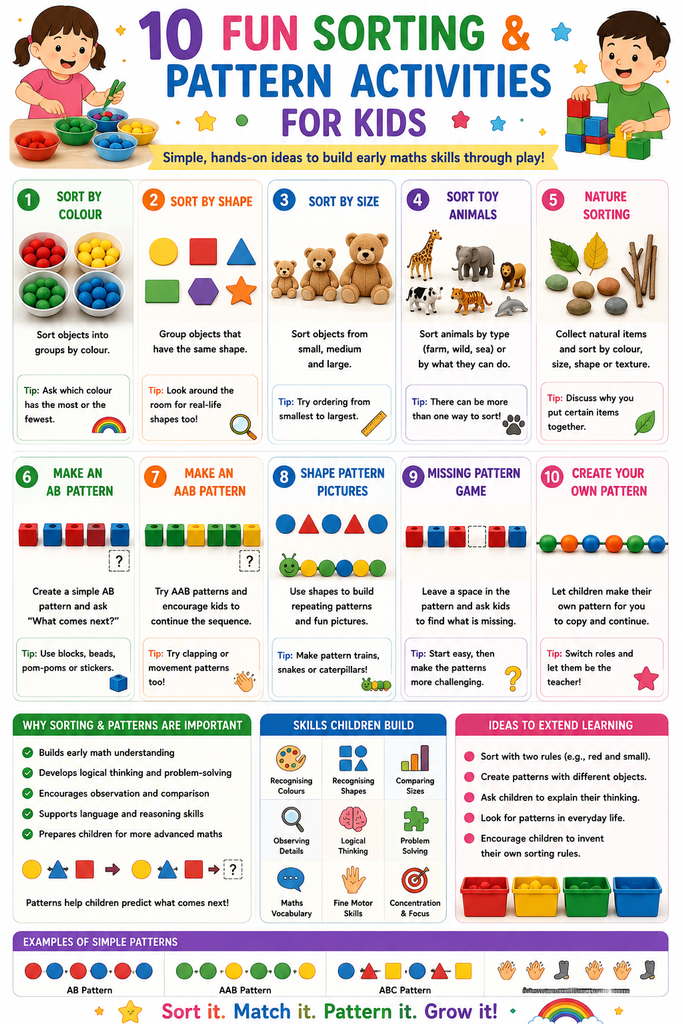
1. Sort by Colour
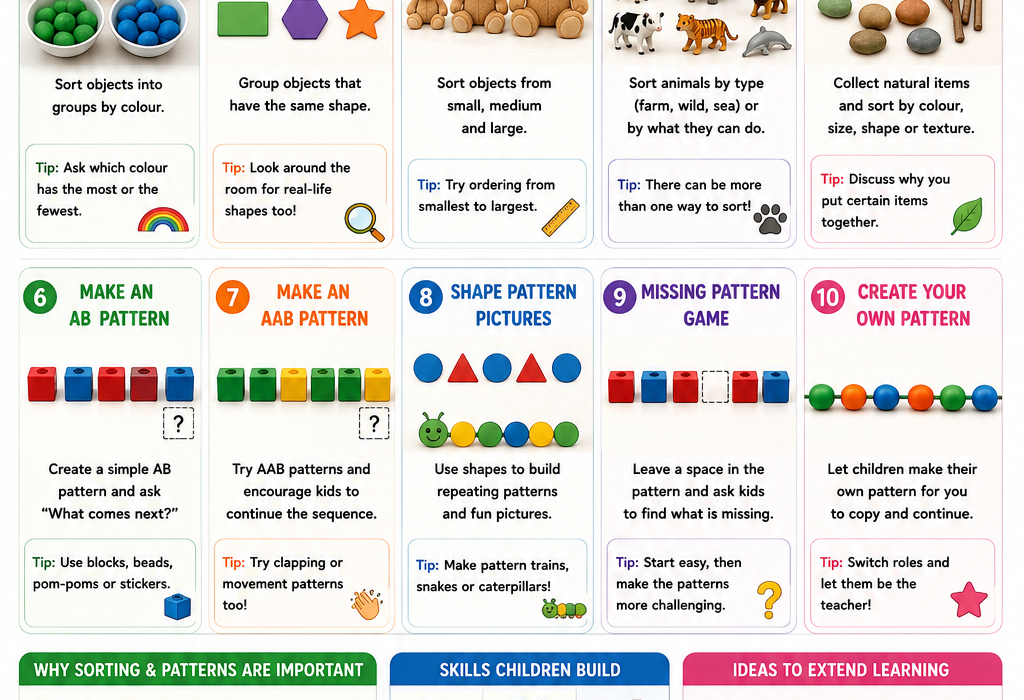
Place several colourful objects on a table.
Use blocks, pom-poms, buttons or toy cars.
Ask children to place all the matching colours together.
For example:
Red → red group
Blue → blue group
Yellow → yellow group
Ask:
Which colour has the most?
Which group has the fewest?
2. Sort by Shape
Provide objects or paper shapes such as:
Circles
Squares
Triangles
Rectangles
Ask children to group matching shapes together.
You can also look around the room for real objects.
For example:
Clock → circle
Book → rectangle
3. Sort by Size
Collect objects that come in different sizes.
Ask children to make groups for:
Small
Medium
Large
Try using:
- Blocks
- Toy animals
- Leaves
- Buttons
- Containers
You can also ask children to arrange objects from smallest to largest.
4. Sort Toy Animals
Gather several toy animals.
Ask children to decide how they could sort them.
Possible groups include:
Farm animals
Wild animals
Sea animals
Animals with four legs
Animals that can fly
This activity encourages children to think about more than one possible sorting rule.
5. Nature Sorting
Collect safe natural objects during a walk.
Try:
- Leaves
- Stones
- Sticks
- Seed pods
Then sort them by:
Colour
Shape
Size
Texture
Ask:
Why did you put these together?
Encouraging children to explain their choices develops mathematical language and reasoning.
6. Make an AB Pattern
Start with two objects or colours.
For example:
🔴 🔵 🔴 🔵 🔴 🔵
Ask:
“What comes next?”
Use:
- Blocks
- Beads
- Pom-poms
- Stickers
- Toy cars
Keep the pattern simple at first.
7. Make an AAB Pattern
When AB patterns become easy, try:
Red – Red – Blue – Red – Red – Blue
Children can copy the pattern and then continue it.
You can also try:
Clap – Clap – Stomp
Clap – Clap – Stomp
Movement patterns are especially fun for active learners.
8. Shape Pattern Pictures
Use paper shapes to build repeating patterns.
For example:
Circle – Triangle – Circle – Triangle
or:
Square – Square – Circle
Glue the finished pattern onto paper.
Children can create:
- Pattern snakes
- Pattern trains
- Pattern borders
- Pattern caterpillars
9. Missing Pattern Game
Create a pattern but leave one space empty.
For example:
🔴 🔵 🔴 ___ 🔴 🔵
Ask:
“What should go here?”
Children need to look at the sequence and identify what is missing.
Start with very simple patterns before making them more challenging.
10. Create Your Own Pattern
Once children understand repeating patterns, let them invent one.
Give them a selection of:
- Blocks
- Stickers
- Beads
- Buttons
- Coloured paper
Ask:
“Can you make a pattern for me to copy?”
Then switch roles.
Let the child become the teacher and ask you to continue their pattern.
Ask Children to Explain Their Sorting
Instead of only checking whether something is “correct,” ask:
Why did you put these together?
A child might say:
“They are all red.”
or:
“These animals all live in water.”
This encourages children to think about the rule they used.
One Object Can Belong to Different Groups
An object can often be sorted in more than one way.
A large red triangle could belong to:
Red objects
Large objects
Triangles
Showing children different possibilities helps develop flexible thinking.
Try Movement Patterns
Patterns do not always need objects.
Try:
Clap – Stomp – Clap – Stomp
or:
Jump – Jump – Turn
Children listen, copy and continue the sequence.
You can also make sound patterns:
Loud – Soft – Loud – Soft
Use Patterns in Everyday Life
Look for patterns around you.
You might notice:
- Stripes on clothing
- Floor tiles
- Brick walls
- Fence designs
- Repeating colours
- Patterns on wrapping paper
Ask:
“Can you spot something that repeats?”
This helps children understand that patterns exist everywhere.
Skills Children Can Practise
Sorting and pattern activities can support:
- Colour recognition
- Shape recognition
- Comparing sizes
- Classification
- Pattern recognition
- Sequencing
- Prediction
- Problem-solving
- Logical thinking
- Mathematical vocabulary
- Concentration
- Early numeracy
Make It More Challenging
As children become confident, introduce more complicated rules.
Instead of sorting only by colour, try:
Red AND small
or:
Animals with four legs
For patterns, progress from:
AB
to:
AAB
then:
ABC
and eventually more complex sequences.
Keep Learning With PlayPrintGrow
Sorting helps children notice how things are alike and different, while patterns help them recognise what comes next.
Both skills form an important foundation for later mathematical thinking.
Start with everyday objects, keep the activity playful and encourage children to explain what they notice.
Sort. Match. Pattern. Grow.