
Water play is one of the easiest ways to combine sensory exploration with hands-on learning.
Children naturally enjoy filling, pouring, splashing, scooping and experimenting with water. While they play, they can also explore ideas such as full and empty, floating and sinking, measuring, volume, movement and cause and effect.
These activities are suitable for children around 2–7 years old and work well in a backyard, garden, outdoor learning area or childcare setting.
What You’ll Need
You can use simple materials such as:
- Large tub or water tray
- Cups
- Jugs
- Funnels
- Spoons
- Bowls
- Measuring cups
- Plastic bottles
- Sponges
- Toy boats
- Natural materials
- Containers of different sizes
Always supervise children closely around water, even when only a small amount is being used.
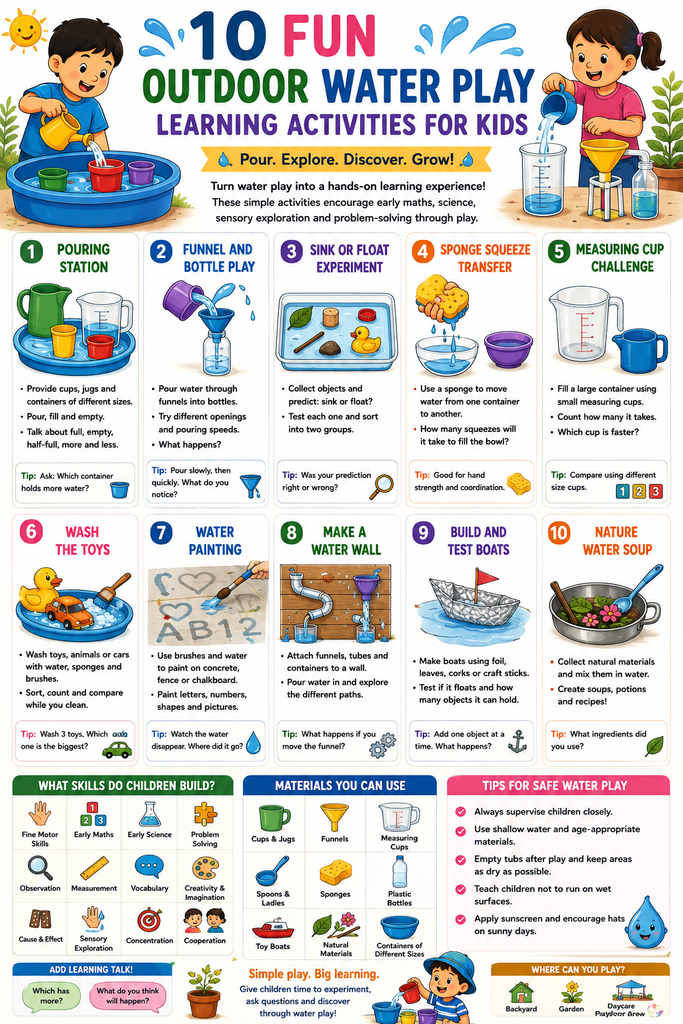
1. Pouring Station
Fill a large tub with shallow water.
Provide cups, jugs and containers of different sizes.
Let children pour water from one container to another.
Talk about:
Full
Empty
Half-full
More
Less
Ask:
“Which container holds more water?”
“Can you fill this cup halfway?”
Pouring helps children practise coordination while introducing early maths vocabulary.
2. Funnel and Bottle Play
Provide funnels and empty plastic bottles.
Children can place the funnel into a bottle and carefully pour water through it.
Try using bottles with different openings.
Ask:
“What happens when we pour slowly?”
“What happens if we pour too quickly?”
This encourages children to experiment with speed, control and cause and effect.
3. Sink or Float Experiment
Collect several safe objects.
Try:
- Leaf
- Small stone
- Plastic toy
- Stick
- Spoon
- Cork
- Bottle cap
Before placing each object in the water, ask:
“Do you think it will sink or float?”
Then test it.
Create two groups:
Floats
Sinks
This is a simple introduction to scientific prediction and testing.
4. Sponge Squeeze Transfer
Place water in one container and leave another container empty.
Give children a sponge.
They dip the sponge into the water, squeeze it out into the second container and repeat.
Ask:
“How many sponge squeezes will it take to fill the bowl?”
This is excellent for hand strength and coordination.
5. Measuring Cup Challenge
Provide measuring cups or containers of different sizes.
Ask children to fill a larger container using one small cup.
Count together:
1 cup
2 cups
3 cups
Then try a larger measuring cup.
Ask:
“Which cup fills the container faster?”
This introduces early ideas about capacity and measurement.
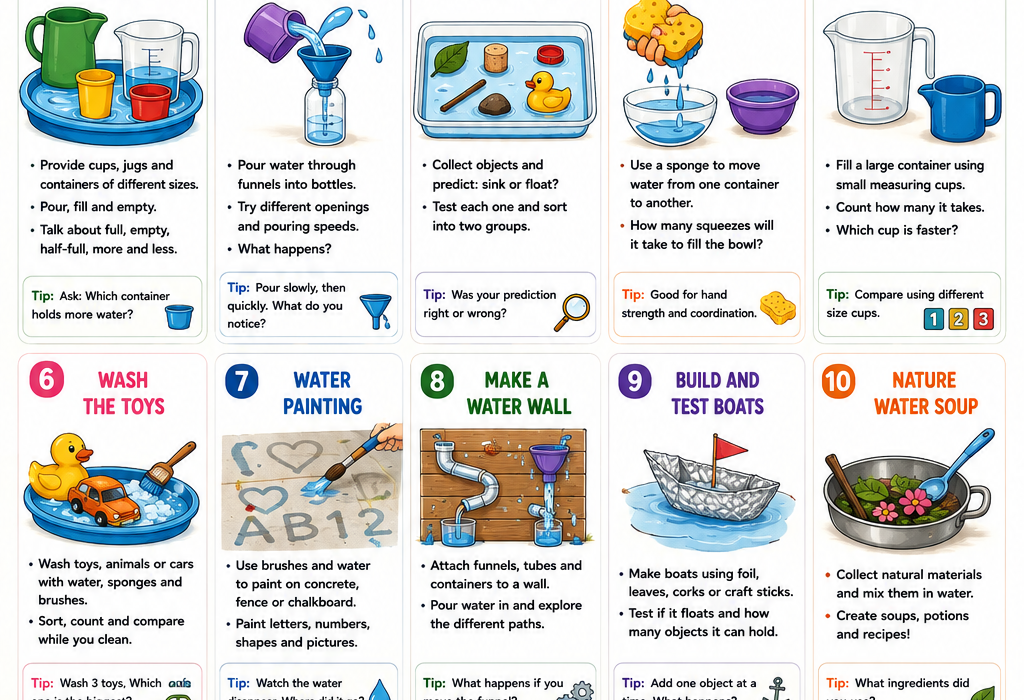
6. Wash the Toys
Place washable toy animals, cars or plastic toys in a tub.
Provide water, sponges and small brushes.
Children can wash each toy and rinse it clean.
Turn it into a sorting or counting activity:
“Can you wash three cars?”
“Put all the animals in this bowl.”
“Which toy is the biggest?”
This combines imaginative play with fine motor and early maths skills.
7. Water Painting
Give children paintbrushes and a bucket of water.
Let them “paint” outdoor surfaces such as:
- Concrete
- Fence
- Chalkboard
- Rocks
- Pavers
Children can paint:
Lines
Shapes
Letters
Numbers
Pictures
Then watch as the water slowly disappears.
Ask:
“Where did the water go?”
This can introduce simple conversations about drying and evaporation.
8. Make a Water Wall
Attach funnels, tubes, containers or cut plastic bottles to a vertical board or fence.
Children pour water into the top and watch how it travels down.
They can experiment with different pathways.
Ask:
“Where will the water go next?”
“What happens if we move this funnel?”
Water walls encourage problem-solving, experimentation and understanding of gravity.
9. Build and Test Boats
Use simple materials to create small boats.
Try:
- Foil
- Cork
- Leaves
- Recycled containers
- Craft sticks
Place the boat in water and test whether it floats.
Then add small objects one at a time.
Ask:
“How many objects can the boat carry before it sinks?”
Children can change the boat design and test it again.
This introduces simple engineering and problem-solving.
10. Nature Water Soup
Provide a water tub, bowls and spoons.
Let children collect safe fallen natural materials such as:
- Leaves
- Flowers
- Grass
- Small sticks
- Seed pods
Children can mix them into pretend soups, potions or recipes.
Encourage imaginative language:
“What are you making?”
“What ingredients did you use?”
“How many leaves should we add?”
This combines sensory play, creativity, counting and vocabulary.
Talk About Full, Empty, More and Less
Water play provides natural opportunities to introduce mathematical language.
Compare two containers and ask:
“Which one has more?”
“Which one is empty?”
“Can you make them hold the same amount?”
Children don’t need formal explanations of volume yet. Simply using these words during play helps build understanding.
Encourage Prediction
Before testing something, ask children what they think will happen.
For example:
“Will this rock sink?”
“Which bottle will fill first?”
“What happens if we block this tube?”
Then test the idea together.
Prediction followed by experimentation is an important part of early scientific thinking.
Add Counting
Water play can easily include numbers.
Try:
Pour 3 cups of water.
Add 5 leaves to the bowl.
Wash 4 toy cars.
Squeeze the sponge 6 times.
This turns ordinary water play into meaningful early maths practice.
What Skills Can Children Practise?
Outdoor water play can support:
- Fine motor skills
- Hand-eye coordination
- Pouring control
- Measuring
- Counting
- Comparing quantities
- Early science
- Prediction
- Problem-solving
- Sensory exploration
- Vocabulary
- Imaginative play
- Cooperation
Let Children Experiment
Try not to show children exactly what should happen every time.
Give them the materials and allow them to test their own ideas.
A child may discover that one cup fills another container in three pours or that a leaf floats while a stone sinks.
These discoveries become more meaningful when children find them through their own play.
Keep Water Play Safe
Use shallow water and supervise children continuously.
Empty containers when the activity is finished and avoid leaving buckets or tubs filled with water unattended.
Keep walking areas as dry as possible to reduce slipping hazards.
Keep Learning With PlayPrintGrow
Water play is simple, calming and full of opportunities for learning.
Give children time to pour, measure, squeeze, test and experiment while talking about what they notice.
A tub of water and a few everyday containers can become a complete hands-on learning experience.
Pour. Explore. Discover. Grow.