
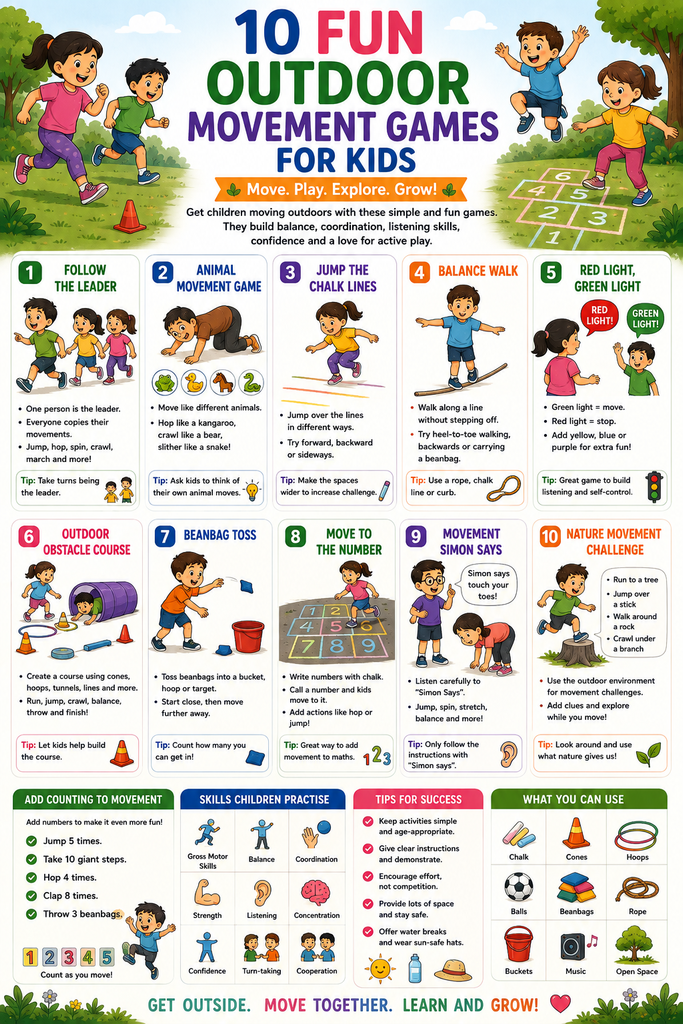
Outdoor movement games are a simple way to help children build strength, coordination and confidence while having fun.
Children naturally learn through movement. Running, jumping, balancing, crawling and throwing all provide opportunities to practise important gross motor skills.
These activities are suitable for children around 3–10 years old and can be adapted for backyards, parks, playgrounds or outdoor learning spaces.
What You’ll Need
Most activities need very little equipment.
You may use:
- Chalk
- Balls
- Hoops
- Cones
- Beanbags
- Rope
- Buckets
- Music
- Open outdoor space
Always check that the play area is safe and free from obvious hazards before starting.
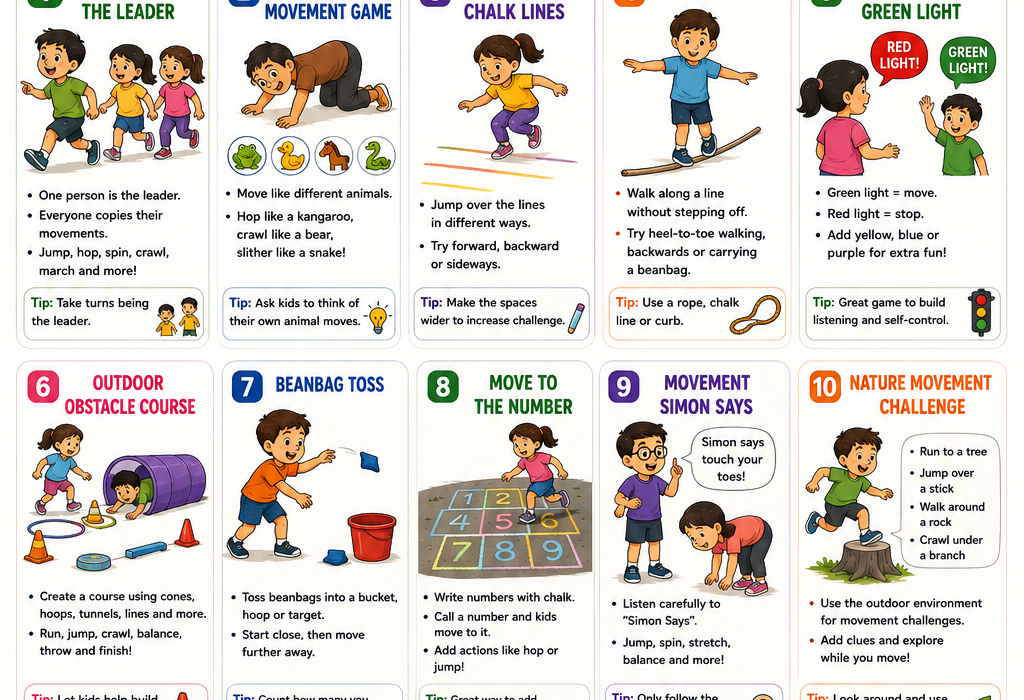
1. Follow the Leader
Choose one person to be the leader.
Everyone else copies their movements.
The leader might:
- Jump
- Hop
- Spin
- March
- Crawl
- Stretch
- Walk backwards
After a short time, choose a new leader.
This game supports coordination, observation and turn-taking.
2. Animal Movement Game
Call out an animal and ask children to move like it.
Try:
Hop like a kangaroo
Crawl like a bear
Waddle like a duck
Slither like a snake
Gallop like a horse
Jump like a frog
Ask children to invent their own animal movement too.
3. Jump the Chalk Lines
Draw several lines on the ground with chalk.
Ask children to jump:
- Over one line
- Over two lines
- Sideways
- Forward
- Backwards
You can gradually make the spaces wider.
Try asking:
“Can you jump over the blue line without touching it?”
4. Balance Walk
Draw a long chalk line or place a rope on the ground.
Ask children to walk along it without stepping off.
Make it more challenging by trying:
- Heel-to-toe walking
- Walking backwards
- Carrying a beanbag
- Walking with arms stretched out
- Following a curved line
This helps develop balance and body control.
5. Red Light, Green Light
Choose one person to call the instructions.
Green light means move forward.
Red light means stop.
You can add:
Yellow light – walk slowly
Blue light – hop
Purple light – spin
This is a fun way to practise listening and self-control.
6. Outdoor Obstacle Course
Use safe outdoor materials to create a simple course.
Children might:
- Run around a cone
- Jump over a rope
- Crawl under a chair or tunnel
- Balance along a line
- Throw a beanbag into a bucket
Keep the course simple for younger children and add more steps for older children.
Ask children to help design the course.
7. Beanbag Toss
Place a bucket, hoop or marked target on the ground.
Give children beanbags or soft balls.
Start close to the target.
Once they become confident, move further away.
Try:
“Can you get three beanbags inside the hoop?”
This supports throwing accuracy and hand-eye coordination.
8. Move to the Number
Write large numbers on the ground using chalk.
Call out a number.
Children must run, walk, hop or skip to the correct numeral.
For example:
“Hop to number 4!”
You can also ask:
“Jump four times when you reach it.”
This combines movement with early maths.
9. Movement Simon Says
Play a movement version of Simon Says.
Try:
“Simon says touch your toes.”
“Simon says jump three times.”
“Simon says balance on one foot.”
“Simon says run to the tree and back.”
Children only complete the action when the instruction begins with “Simon says.”
This supports listening, attention and body awareness.
10. Nature Movement Challenge
Use the outdoor environment as part of the game.
Try:
Run to a tree.
Walk around a rock.
Jump beside a flower bed.
Crawl under a low branch if safe.
Walk slowly like you’re crossing a tiny bridge.
You can also create simple clues:
“Find something green, then do five jumps beside it.”
This combines movement with observation and outdoor exploration.
Add Counting to Movement
Movement games are an easy way to include early maths.
Ask children to:
Jump 5 times
Clap 8 times
Take 10 giant steps
Hop 4 times
Throw 3 beanbags
Encourage children to count each movement aloud.
Practise Different Ways of Moving
Children benefit from experiencing many types of movement.
Try:
- Running
- Walking
- Hopping
- Jumping
- Skipping
- Crawling
- Galloping
- Tiptoeing
- Marching
- Balancing
Ask:
“Which movement is easiest?”
“Which one is tricky?”
“Can you invent a new way to move?”
Let Children Create the Rules
Once children understand a game, let them change it.
For example, they might invent a new colour for Red Light, Green Light or add a new obstacle to the course.
Giving children opportunities to create rules encourages problem-solving and independence.
Skills Children Can Practise
Outdoor movement games can support:
- Gross motor skills
- Balance
- Coordination
- Strength
- Hand-eye coordination
- Spatial awareness
- Listening
- Following instructions
- Concentration
- Turn-taking
- Confidence
- Cooperation
Make Activities Easier or Harder
For younger children:
- Use shorter distances
- Use larger targets
- Keep instructions simple
- Demonstrate the movement first
For older children:
- Add more steps
- Increase the distance
- Combine several movements
- Add counting challenges
- Ask them to complete activities backwards or with greater accuracy
The goal is to provide enough challenge to stay interesting without making the activity frustrating.
Focus on Participation, Not Winning
Movement activities don’t always need winners and losers.
Children can try to improve their own balance, throwing distance or obstacle-course time.
Celebrate effort such as:
“You kept trying.”
“You balanced further this time.”
“You remembered all three instructions.”
This helps make movement enjoyable for children with different abilities.
Keep Outdoor Play Safe
Before starting:
- Check the play area
- Use soft equipment where possible
- Provide enough space between children
- Encourage appropriate footwear
- Offer water breaks
- Consider sun protection and weather conditions
Activities should always be adjusted to suit the children and environment.
Keep Learning With PlayPrintGrow
Outdoor movement gives children opportunities to learn with their whole bodies.
Run, jump, balance, throw, listen and explore while building skills that support confidence and everyday movement.
Move. Play. Explore. Grow.