
Sensory play is a wonderful way for children to explore textures, colours, movement and sounds, but it doesn’t always need to involve rice across the floor or paint covering the table.
With a few simple materials, you can create mess-free sensory activities that children can squeeze, press, shake, trace and explore while keeping most of the materials safely contained.
These activities are especially useful for indoor play, quiet time, classrooms or days when you want a quick setup and easy cleanup.
What Is Mess-Free Sensory Play?
Mess-free sensory play gives children opportunities to explore using their senses while keeping materials contained.
Instead of placing paint or gel directly onto a table, for example, it can be sealed inside a strong bag.
Children still experience movement, colour, texture and cause and effect without having direct contact with the material.
Safety First
Always supervise young children during sensory activities.
Use strong, securely sealed containers and bags, and check them regularly for leaks or damage.
Avoid small loose items with children who may put objects in their mouths.
Even when an activity is described as mess-free, adult supervision is still important.
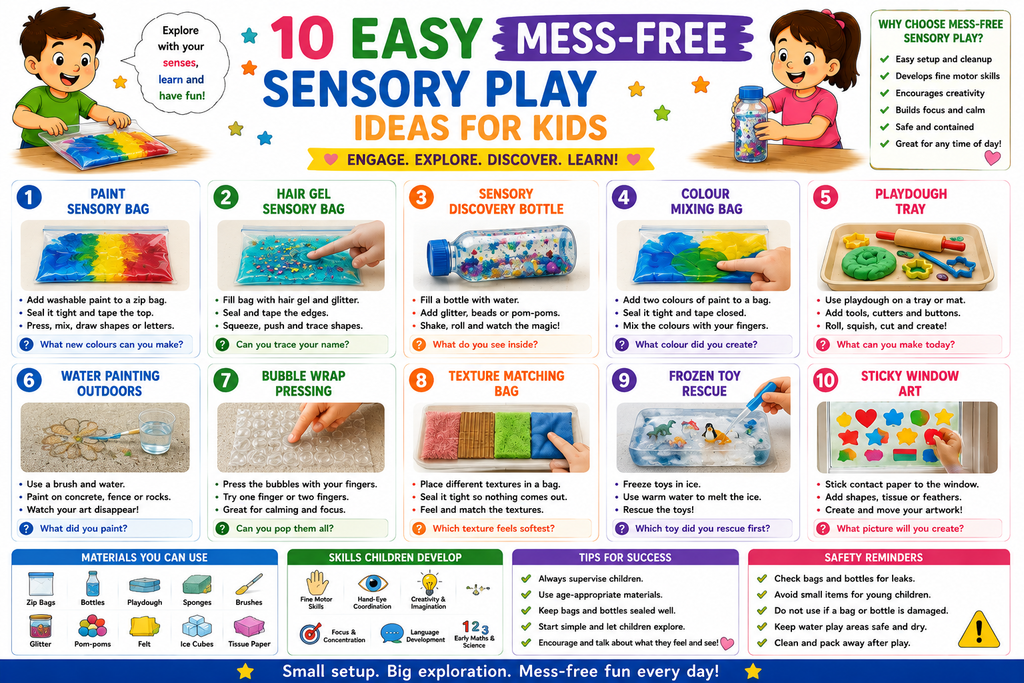
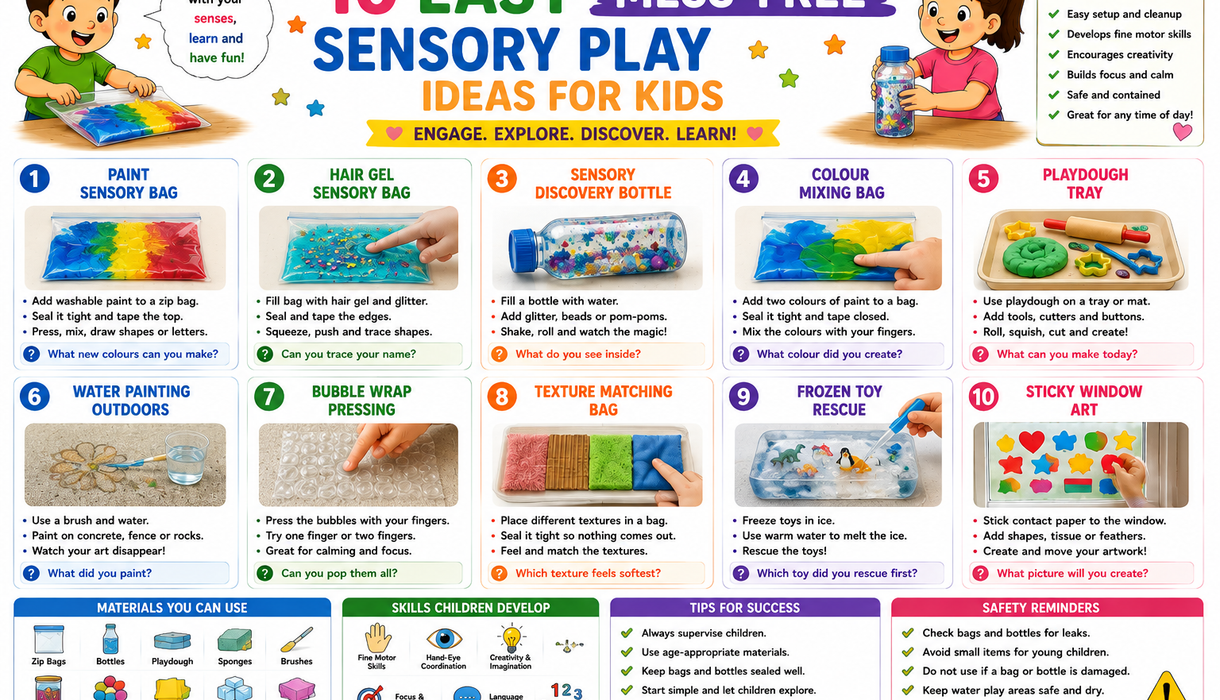
1. Paint Sensory Bag
Add a few spoonfuls of washable paint to a strong zip-lock bag.
Use one colour or several colours.
Remove excess air, seal the bag securely and reinforce the opening with tape.
Place it flat on a table.
Children can:
- Press the paint
- Mix colours
- Draw lines with their fingers
- Make shapes
- Write letters or numbers
Ask:
“What happens when the colours mix?”
“Can you draw a circle?”
This gives children a painting experience without needing to touch the paint directly.
2. Hair Gel Sensory Bag
Add clear or coloured hair gel to a securely sealed bag.
You can include a small amount of food colouring or glitter if appropriate for your setting.
Children can squeeze and push the gel around.
Try drawing a simple shape or letter underneath the bag and asking children to trace over it with their finger.
This can be used for:
Lines
Shapes
Numbers
Letters
Names
3. Sensory Discovery Bottle
Fill a clear plastic bottle with water and add visually interesting materials.
Try:
- Glitter
- Sequins
- Large beads
- Pom-poms
- Foil pieces
Seal the lid securely.
Children can shake, roll and turn the bottle.
Ask:
“What happens when you shake it?”
“Which objects move fastest?”
“Can you find the red piece?”
Sensory bottles can also be useful for quiet observation.
4. Colour Mixing Bag
Place small amounts of two paint colours inside a sealed bag.
Try:
Blue + yellow
Red + yellow
Blue + red
Ask children to predict:
“What colour do you think they will make?”
Then let them press and mix the colours together through the bag.
This combines sensory exploration with early science.
5. Playdough Tray
Playdough can be a relatively easy-to-manage sensory activity when kept on a tray or placemat.
Provide:
- Playdough
- Rolling pin
- Cookie cutters
- Craft sticks
- Large buttons
- Safe plastic tools
Children can squeeze, flatten, roll and build.
Keeping everything on one tray makes cleanup much easier.
6. Water Painting Outdoors
Give children a container of water and a paintbrush.
Let them paint on:
- Concrete
- Fence
- Chalkboard
- Rocks
- Pavers
They can create:
Pictures
Letters
Numbers
Shapes
The water gradually disappears as it dries.
Ask:
“Where did your picture go?”
This is simple sensory play with almost no cleanup.
7. Bubble Wrap Pressing
Place a piece of clean bubble wrap on a table or floor.
Children can gently press the bubbles with their fingers.
Try asking them to:
Press one bubble at a time
Use one finger
Use two fingers
Find an unpopped bubble
For a reusable version, use textured silicone mats or similar sensory surfaces rather than disposable bubble wrap.
8. Texture Matching Bag
Place different textured materials inside individual clear bags or under securely taped transparent sheets.
Examples might include:
- Soft fabric
- Corrugated cardboard
- Sponge
- Felt
- Smooth ribbon
Children can press and feel each texture through the surface.
Ask:
“Which one feels soft?”
“Which one feels bumpy?”
“Which two feel different?”
This introduces descriptive vocabulary without loose materials spreading around the play area.
9. Frozen Toy Rescue
Freeze a few larger waterproof toys inside a container of ice.
Place the ice block in a tray.
Give children small amounts of warm water with droppers, spoons or squeeze bottles.
They can gradually melt the ice to rescue the toys.
Ask:
“What is happening to the ice?”
“Which part is melting fastest?”
The tray helps contain the water as the ice melts.
Adult supervision is important with temperature and water.
10. Sticky Window Art
Attach a piece of clear contact paper to a window or wall with the sticky side facing outward.
Provide lightweight, age-appropriate materials such as:
- Large paper shapes
- Tissue paper
- Feathers
- Foam pieces
- Large fabric pieces
Children press the materials onto the sticky surface and move them around to create pictures.
Try:
Colour sorting
Shape pictures
Patterns
Free art
Most of the materials stay attached to the surface, keeping cleanup simple.
Create a Sensory Bag Drawing Activity
Sensory bags can also become simple pre-writing tools.
Place a coloured gel or paint bag on a flat surface.
Children can use their finger to draw:
Straight lines
Wavy lines
Circles
Shapes
Letters
Numbers
After each drawing, smooth the bag and begin again.
This lets children practise movements without using paper each time.
Add Simple Learning Challenges
Mess-free sensory play can easily include early learning.
Try:
“Can you find three red objects in the bottle?”
“Draw number 4 in the sensory bag.”
“Make a triangle.”
“Which colour did blue and yellow make?”
Keep challenges optional so children still have opportunities for open-ended exploration.
Make a Quiet Sensory Basket
Keep several reusable mess-free sensory resources together.
For example:
- Sensory bottle
- Sealed gel bag
- Playdough container
- Textured fabric squares
- Pop-it or textured silicone toy
- Simple tracing cards
This can create an easy quiet-time activity that requires very little preparation.
Skills Children Can Practise
Mess-free sensory activities can support:
- Fine motor skills
- Finger strength
- Hand-eye coordination
- Sensory exploration
- Colour recognition
- Shape recognition
- Early writing movements
- Vocabulary
- Concentration
- Creativity
- Problem-solving
- Cause and effect
Why Choose Mess-Free Sensory Play?
Mess-free activities can be useful when:
- You have limited space
- You need a quick activity
- You’re playing indoors
- Cleanup time is limited
- A child prefers not to directly touch certain textures
- You want a reusable sensory resource
They can complement messier sensory experiences rather than replacing them completely.
Follow the Child’s Preferences
Children respond differently to sensory experiences.
One child may enjoy squeezing gel while another prefers watching objects move inside a bottle.
Offer different options and allow children to choose how they interact with the activity.
There is no need to force a child to touch a texture they dislike.
Keep Learning With PlayPrintGrow
Sensory play can be simple, contained and easy to prepare.
A sealed bag, sensory bottle, tray of playdough or paintbrush with water can provide plenty of opportunities to explore texture, movement and colour.
Keep the setup simple and let children discover what the materials can do.
Touch. Explore. Create. Grow.