
Water is one of the simplest sensory materials available.
Children naturally enjoy pouring, splashing, scooping, squeezing and moving water between containers. These repeated actions can support fine motor development, coordination, concentration and early maths and science concepts.
Water sensory play can be set up indoors in a suitable area or outdoors in a backyard, garden, balcony or childcare environment.
These ideas are designed for children around 2–6 years old with close adult supervision.
What You’ll Need
Depending on the activity, you might use:
- Shallow water tub
- Cups
- Bowls
- Jugs
- Spoons
- Funnels
- Sponges
- Toy animals
- Toy cars
- Large pom-poms
- Plastic balls
- Measuring cups
- Brushes
- Ice cubes
- Food colouring
- Natural materials
You don’t need everything at once. A tub of water and two cups can already provide plenty of sensory play.
Safety First
Children should always be actively supervised around water, even when the water is shallow.
Use age-appropriate materials, keep floors and walking areas as dry as possible, and empty water containers immediately after play.
For younger children, avoid small objects that may be choking hazards.
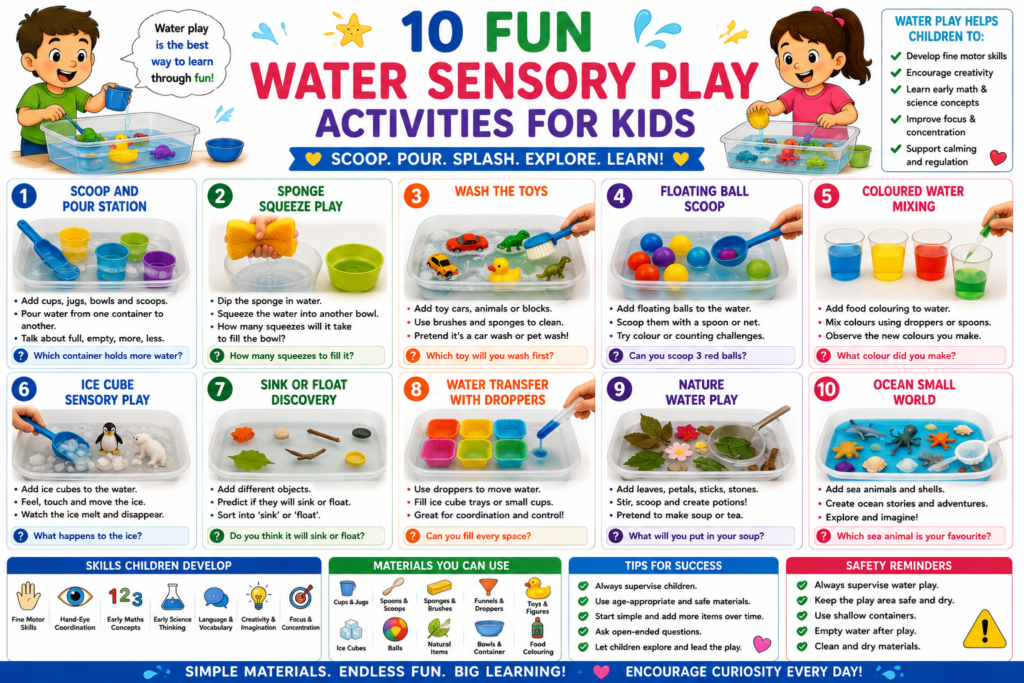
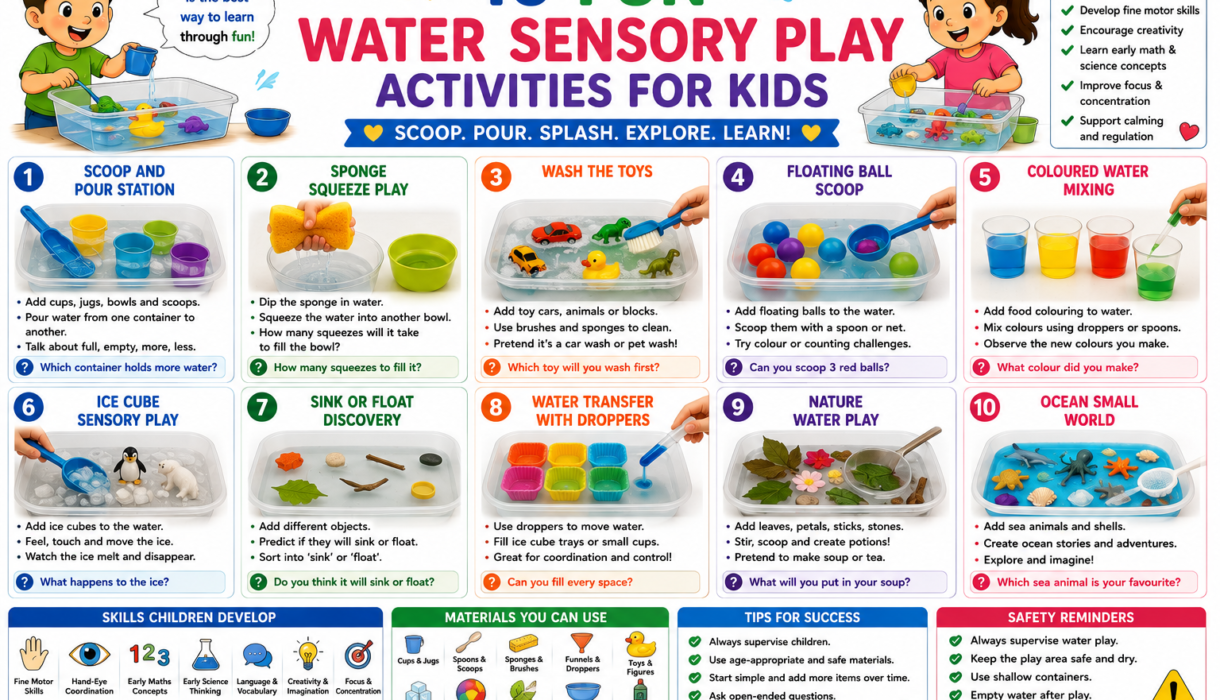
1. Scoop and Pour Station
Fill a shallow tub with water.
Add:
- Cups
- Jugs
- Bowls
- Scoops
- Funnels
Let children transfer water between the containers.
Introduce words such as:
Full
Empty
Half-full
More
Less
Ask:
“Which container holds more water?”
“Can you fill this cup?”
Children may repeat the same pouring action many times, which provides valuable coordination practice.
2. Sponge Squeeze Play
Place two bowls beside each other.
Fill one with water and leave the other empty.
Give children a sponge.
They can:
- Dip the sponge into the water.
- Lift it out.
- Squeeze the water into the empty bowl.
- Repeat.
Ask:
“How many squeezes will it take to fill the bowl?”
Squeezing a sponge can help strengthen hands and fingers.
3. Wash the Toys
Add washable toys to a tub of water.
Try:
- Toy cars
- Plastic animals
- Dolls designed for water
- Building blocks
Provide small brushes, cloths and sponges.
Children can pretend they are running a:
Car wash
Animal washing station
or
Toy cleaning shop
Ask:
“Which toy should we wash first?”
“Can you find all the red cars?”
This combines sensory play with imaginative play.
4. Floating Ball Scoop
Place several lightweight floating balls in the water.
Give children:
- Spoon
- Ladle
- Small net
- Scoop
Ask them to catch and transfer the balls into another container.
Try colour challenges:
“Find a blue ball.”
or counting challenges:
“Can you scoop three balls?”
This supports hand-eye coordination.
5. Coloured Water Mixing
Prepare several small containers of water.
Add a little food colouring to create basic colours such as:
Red
Yellow
Blue
Give children clear cups and droppers, spoons or small jugs.
Let them combine colours.
Try:
Blue + yellow
Red + yellow
Red + blue
Ask:
“What new colour did you make?”
This is an easy introduction to colour mixing and cause and effect.
6. Ice Cube Sensory Play
Add ice cubes to a shallow tub of water.
Let children observe and touch them briefly with supervision.
Provide:
- Spoons
- Cups
- Tongs
- Warm water in a separate adult-controlled container
Ask:
“How does the ice feel?”
“What happens when we leave it in the water?”
“Where did the ice go?”
Children can observe how ice gradually melts into liquid water.
7. Sink or Float Discovery
Choose several safe objects.
Try:
- Leaf
- Cork
- Plastic toy
- Stone
- Spoon
- Bottle lid
- Stick
Before adding each object, ask:
“Do you think it will sink or float?”
Test it and observe.
Make two groups:
SINK
FLOAT
This turns sensory play into a simple science investigation.
8. Water Transfer With Droppers
Provide child-friendly droppers or large pipettes.
Place coloured water in one container and an empty tray or cup nearby.
Children squeeze the dropper, collect the water and release it somewhere else.
Try adding an ice cube tray.
Children can place different colours into individual sections.
This activity can support finger strength and controlled hand movements.
9. Nature Water Play
Add safe natural materials to a water tray.
Try:
- Leaves
- Flowers or petals
- Sticks
- Large stones
- Seed pods
Children can stir, scoop and create pretend:
Soup
Potion
Tea
Garden recipe
Ask:
“What ingredients are you adding?”
“How many leaves did you use?”
This combines sensory exploration with imaginative language.
10. Ocean Small World
Create a simple ocean-themed sensory tub.
Use shallow water and add:
- Large sea-animal toys
- Shells appropriate for the child’s age
- Blue cups
- Stones
- Small net
Children can create underwater stories.
Ask:
“Which animal lives underwater?”
“Can you find the biggest sea animal?”
“How many fish can you see?”
This supports vocabulary and pretend play.
Add Early Maths
Water play naturally introduces mathematical ideas.
Try questions such as:
“Which cup holds more?”
“How many scoops will fill this bowl?”
“Can you pour three cups of water?”
“Which container is empty?”
Children can explore quantity and capacity without needing formal worksheets.
Add Early Science
Water sensory play can also introduce simple science concepts.
Children can explore:
- Floating and sinking
- Ice melting
- Colour mixing
- Water movement
- Absorption
- Cause and effect
Ask children to predict before testing.
For example:
“What do you think will happen to the sponge?”
“Will this object float?”
“What colour will these two make?”
Encourage New Vocabulary
During water play, introduce words such as:
Pour
Scoop
Squeeze
Drip
Splash
Float
Sink
Full
Empty
Wet
Dry
Using the words while children experience the action helps give them meaning.
Let Children Lead
Not every water activity needs a challenge.
Sometimes provide the materials and allow children to decide how they want to use them.
They might:
- Fill containers
- Create pretend food
- Wash toys
- Make patterns
- Invent games
- Experiment with pouring
Open-ended play gives children opportunities to make decisions and solve their own problems.
Skills Children Can Practise
Water sensory activities can support:
- Fine motor skills
- Hand strength
- Hand-eye coordination
- Pouring control
- Sensory exploration
- Early maths
- Early science
- Colour recognition
- Counting
- Vocabulary
- Problem-solving
- Imaginative play
- Concentration
Keep the Setup Simple
Water play doesn’t need to become a huge activity.
Try:
Water + cups
Water + sponges
Water + toy cars
Water + floating balls
A simple setup often gives children more freedom to explore than an activity with too many materials.
Make Cleanup Part of the Activity
Children can help:
- Pour unused water out safely
- Return cups to containers
- Place wet toys on a towel
- Wipe the table
- Put equipment away
This can help build responsibility and independence.
Keep Learning With PlayPrintGrow
A simple tub of water can offer opportunities for sensory exploration, early maths, science, language and imaginative play.
Give children safe materials, plenty of time and the freedom to experiment with what water can do.
Splash. Pour. Explore. Grow.