
Young children often explore the world by touching—and sometimes tasting—what is around them.
For children who are still likely to put materials in their mouths, taste-safe sensory play can offer another option for hands-on exploration.
Taste-safe does not mean children should be encouraged to eat the sensory materials. It simply means the activity uses familiar food ingredients rather than craft products that are not intended for ingestion.
These activities are particularly suited to children around 1–4 years old, with close adult supervision.
Safety First
Always supervise sensory play closely.
Before using any food ingredient, consider:
- Allergies
- Food intolerances
- Choking risks
- The child’s age
- Cultural or dietary requirements
- Safe food handling
Avoid hard, round or small foods that could present a choking hazard.
If you’re using sensory play in an early learning setting, follow your service’s allergy and food-safety procedures.
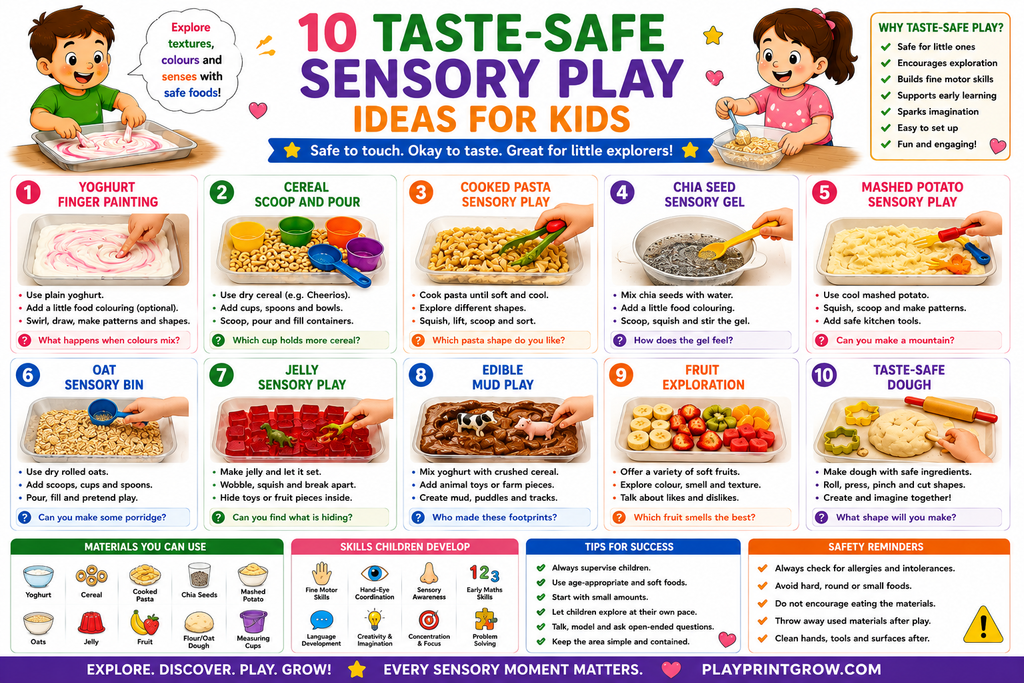
1. Yoghurt Finger Painting
Plain yoghurt can become a simple sensory paint.
Divide yoghurt between small bowls and add a tiny amount of food colouring if desired.
Place spoonfuls onto a tray or highchair surface.
Children can use their fingers to:
- Spread
- Swirl
- Mix colours
- Make handprints
- Draw simple shapes
Ask:
“How does it feel?”
“What happens when the colours mix?”
The cool, smooth texture makes this a simple first sensory activity.
2. Cereal Scoop and Pour Bin
Use an age-appropriate dry cereal as a sensory filler.
Add:
- Cups
- Scoops
- Bowls
- Spoons
Children can move cereal from one container to another.
Talk about:
Full
Empty
More
Less
Big
Small
This supports both fine motor skills and early maths language.
3. Cooked Pasta Sensory Play
Cook pasta until soft and allow it to cool completely.
Place it in a shallow tray.
Try different pasta shapes such as:
- Spaghetti
- Spirals
- Penne
- Shells
Children can squish, lift and move the pasta.
Add child-safe kitchen utensils such as tongs or spoons.
Ask:
“Which pasta feels slippery?”
“Can you find a long piece?”
4. Chia Seed Sensory Gel
Soaked chia seeds create an unusual gel-like texture.
Mix chia seeds with water and allow them to absorb the liquid.
Once prepared safely, place a small amount into a sensory tray.
Children can:
- Scoop
- Squish
- Stir
- Press
- Draw paths through the mixture
You can add a little food colouring for visual interest.
Because seeds can still present dietary or choking considerations for some children, use only when appropriate and supervise closely.
5. Mashed Potato Sensory Play
Cool mashed potato can create a soft mouldable sensory material.
Place some on a tray.
Children can:
- Squish it
- Scoop it
- Make hills
- Flatten it
- Draw lines through it
Add large age-appropriate edible items for decorating if suitable.
You can also use utensils to create different marks.
Ask:
“Can you make a big mountain?”
“What happens when you press it flat?”
6. Oat Sensory Bin
Dry rolled oats can make an easy sensory base for children who can safely manage the material.
Add:
- Measuring cups
- Bowls
- Scoops
- Large spoons
Children can pour and transfer the oats.
Try a simple pretend cooking activity:
“Can you make some porridge?”
“How many scoops do we need?”
This combines sensory play with imaginative language.
7. Jelly Sensory Play
Prepare jelly according to the packet instructions and allow it to set fully.
Place portions into a tray.
Children can explore:
- Wobbling
- Squashing
- Scooping
- Breaking it apart
- Mixing colours
Hide large age-appropriate edible or washable items inside if suitable.
Ask:
“Can you find what is hiding?”
“What happens when you squeeze the jelly?”
The slippery, wobbly texture provides a very different sensory experience.
8. Edible Mud Play
Create pretend mud using a familiar food such as yoghurt mixed with crushed cereal or another suitable ingredient.
Place it in a tray.
Add large washable toy animals if developmentally appropriate.
Children can make:
A farm
A muddy dinosaur world
Animal footprints
Pretend puddles
Ask:
“Which animal made this footprint?”
“Can you wash the animal afterwards?”
This works especially well when followed by a simple water-washing activity.
9. Fruit Sensory Exploration
Offer a small selection of safe fruit prepared appropriately for the child’s age.
Explore differences between:
- Banana
- Strawberry
- Orange
- Watermelon
- Kiwi
- Mango
Children can observe:
Colour
Smell
Texture
Softness
Juiciness
Ask:
“Which one feels soft?”
“Which one smells strongest?”
“What colours can you see?”
This combines sensory learning with real foods.
10. Taste-Safe Dough
Make a simple taste-safe dough using ingredients suitable for the child.
Depending on dietary needs, recipes might use flour-based or oat-based mixtures prepared specifically for sensory play.
Children can:
- Roll
- Press
- Pinch
- Flatten
- Use cookie cutters
Add child-safe kitchen tools.
Ask:
“Can you make a ball?”
“Can you roll a long snake?”
“What shape did you make?”
Even when the ingredients are edible, the dough should still be treated as a play material rather than a snack.
Talk About the Senses
Taste-safe play is a great opportunity to introduce sensory words.
Talk about:
Soft
Hard
Cold
Warm
Smooth
Sticky
Slippery
Dry
Wet
Sweet-smelling
Bumpy
You can ask:
“How does it feel in your hands?”
“What can you smell?”
“Is it smooth or lumpy?”
Add Scooping and Pouring
Simple tools can extend almost any taste-safe activity.
Try:
- Measuring cups
- Large spoons
- Bowls
- Silicone utensils
- Scoops
- Muffin trays
Children can transfer materials from one container to another.
These repeated movements support hand-eye coordination and fine motor skills.
Add Early Maths
Taste-safe sensory play can include simple counting and comparison.
Try:
“Can you make three yoghurt dots?”
“How many scoops filled the bowl?”
“Which container has more?”
“Can you make two pasta groups?”
Keep the maths playful rather than turning the sensory experience into a formal lesson.
Encourage Imaginative Play
Food-based sensory materials can easily become pretend play.
Children might create:
- Soup
- Cakes
- Ice cream
- Mud pies
- Pasta restaurants
- Fruit shops
Ask:
“What are you making?”
“Who is it for?”
“What ingredients do you need?”
This encourages language and storytelling.
Taste-Safe Does Not Mean Eat Freely
It is useful to make a clear distinction between safe ingredients and mealtime food.
Children may taste a sensory material, but the aim of the activity is exploration.
Sensory materials can become contaminated through repeated touching, toys or surfaces, so they should not be treated like food served for eating afterwards.
Dispose of used materials appropriately.
Keep Portions Small
You do not need a huge container of food.
Small portions reduce:
- Food waste
- Cleanup
- Cost
- Overstimulation
A shallow tray with a modest amount of material is often enough.
Follow the Child’s Sensory Preferences
Some children love sticky or wet textures.
Others may prefer dry materials.
A child does not need to touch something directly if they are uncomfortable.
Offer tools such as:
- Spoon
- Scoop
- Brush
- Tongs
This allows them to participate without forcing direct contact.
Skills Children Can Practise
Taste-safe sensory play can support:
- Fine motor skills
- Hand-eye coordination
- Sensory exploration
- Vocabulary
- Colour recognition
- Early maths
- Imaginative play
- Concentration
- Cause and effect
- Independent exploration
- Creativity
Keep the Setup Manageable
Try using a large tray, washable mat or highchair tray.
Have wipes or a damp cloth nearby.
A simple setup could be:
Yoghurt + tray
Pasta + bowl + spoon
Oats + two cups
Sensory play doesn’t need lots of extras to be effective.
Keep Learning With PlayPrintGrow
Taste-safe sensory play gives younger children opportunities to explore texture, movement, colour and everyday materials in a developmentally appropriate way.
Choose safe ingredients, keep portions small, supervise closely and let children explore at their own pace.
Squish. Scoop. Explore. Grow.