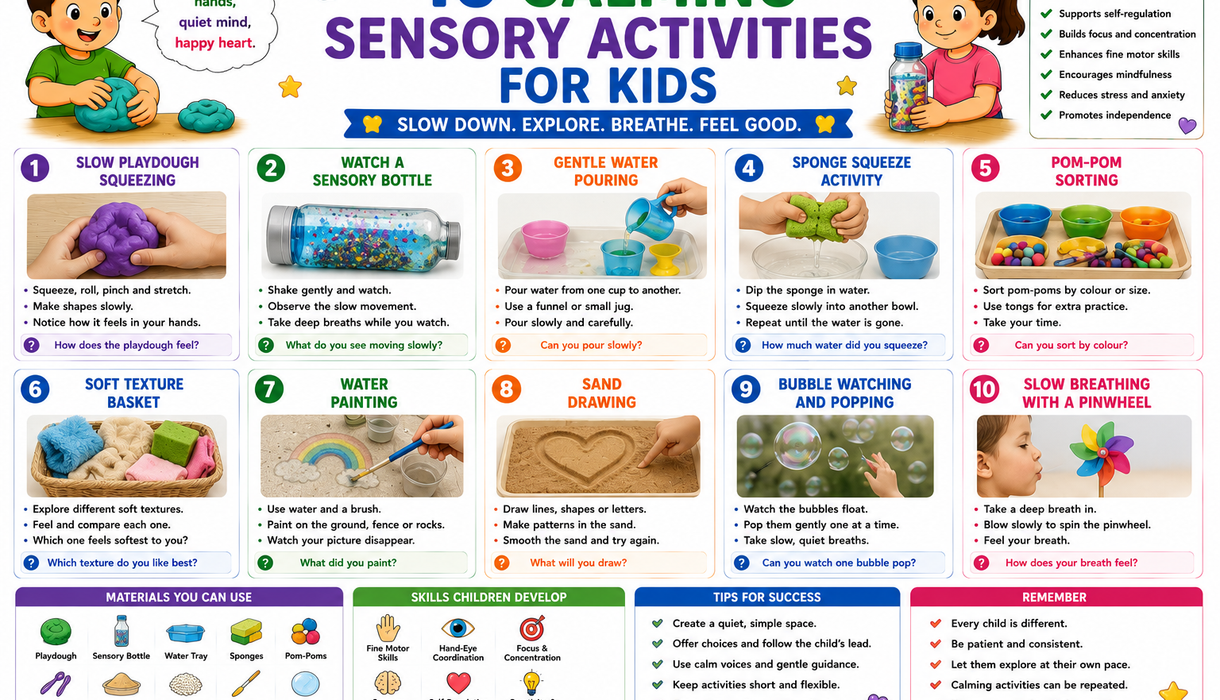

Some sensory activities are exciting and energetic, while others can encourage children to slow down, concentrate and enjoy quieter play.
Calming sensory activities often involve repetitive movements such as squeezing, pouring, watching, sorting or slowly moving objects.
These activities are suitable for children around 2–8 years old and can be used during quiet play, transitions or whenever a slower activity would suit the moment.
Every child responds differently to sensory experiences, so offer choices and follow the child’s cues.
What You’ll Need
Depending on the activity, you might use:
- Playdough
- Sensory bottle
- Water
- Sponges
- Large pom-poms
- Tongs
- Soft fabric
- Paintbrushes
- Sand
- Rice or other age-appropriate sensory fillers
- Paper
- Crayons
- Bubbles
- Small containers
You don’t need all of these. Even one simple material can provide meaningful sensory play.
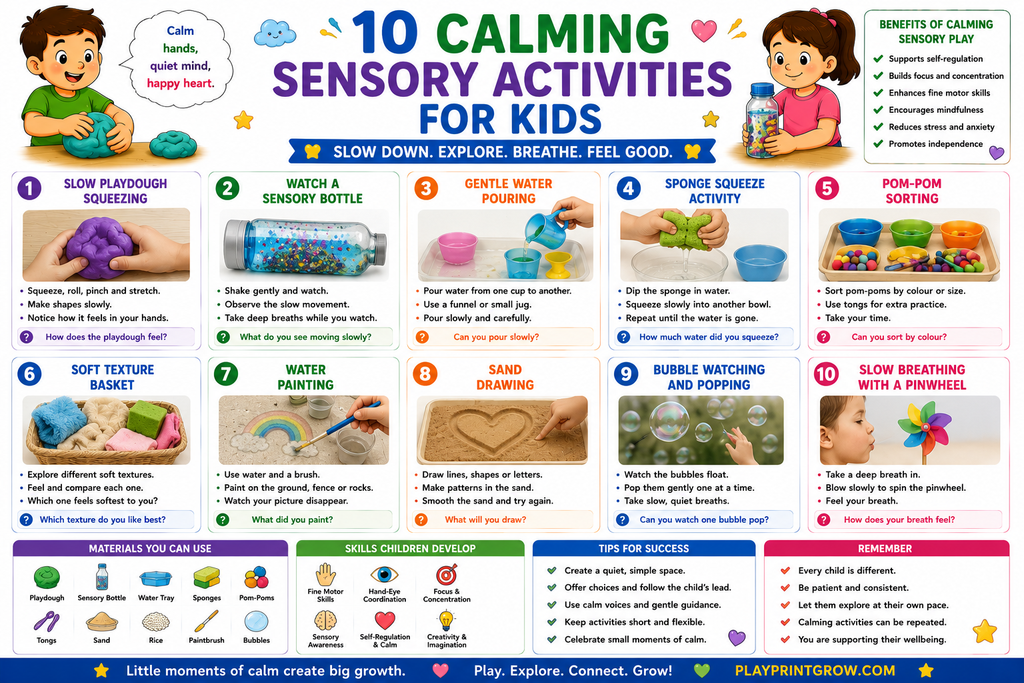
1. Slow Playdough Squeezing
Give children a soft ball of playdough.
Encourage them to slowly:
- Squeeze
- Roll
- Flatten
- Pinch
- Stretch
Try saying:
“Squeeze slowly, then let go.”
Children can also make simple balls, snakes or shapes.
The repetitive hand movements can encourage focused, quiet play while strengthening the hands and fingers.
2. Watch a Sensory Bottle
Use a securely sealed sensory bottle filled with water and slow-moving visual materials.
Children can gently turn or shake the bottle and watch the contents move.
Try asking:
“Can you watch until everything reaches the bottom?”
“What do you notice moving slowly?”
Avoid telling children that they must calm down. Simply offer the bottle as something interesting to observe.
3. Gentle Water Pouring
Set up a shallow water tray with:
- Small jug
- Cups
- Funnel
- Bowls
Children can slowly transfer water from one container to another.
Encourage careful pouring rather than splashing.
Introduce words such as:
Slow
Full
Empty
Drip
Pour
The repeated movement can provide a simple, focused sensory experience.
Always supervise water play closely.
4. Sponge Squeeze Activity
Place a sponge and two bowls beside each other.
Fill one bowl with a small amount of water.
Children soak the sponge, lift it and slowly squeeze the water into the empty bowl.
Repeat until the water has been transferred.
Ask:
“Can you squeeze very slowly?”
“How much water came out?”
This provides repetitive hand movement with a clear beginning and end.
5. Pom-Pom Sorting
Provide large colourful pom-poms and several bowls.
Children can slowly sort them by:
- Colour
- Size
- Quantity
Add child-safe tongs for extra fine motor practice.
Try:
“Put all the blue pom-poms together.”
or:
“Can you make two matching groups?”
Sorting can encourage concentration without requiring lots of noise or movement.
Use only age-appropriate materials and supervise younger children closely.
6. Soft Texture Basket
Create a small basket with different safe textures.
Try:
- Soft fabric
- Felt
- Fluffy cloth
- Smooth ribbon
- Sponge
- Textured silicone items
Children can touch and compare the materials.
Ask:
“Which one feels softest?”
“Which one feels smooth?”
“Do any of these feel the same?”
Let children avoid any texture they don’t enjoy.
7. Water Painting
Give children a paintbrush and a small container of water.
Let them paint on:
- Concrete
- Chalkboard
- Fence
- Rocks
- Pavers
Encourage slow strokes.
Children can paint:
Lines
Circles
Pictures
Letters
Then watch the water gradually dry.
Ask:
“Can you see your picture changing?”
This is simple, low-mess sensory play.
8. Sand Drawing
Place a thin layer of sand in a shallow tray.
Children can slowly move their fingers through the sand.
Try making:
- Straight lines
- Waves
- Circles
- Shapes
- Letters
- Simple pictures
When finished, gently shake or smooth the tray and begin again.
If sand is not appropriate for the child’s age, use another suitable sensory material.
9. Bubble Watching and Popping
Blow bubbles for children in an open space.
Instead of turning it into a fast chasing game, encourage children to watch how bubbles:
- Float
- Move
- Change direction
- Pop
Ask:
“Can you watch one bubble until it pops?”
Children can gently reach out and pop bubbles one at a time.
Keep bubble solution away from eyes and mouths.
10. Slow Breathing With a Pinwheel
Use a child-safe pinwheel or lightweight paper spinner.
Show children how a gentle breath makes it move.
Try:
Slow breath → slow spinning
Bigger breath → faster spinning
Rather than expecting children to perform a breathing exercise perfectly, let them experiment with how their breath changes the movement.
You can also use bubbles in a similar way, with appropriate supervision.
Create a Quiet Sensory Space
You don’t need a special sensory room.
A small comfortable area can work well.
You might include:
- Soft cushion
- Books
- Sensory bottle
- Playdough
- Drawing materials
- Soft textures
- Simple puzzles
Keep the area uncluttered and allow children to choose whether they want to use it.
Keep the Environment Simple
Too many sensory materials at once can sometimes make an activity distracting.
Instead of providing ten different tools, try:
Playdough + rolling pin
or:
Water + two cups
or:
Pom-poms + three bowls
A simple setup gives children space to focus on the sensory experience.
Try Repetitive Movements
Some children enjoy repeated actions such as:
Pour → empty → pour again
Roll → flatten → roll again
Sort → mix → sort again
Squeeze → release → squeeze again
There is no need to constantly introduce a new activity.
Repetition can be an important part of sensory exploration and learning.
Add Quiet Language
Adults can support a calmer atmosphere by using simple descriptive language.
Try:
“The water is dripping slowly.”
“That playdough feels soft.”
“You’re placing them one at a time.”
“The glitter is falling to the bottom.”
There is no need to fill every moment with questions.
Sometimes children benefit from having time to explore quietly.
Follow the Child’s Preferences
A calming activity for one child may not feel calming to another.
One child may enjoy water while another prefers dry textures.
Offer choices such as:
Would you like playdough or drawing?
Would you like water or the sensory bottle?
Allow children to stop if they no longer want to participate.
Skills Children Can Practise
Calming sensory activities can support:
- Fine motor skills
- Hand strength
- Hand-eye coordination
- Concentration
- Sensory awareness
- Vocabulary
- Observation
- Independent play
- Decision-making
- Creativity
- Slow and controlled movements
Keep Activities Short and Flexible
There is no set amount of time children need to spend on a sensory activity.
Some children may explore for five minutes.
Others may repeat the same action for much longer.
Follow their interest rather than expecting the activity to last for a particular amount of time.
Keep Learning With PlayPrintGrow
Sensory play can be exciting, messy and energetic, but it can also be slow, simple and quiet.
Offer children materials they can squeeze, pour, watch, sort and explore at their own pace.
Sometimes the simplest activities provide the most meaningful moments of play.
Slow. Explore. Create. Grow.