
Children experience big feelings just like adults, but they are still learning how to understand what is happening in their bodies and what they can do next.
Self-regulation develops gradually.
It includes noticing emotions, recognising body signals, communicating needs and learning strategies that may help when feelings become strong.
The aim is not to stop children from feeling angry, worried, disappointed or excited.
Instead, we can help children learn:
“I can notice what I’m feeling.”
“I can find something that may help.”
“I can ask someone for support.”
These activities are suitable for children around 3–10 years old and can be adapted for home, preschool, childcare or school.
What Is Self-Regulation?
Self-regulation is the developing ability to manage attention, emotions, behaviour and responses to different situations.
For young children, this often happens with support from an adult.
A child may gradually learn to:
- Notice their body becoming tense
- Recognise that they are frustrated
- Move away from a busy area
- Ask for help
- Take some slow breaths
- Use words instead of hitting
- Choose a quiet activity
- Return when they feel ready
Different strategies work for different children.
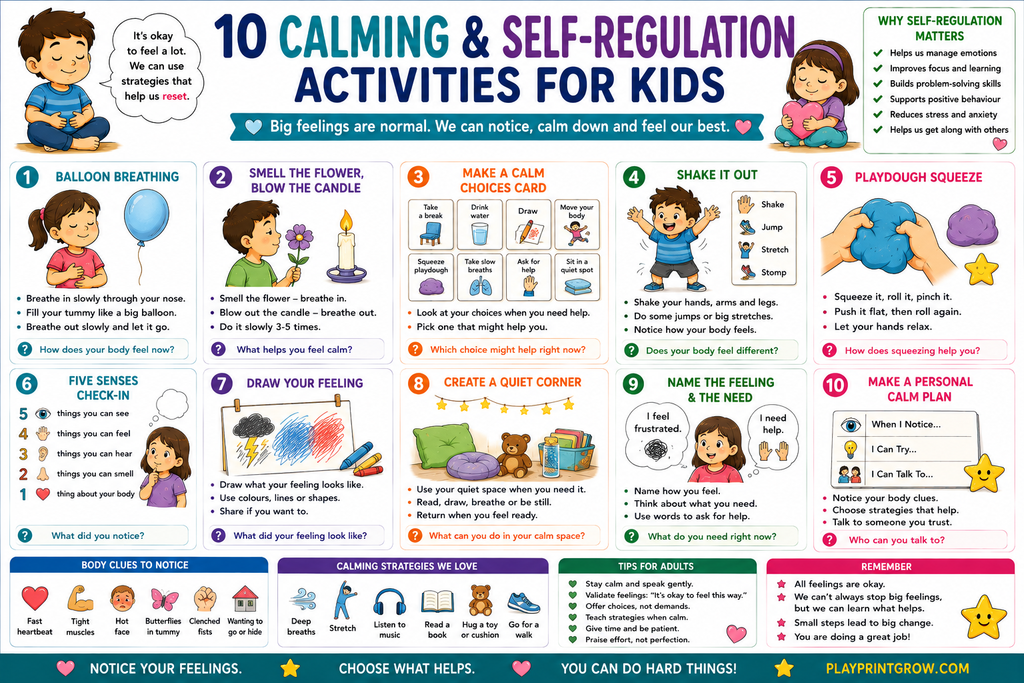
1. Balloon Breathing
Ask children to imagine that their tummy is a balloon.
Place a hand gently on the tummy.
Breathe in slowly through the nose.
Imagine the balloon getting bigger.
Then breathe out slowly and imagine the balloon becoming smaller.
Try three or four slow breaths.
You might say:
“Breathe in slowly.”
“Let the balloon grow.”
“Now breathe out gently.”
Avoid forcing children to breathe in a particular way. Treat it as something they can experiment with.
2. Smell the Flower, Blow the Candle
Use a simple visual idea.
Pretend one hand is holding a flower.
The other hand is holding a birthday candle.
Say:
“Smell the flower.”
Take a slow breath in.
Then:
“Blow out the candle.”
Breathe out gently.
Repeat a few times.
For younger children, the pretend-play element can make breathing practice easier to understand.
3. Make a Calm Choices Card
Create a small card showing several activities the child can choose from.
For example:
Take a break
Drink some water
Ask for help
Draw
Squeeze playdough
Take slow breaths
Sit somewhere quiet
Move your body
When the child is calm, look at the card together.
Ask:
“Which of these do you think might help you sometimes?”
Giving choices can be more useful than telling children there is one correct way to calm down.
4. Shake It Out
Sometimes children need movement rather than stillness.
Invite them to shake their:
Hands
Arms
Legs
Shoulders
Then try:
Five jumps
Ten stomps
A big stretch
Running to a marker and back
Afterwards, pause and notice the body.
Ask:
“Does your body feel different now?”
Movement can be useful before expecting a child to sit quietly.
5. Playdough Squeeze
Give children some soft playdough.
Invite them to:
- Squeeze
- Roll
- Pinch
- Flatten
- Stretch
You can say:
“Squeeze it hard, then let your hands relax.”
Children can also make whatever they like rather than following instructions.
The repetitive hand movements can provide a focused activity while supporting fine motor development.
6. Five Senses Check-In
Guide children to notice what is around them.
Try:
5 things you can see
4 things you can feel
3 things you can hear
2 things you can smell
1 thing you can notice about your body
For younger children, simplify it.
You might ask:
“What can you see?”
“What can you hear?”
“What can your hands feel?”
This helps bring attention to the present environment.
7. Draw Your Feeling
Give children paper and crayons.
Ask:
“If your feeling could be a picture, what would it look like?”
They might draw:
- Scribbles
- Storm clouds
- Hearts
- Lines
- Faces
- Colours
- Shapes
There is no correct way to draw an emotion.
Afterwards, ask:
“Would you like to tell me about it?”
Children should be able to choose whether they want to talk.
8. Create a Quiet Corner
Create a small, comfortable place children can choose to use.
It might include:
- Cushion
- Books
- Sensory bottle
- Soft toy
- Drawing materials
- Feelings cards
- Playdough
The area should not be used as punishment.
Instead, explain:
“This is a place you can use when you want some quiet space.”
Children can learn to recognise when they need a break and return when they feel ready.
9. Name the Feeling and the Need
Help children connect feelings with possible needs.
For example:
“I feel frustrated. I need help.”
“I feel tired. I need a break.”
“I feel worried. I want someone to stay with me.”
“I feel angry. I need some space.”
Practise these sentences when children are calm.
You can use pictures or role-play.
This gives children language they may be able to use later during difficult moments.
10. Make a Personal Calm Plan
Every child may prefer different strategies.
Create a simple plan together:
When I Notice…
My hands are tight
My tummy feels funny
I want to yell
I Can Try…
Taking some space
Asking for help
Breathing slowly
Drawing
Moving my body
Using playdough
I Can Talk To…
Add the names or pictures of trusted adults.
Keep the plan simple and review it occasionally.
Notice Body Signals
Children can begin learning that emotions often come with physical sensations.
For example:
Angry
- Tight muscles
- Hot face
- Fast breathing
- Loud voice
Worried
- Butterflies in the stomach
- Sweaty hands
- Fast heartbeat
- Wanting to stay close to someone
Excited
- Lots of energy
- Fast talking
- Smiling
- Wanting to move
Ask:
“What does your body feel like when you’re excited?”
Body awareness can help children notice emotions earlier.
Regulate First, Talk Later
When a child is extremely upset, it may be difficult for them to answer lots of questions or solve a problem immediately.
Sometimes the first priority is helping the situation become safe and manageable.
Afterwards, when the child is more settled, you can talk about what happened.
For example:
“You were really frustrated when the tower fell. What might help next time?”
This often works better than trying to teach a new strategy in the middle of a very intense moment.
Adults Can Help Co-Regulate
Young children often learn regulation with support from adults.
Adults can help by:
- Speaking calmly
- Staying nearby when appropriate
- Reducing unnecessary noise
- Offering simple choices
- Giving time
- Helping children name feelings
- Supporting safe boundaries
You might say:
“I’m here.”
“We can work this out together.”
“Would you like some space or would you like me nearby?”
Don’t Force a Strategy
A strategy that works one day may not work the next.
If a child does not want to breathe slowly, they might prefer movement.
If they do not want the quiet corner, they may want to stay near an adult.
Offer options rather than insisting:
“Would you like to draw, move your body or sit with me?”
Self-regulation develops partly through learning which strategies work for the individual child.
Create a Calm Kit
Keep a few simple resources together.
A calm kit might include:
- Feelings cards
- Soft stress ball
- Playdough
- Small drawing pad
- Crayons
- Sensory bottle
- Simple breathing card
- Soft fabric
The kit does not need to be expensive.
Choose materials the child genuinely enjoys using.
Use Simple Language During Big Feelings
Long explanations can be difficult to process when emotions are intense.
Try short phrases such as:
“You’re safe.”
“I’m here.”
“Let’s move somewhere quieter.”
“You can tell me when you’re ready.”
“Would you like help?”
More detailed conversation can happen later.
Practise When Children Are Calm
Calming strategies are easier to learn before they are urgently needed.
Practise:
Balloon breathing during circle time
Using the calm card during play
Visiting the quiet space when relaxed
Role-playing asking for help
Then the strategies are already familiar when children need them.
What If a Strategy Doesn’t Work?
That’s okay.
You can say:
“That didn’t seem to help this time. What else could we try?”
This teaches children that self-regulation involves experimenting and learning about themselves.
There is no universal strategy that works for every person.
Skills Children Can Practise
Self-regulation activities can support:
- Emotional awareness
- Body awareness
- Communication
- Decision-making
- Problem-solving
- Asking for help
- Recognising needs
- Attention
- Self-control
- Independence
- Emotional vocabulary
- Coping with frustration
Model Your Own Strategies
Adults can talk about age-appropriate examples.
For instance:
“I’m feeling frustrated, so I’m going to slow down and try again.”
or:
“This room feels noisy to me. I’m going to move somewhere quieter.”
or:
“I need a short break before I finish this.”
This shows children that everyone uses strategies to manage different feelings and situations.
Keep Learning With PlayPrintGrow
Self-regulation isn’t about expecting children to stay calm all the time.
It is about gradually helping them understand what they feel, recognise what their body is telling them and discover safe strategies that may help.
Give children time, choices and supportive adults while these skills develop.
Notice. Choose. Regulate. Grow.