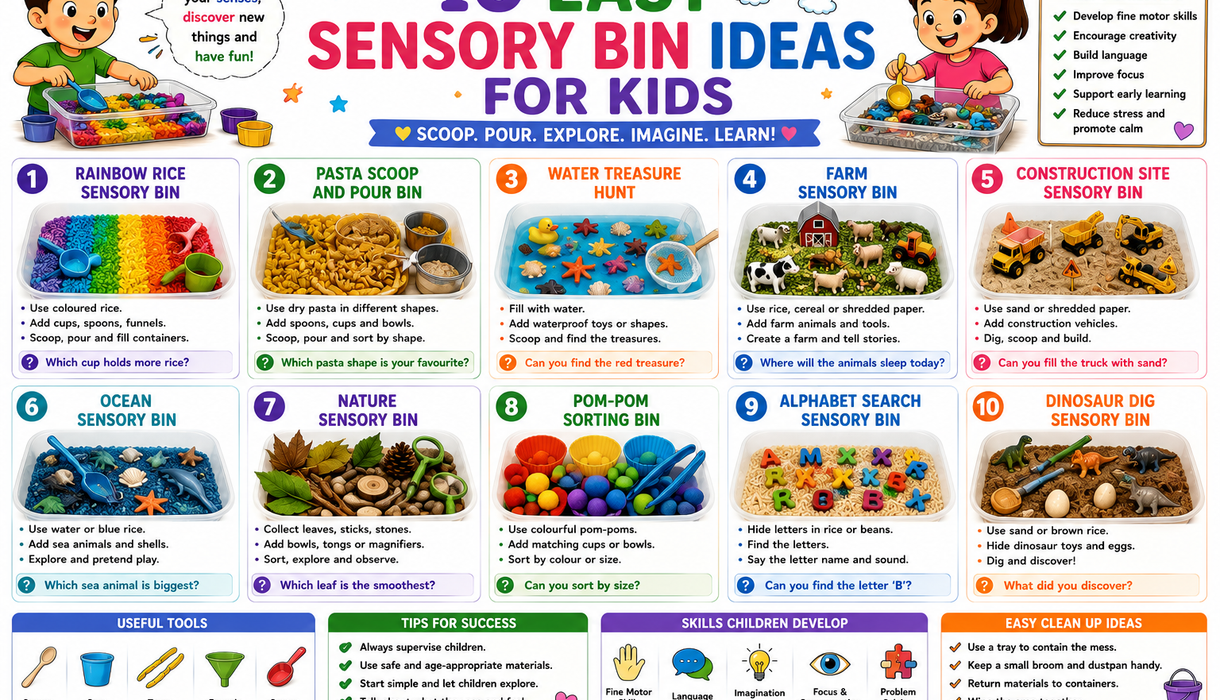

Sensory bins are a simple way to give children opportunities to explore materials using their hands and senses.
Children can scoop, pour, squeeze, search, sort and move objects while developing fine motor skills, concentration and imaginative play.
A sensory bin does not need to be complicated. A shallow container, a safe filler and a few scoops or toys can create plenty of meaningful play.
These ideas are suitable for children around 2–6 years old, with materials adjusted to suit the child’s age and development.
What Is a Sensory Bin?
A sensory bin is a container filled with materials that children can safely explore.
The filler might be:
- Rice
- Pasta
- Water
- Pom-poms
- Leaves
- Sand
- Shredded paper
Then you can add tools or toys such as:
- Cups
- Spoons
- Tongs
- Funnels
- Small containers
- Toy animals
- Letters
- Numbers
The goal is open-ended exploration rather than creating one particular finished product.
Safety First
Always supervise sensory play.
Choose materials that are suitable for the child’s age and avoid small loose items with children who may put objects in their mouths.
Keep dry sensory materials away from eyes and mouths, and clean or replace materials when needed.
For younger children, consider using larger or taste-safe materials instead.
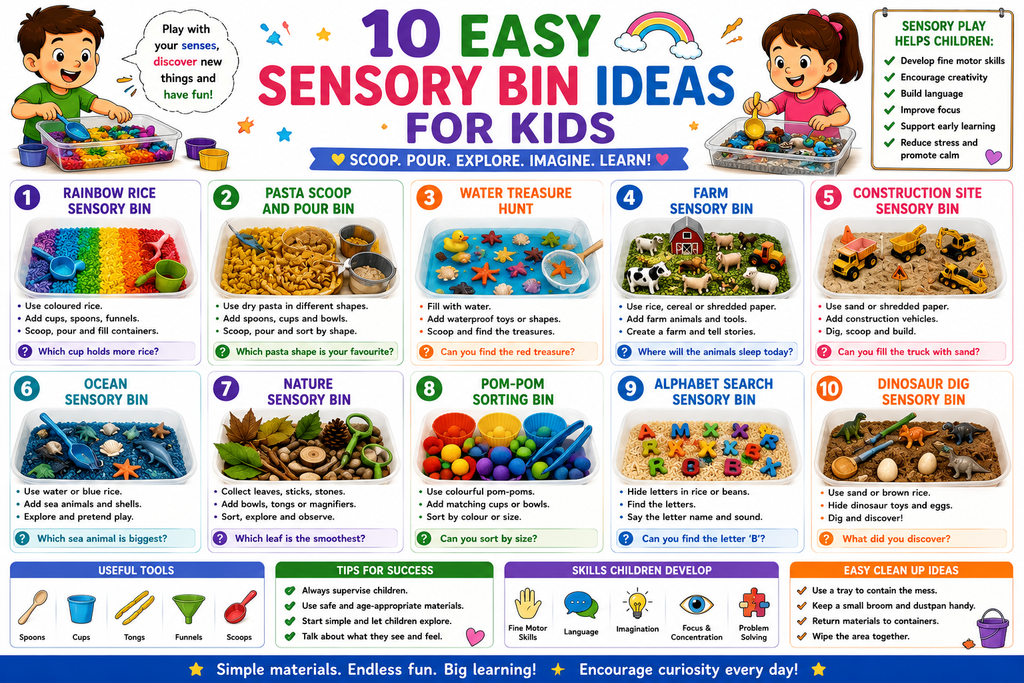
1. Rainbow Rice Sensory Bin
Fill a container with coloured rice or plain uncooked rice.
Add:
- Cups
- Spoons
- Funnels
- Small bowls
- Scoops
Children can scoop rice from one container to another.
Try asking:
“Which cup holds more?”
“Can you fill this container halfway?”
“Can you find all the blue pieces?”
This activity supports pouring, transferring and fine motor control.
2. Pasta Scoop and Pour Bin
Use dry pasta in different shapes.
Try:
- Penne
- Spirals
- Shells
- Large macaroni
Add spoons, cups and containers.
Children can scoop, pour and sort the pasta.
Ask:
“Can you find all the spiral pasta?”
“Which pieces are bigger?”
“How many can you put in this cup?”
Different pasta shapes also provide interesting textures to explore.
3. Water Treasure Hunt
Fill a shallow container with water.
Add several safe waterproof objects.
Try:
- Toy animals
- Large plastic shapes
- Floating balls
- Blocks
- Bottle lids suitable for the child’s age
Give children a scoop, spoon or small net.
Ask them to find particular objects.
For example:
“Can you find the red treasure?”
“Can you rescue three animals?”
This combines sensory play with colour recognition and counting.
4. Farm Sensory Bin
Create a small pretend farm.
Use a sensory base such as:
- Shredded paper
- Large dry pasta
- Taste-safe cereal for younger children
- Soil for supervised outdoor play
Add:
- Toy farm animals
- Small containers
- Toy tractor
- Blocks for fences
Children can create pens, feed the animals and invent stories.
Ask:
“Which animals live on the farm?”
“How many cows can you find?”
“Where should the horse sleep?”
This adds language and imaginative play.
5. Construction Site Sensory Bin
Create a mini construction area using a safe filler such as sand, kinetic sand or shredded paper.
Add:
- Toy excavator
- Dump truck
- Large stones
- Blocks
- Small cups
Children can dig, carry and move materials.
Try saying:
“Can the excavator fill the truck?”
“Where should we build the road?”
“How many rocks can the truck carry?”
This is especially engaging for children who enjoy vehicles.
6. Ocean Sensory Bin
Fill a shallow tray with water or blue sensory material.
Add:
- Toy fish
- Sea animals
- Shells that are large and safe
- Cups
- Small net
Children can pretend to explore the ocean.
Ask:
“Which animals can you find?”
“Which one is biggest?”
“Can you catch three fish?”
You can also introduce simple vocabulary such as ocean, shell, coral, fish and sea creature.
7. Nature Sensory Bin
Collect safe natural items that have already fallen.
Try:
- Leaves
- Sticks
- Seed pods
- Large stones
- Flowers or petals
- Bark pieces
Place them in a tray with magnifying glasses, bowls or tongs.
Children can sort by:
- Colour
- Size
- Texture
- Shape
Ask:
“Which leaf feels smooth?”
“Can you find something rough?”
“Which stick is longest?”
This combines sensory exploration with outdoor learning.
8. Pom-Pom Sorting Bin
Fill a container with large colourful pom-poms.
Add matching coloured cups or bowls.
Children can sort them by colour.
For example:
Red → red bowl
Blue → blue bowl
Yellow → yellow bowl
Use tongs or tweezers for extra fine motor practice.
You can also sort by size or count how many pom-poms are in each group.
For younger children, use only large pom-poms and supervise closely.
9. Alphabet Search Bin
Hide large alphabet letters inside a sensory base.
You might use:
- Rice
- Pasta
- Shredded paper
- Fabric strips
Children search for the letters.
When they find one, say the letter name and sound.
For example:
“You found B. B says /b/.”
Older children can search for the letters in their name.
Try:
“Can you find S?”
“Can you find the first letter of your name?”
This adds early literacy to sensory play.
10. Dinosaur Dig Sensory Bin
Create a pretend dinosaur excavation.
Use:
- Sand
- Kinetic sand
- Crushed taste-safe cereal for younger children
- Shredded paper
Hide:
- Large toy dinosaurs
- Dinosaur eggs
- Large pretend fossils
- Stones
Give children brushes, spoons or scoops.
Ask:
“What did you discover?”
“Which dinosaur is hiding here?”
“Can you brush the sand away carefully?”
Pretending to be a palaeontologist can make sensory play feel like an adventure.
Add Scooping and Pouring Tools
Simple tools can completely change a sensory bin.
Try adding:
- Measuring cups
- Spoons
- Ladles
- Funnels
- Tongs
- Scoops
- Small bowls
Children can practise filling and emptying containers repeatedly.
These movements can support hand-eye coordination and fine motor control.
Add Sorting Activities
Sensory bins can also include simple early maths.
Ask children to sort objects by:
Colour
Shape
Size
Type
For example, in a farm bin:
Cows in one area
Horses in another
Pigs in another
Or in a nature bin:
Leaves
Sticks
Stones
Add Counting
Use simple number prompts.
Try:
Find 3 dinosaurs.
Put 5 pom-poms in the cup.
Scoop 4 shells.
Feed the cow 2 pieces of pretend food.
Counting real objects helps children connect numbers with quantities.
Add Language and Storytelling
Sensory play naturally encourages conversation.
Instead of only asking children what they are doing, try:
“Tell me about your farm.”
“Where is the dinosaur going?”
“What are you cooking?”
“What do you think is hidden underneath?”
Children can create stories while manipulating the materials.
Let Children Explore Freely
Not every sensory bin needs instructions.
Sometimes the best approach is simply to provide the materials and observe what children choose to do.
They may:
- Pour
- Sort
- Build
- Hide objects
- Create stories
- Make patterns
Open-ended play allows children to follow their own curiosity.
Keep the Setup Simple
A sensory activity does not need dozens of materials.
A very simple bin could be:
Rice + two cups + spoon
or:
Water + toy animals + small net
Children often repeat the same scooping and pouring actions many times, which is part of the learning.
Skills Children Can Practise
Sensory bins can support:
- Fine motor skills
- Hand-eye coordination
- Pincer grip
- Scooping and pouring
- Sorting
- Counting
- Colour recognition
- Vocabulary
- Imaginative play
- Concentration
- Problem-solving
- Sensory exploration
- Independent play
Adapt the Bin for Different Ages
For younger children, use larger objects and simpler materials.
For older children, add:
- Number challenges
- Letter searches
- Patterns
- Measuring
- Sorting rules
- Story prompts
The same sensory bin can often be adapted rather than completely rebuilt.
Keep Learning With PlayPrintGrow
Sensory play doesn’t need to be complicated or expensive.
A simple container filled with safe materials can give children opportunities to explore, move, sort, imagine and learn through their senses.
Start with one simple idea, add a few tools and let the child’s curiosity lead the play.
Scoop. Pour. Explore. Grow.