
STEM learning doesn’t need complicated technology or expensive equipment.
A pile of blocks, some cardboard, paper cups or recycled materials can give children opportunities to design, build, test, improve and solve problems.
Building challenges introduce children to early engineering in a playful way.
Instead of showing children exactly what to make, give them a problem and encourage them to find their own solution.
These activities are suitable for children around 4–10 years old and can be made easier or more challenging depending on their ability.
What Does STEM Mean?
STEM stands for:
Science
Technology
Engineering
Mathematics
A simple building challenge can include several of these areas at the same time.
For example, when children build a bridge they may explore:
- Which materials are strongest
- How objects balance
- How long the bridge is
- How much weight it can hold
- How to improve the design
The goal isn’t to build something perfect.
The important part is thinking, testing and trying again.
Materials You Can Use
Try collecting:
- Building blocks
- Paper cups
- Cardboard
- Paper
- Craft sticks
- Straws
- Tape
- String
- Aluminium foil
- Recycled boxes
- Paper rolls
- Toy cars
- Small toy animals
- Coins or counters
Give children only the materials needed for the challenge so they can focus on finding a solution.
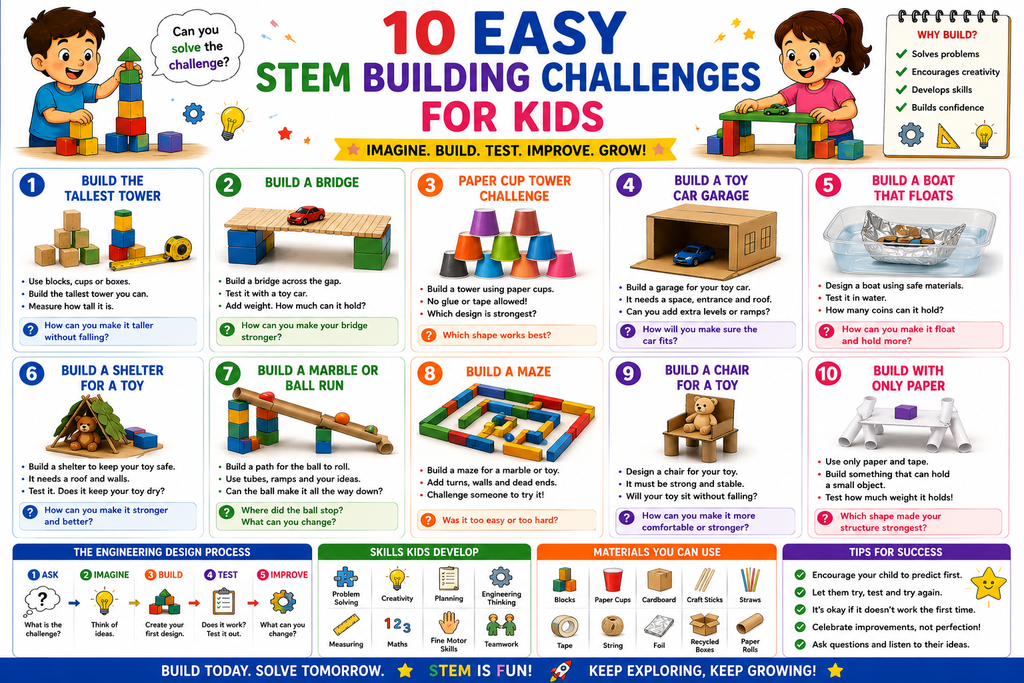
1. Build the Tallest Tower
Give children blocks, cups or cardboard boxes.
Challenge them:
“Can you build the tallest tower you can?”
Once finished, measure the tower.
Ask:
“How many blocks did you use?”
“What happens if the bottom is too narrow?”
“How could you make it taller without falling?”
Children may discover that a wider or stronger base makes a tower more stable.
2. Build a Bridge
Create two supports using books or blocks.
Ask children to build a bridge across the gap.
Try using:
- Cardboard
- Craft sticks
- Paper
- Blocks
Once the bridge is finished, test it with a toy car.
Ask:
“Can the car cross without the bridge falling?”
Then add small weights.
“How many blocks can your bridge hold?”
Children can strengthen the bridge and test again.
3. Paper Cup Tower Challenge
Give children a stack of paper or plastic cups.
Ask them to build a tower without using glue or tape.
Try different designs:
Straight tower
Pyramid
Wide base
Narrow base
Ask:
“Which design is strongest?”
For an extra challenge, see whether the structure can hold a small toy on top.
4. Build a Toy Car Garage
Give children cardboard, blocks or recycled boxes.
Challenge them to create a garage for a toy car.
The garage needs:
- A space large enough for the car
- An entrance
- A roof
Ask:
“How will you make sure the car fits?”
Children may need to measure or compare the car with their building materials.
Older children can add ramps, parking spaces or multiple levels.
5. Build a Boat That Floats
Provide materials such as:
- Foil
- Craft sticks
- Straws
- Cork
- Recycled containers
Ask children to build something that can float on water.
Test the boat.
If it floats, add counters or coins one at a time.
Ask:
“How much can your boat carry before it sinks?”
If the boat sinks immediately, encourage children to change the design.
6. Build a Shelter for a Toy
Choose a small toy animal or figure.
Challenge children:
“Can you build a shelter that keeps this toy safe?”
Use:
- Sticks
- Blocks
- Cardboard
- Leaves
- Fabric
- Recycled materials
The shelter might need:
A roof
Walls
An entrance
You can even test it by gently spraying water above the roof.
Ask:
“Did the toy stay dry?”
“How could we improve the roof?”
7. Build a Marble or Ball Run
Use cardboard tubes, folded paper or ramps.
Challenge children to create a pathway for a small ball.
The ball should travel from the top to the bottom without falling off.
Children can experiment with:
- Steep ramps
- Gentle ramps
- Curves
- Tunnels
- Drops
Ask:
“Where did the ball stop?”
“What can we change?”
This activity explores movement, gravity and problem-solving.
Use balls that are appropriate for the child’s age and supervise closely.
8. Build a Maze
Use blocks, craft sticks or cardboard strips.
Create a maze for:
- Toy car
- Ball
- Small toy animal
Start with a simple path.
Then add:
- Dead ends
- Corners
- Obstacles
Ask another child or adult to try the maze.
Then ask:
“Was it too easy or too difficult?”
Children can redesign it after watching someone use it.
9. Build a Chair for a Toy
Choose a teddy bear, doll or toy animal.
Tell children:
“Your toy needs a chair. Can you design one?”
Use cardboard, blocks or recycled materials.
The chair needs to support the toy without collapsing.
Ask:
“Does the toy fit?”
“Does the chair stay standing?”
“What could make it stronger?”
This is a great introduction to designing for a specific purpose.
10. Build With Only Paper
Give children several sheets of paper and tape.
Challenge them to create a structure that can hold a small object.
They may:
- Fold the paper
- Roll it into tubes
- Create triangles
- Stack shapes
Test how much weight the structure can hold.
Ask:
“Is flat paper stronger or folded paper?”
“What shape made your structure strongest?”
This demonstrates how changing the shape of a material can change its strength.
Use the Engineering Design Process
You can keep the engineering process very simple.
1. Ask
What are we trying to build?
2. Imagine
What could we make?
3. Build
Create the first design.
4. Test
See whether it works.
5. Improve
Change something and try again.
The final step is particularly important.
Children learn that a design not working the first time is an opportunity to improve it.
Ask Questions Instead of Giving the Answer
If a tower keeps falling, try not to immediately rebuild it for the child.
Ask:
“What do you notice?”
“Which part keeps falling?”
“What could make the bottom stronger?”
“What could you try differently?”
Questions encourage children to develop their own solutions.
Test How Strong It Is
Many building challenges can include a simple strength test.
For example:
Tower: Can it hold a toy?
Bridge: How many blocks can it carry?
Boat: How many coins can it hold?
Chair: Can the toy sit without falling?
Children can count or record the results.
Then challenge them:
“Can you improve your design so it holds one more?”
Add Measuring
Introduce maths by measuring finished creations.
You can measure:
- Height
- Length
- Width
- Distance
- Number of blocks
- Number of objects supported
Ask:
“Which tower is taller?”
“How long is your bridge?”
“How many cups did you use?”
This makes maths meaningful within the project.
Encourage Different Solutions
Two children may solve the same challenge completely differently.
One bridge may use blocks while another uses folded cardboard.
Both can be successful.
Avoid presenting one model as the only correct way to complete the activity.
Different solutions encourage creativity and flexible thinking.
Try Recycled Materials
Keep a small collection of clean recycled materials for STEM building.
You might save:
- Cereal boxes
- Paper tubes
- Small cardboard boxes
- Plastic lids
- Egg cartons
- Packaging
Before recycling an item, ask:
“Could we build something with this?”
This can also introduce conversations about reusing materials.
Skills Children Can Practise
STEM building challenges can support:
- Problem-solving
- Creativity
- Engineering thinking
- Planning
- Prediction
- Testing
- Measuring
- Counting
- Spatial awareness
- Fine motor skills
- Persistence
- Cooperation
- Communication
- Cause and effect
Let Children Work Together
Building challenges can also become team activities.
Children can discuss:
What should we build?
Who will do each part?
What materials should we use?
What should we change?
Working together encourages communication, negotiation and shared problem-solving.
Celebrate Improvements
The first design does not need to work.
A bridge might collapse.
A tower may fall.
A boat might sink.
Instead of focusing only on the result, talk about what changed between attempts.
You might say:
“Your first bridge held two blocks. After you changed it, it held six.”
That improvement is the learning.
Keep Learning With PlayPrintGrow
STEM building challenges give children something powerful: a problem they can solve with their own ideas.
Give them simple materials, ask an interesting question and allow time to build, test and change their designs.
Every tower that falls and every boat that sinks creates another opportunity to think:
“What should I try next?”
Imagine. Build. Test. Improve. Grow.