
Children experience lots of emotions every day, but they may not always have the words to explain what they are feeling.
Helping children recognise and name emotions can support communication, self-awareness, relationships and eventually their ability to choose helpful ways to respond.
These simple feelings and emotions activities for kids use play, art, stories and conversation to explore emotions in an age-appropriate way.
They are suitable for children around 3–8 years old and can be adapted for home, preschool, childcare or early primary settings.
Start With Simple Feeling Words
You don’t need to introduce lots of emotions at once.
Start with familiar feelings such as:
- Happy
- Sad
- Angry
- Worried
- Excited
- Scared
- Calm
- Tired
- Frustrated
- Proud
As children become more confident, you can introduce words such as:
Disappointed
Surprised
Nervous
Lonely
Confused
Embarrassed
The goal is not for children to memorise emotion words. It is to help them gradually connect words with their own experiences.
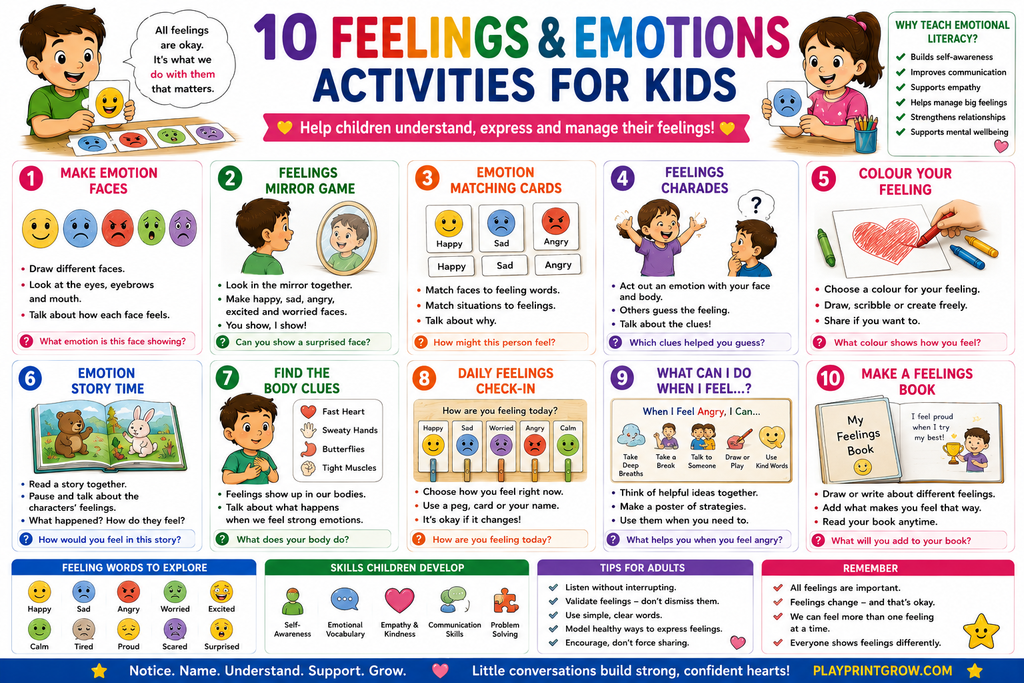
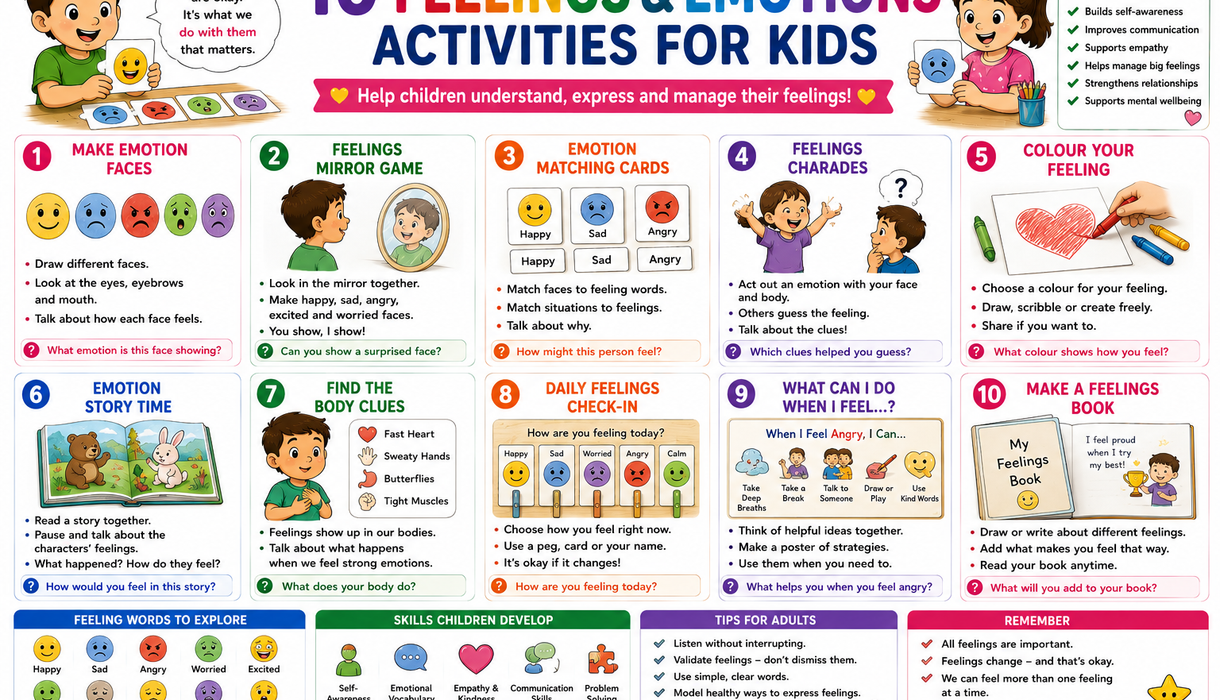
1. Make Emotion Faces
Draw several simple faces on paper.
Try:
Happy 🙂
Sad ☹️
Angry 😠
Surprised 😮
Worried 😟
Ask children to look at each face and guess the emotion.
Talk about clues such as:
“What do you notice about the eyebrows?”
“What is the mouth doing?”
“How do the eyes look?”
Then let children draw their own emotion faces.
2. Feelings Mirror Game
Sit with a child in front of a mirror.
Call out an emotion and make a matching facial expression.
Try:
“Show me a happy face.”
“Can you make a worried face?”
“What might an excited face look like?”
Children can also choose an emotion for you to copy.
This helps children notice how emotions can appear through facial expressions.
Remind them that people can show the same feeling in different ways.
3. Emotion Matching Cards
Create two sets of simple emotion cards.
One set might show facial expressions.
The other set shows the emotion word or another matching face.
Children match:
Happy → Happy
Sad → Sad
Angry → Angry
Older children can match situations to feelings.
For example:
“My friend invited me to play.” → Happy
“My tower fell down.” → Frustrated
There can sometimes be more than one reasonable answer, which makes a good conversation.
4. Feelings Charades
Write or draw different emotions on cards.
Take turns choosing one without showing anyone else.
Act out the emotion using only facial expressions and body movements.
Others guess:
“Are you excited?”
“Are you angry?”
“Are you nervous?”
After guessing, ask:
“What clues helped you know?”
This encourages children to notice body language as well as facial expressions.
5. Colour Your Feeling
Give children paper and drawing materials.
Ask:
“If your feeling had a colour today, what colour would it be?”
A child might choose:
Yellow for happy
Blue for sad
Red for angry
But there is no correct colour.
Let children choose whatever makes sense to them.
They can fill the page with:
- Lines
- Shapes
- Scribbles
- Pictures
- Patterns
Then ask whether they would like to tell you about their drawing.
Avoid assuming that one colour always means one emotion.
6. Emotion Story Time
While reading a children’s story, pause and talk about how the characters might be feeling.
Ask:
“How do you think she feels?”
“What happened that made him feel that way?”
“How would you feel in this situation?”
“What could the character do next?”
Stories are useful because children can talk about emotions through someone else’s experience rather than always talking directly about themselves.
7. Find the Body Clues
Feelings can also show up in the body.
Talk about simple body clues.
For example:
When someone feels nervous they might notice:
- Butterflies in their tummy
- Faster heartbeat
- Sweaty hands
When someone feels angry they might notice:
- Tight fists
- Hot face
- Fast breathing
- Tense body
When someone feels calm they might notice:
- Slower breathing
- Relaxed hands
- Soft shoulders
Ask:
“What does your body feel like when you’re excited?”
This can help children begin noticing their own internal signals.
8. Daily Feelings Check-In
Create a simple feelings chart.
Include a few choices such as:
🙂 Happy
😢 Sad
😠 Angry
😟 Worried
😄 Excited
😌 Calm
Ask:
“How are you feeling right now?”
Children can:
- Point
- Move a peg
- Place their name beside a feeling
- Choose a card
- Draw their own face
A feelings check-in should be an invitation, not a requirement to explain.
Sometimes a child may simply choose a feeling and move on.
9. What Can I Do When I Feel…?
Choose one emotion.
For example:
“What can I do when I feel frustrated?”
Talk about safe, practical options.
Children might suggest:
- Ask for help
- Take a break
- Take slow breaths
- Get a drink of water
- Sit somewhere quiet
- Draw
- Squeeze playdough
- Talk to an adult
- Try again later
You can create a simple poster:
When I Feel Angry, I Can…
Stop
Take some space
Breathe
Ask for help
Use words
The aim is to build a collection of possible strategies rather than telling children one method must work every time.
10. Make a Feelings Book
Give children several sheets of paper.
Create one page for each feeling.
For example:
I Feel Happy When…
The child can draw something that makes them happy.
I Feel Sad When…
Draw something that may make them sad.
I Feel Proud When…
Draw something they have achieved.
When I Feel Worried, I Can…
Draw someone they can talk to or something they like to do.
Staple the pages together to create a personal Feelings Book.
Children can return to it later and add more emotions.
All Feelings Are Okay
Children may sometimes hear emotions described as:
Good feelings
and
Bad feelings
It can be more helpful to explain that all emotions give us information.
Feeling angry, disappointed, scared or sad is not wrong.
What matters is how we respond.
You might say:
“It’s okay to feel angry. We still need to keep ourselves and other people safe.”
This helps separate the emotion from the behaviour.
Avoid Guessing a Child’s Feeling
Instead of saying:
“You’re angry.”
try:
“I noticed your voice got louder and your hands are tight. I wonder if you’re feeling angry or frustrated?”
This leaves room for the child to tell you what they are actually experiencing.
Children do not always feel what adults assume they feel.
Build Emotional Vocabulary
As children get older, introduce more specific words.
Instead of only:
Sad
you might explore:
Disappointed
Lonely
Upset
Instead of only:
Happy
you might use:
Excited
Proud
Content
Relieved
More specific words can help children communicate their experiences more clearly.
Talk About Mixed Feelings
Children can experience more than one emotion at the same time.
For example:
A child starting school may feel:
Excited AND nervous
A child moving house may feel:
Happy AND sad
You can say:
“Sometimes we can have two feelings at the same time.”
This helps children understand that emotions are not always simple.
Model Emotion Language
Adults can model healthy ways to talk about feelings.
For example:
“I’m feeling frustrated because this isn’t working. I’m going to try again slowly.”
or:
“I was nervous before the meeting, but now I feel relieved.”
Children learn a lot by hearing adults describe emotions calmly and appropriately.
Ask Open-Ended Questions
Try:
“How do you think they feel?”
“What makes you think that?”
“Have you ever felt that way?”
“What might help?”
“What could they say?”
Avoid pressuring children to answer personal questions if they don’t want to.
Skills Children Can Practise
Feelings and emotions activities can support:
- Emotional vocabulary
- Self-awareness
- Recognising facial expressions
- Body awareness
- Communication
- Empathy
- Perspective-taking
- Problem-solving
- Self-regulation
- Confidence
- Relationship skills
- Listening
Make Emotional Learning Part of Everyday Life
You don’t need a dedicated lesson every day.
Use natural moments.
For example:
“You look really proud of that tower.”
“Your friend seems disappointed that the game finished.”
“You were nervous at first, but you kept trying.”
These everyday conversations help children gradually understand emotions in real situations.
Keep Learning With PlayPrintGrow
Understanding emotions develops over time.
Children need repeated opportunities to notice feelings, hear emotion words, talk about experiences and discover strategies that work for them.
Keep conversations simple, listen carefully and remind children that every feeling can be talked about.
Feel. Notice. Talk. Grow.