
Kindness is something children learn through everyday experiences.
Sharing a toy, helping someone who has dropped something, including another child in a game or simply saying thank you can all become opportunities to practise caring for others.
Kindness activities don’t need to involve rewards or big gestures. The aim is to help children notice other people’s needs and understand that their own actions can positively affect someone else.
These activities are suitable for children around 3–10 years old and can be adapted for home, preschool, childcare or school.
What Does Kindness Mean?
You can explain kindness simply:
“Kindness means doing or saying something that helps another person feel cared for, included or respected.”
Examples might include:
- Helping someone
- Sharing
- Listening
- Using friendly words
- Including others
- Saying thank you
- Taking care of animals
- Caring for the environment
- Comforting someone
- Celebrating another person’s success
Children learn kindness best when they see it happening in real situations.
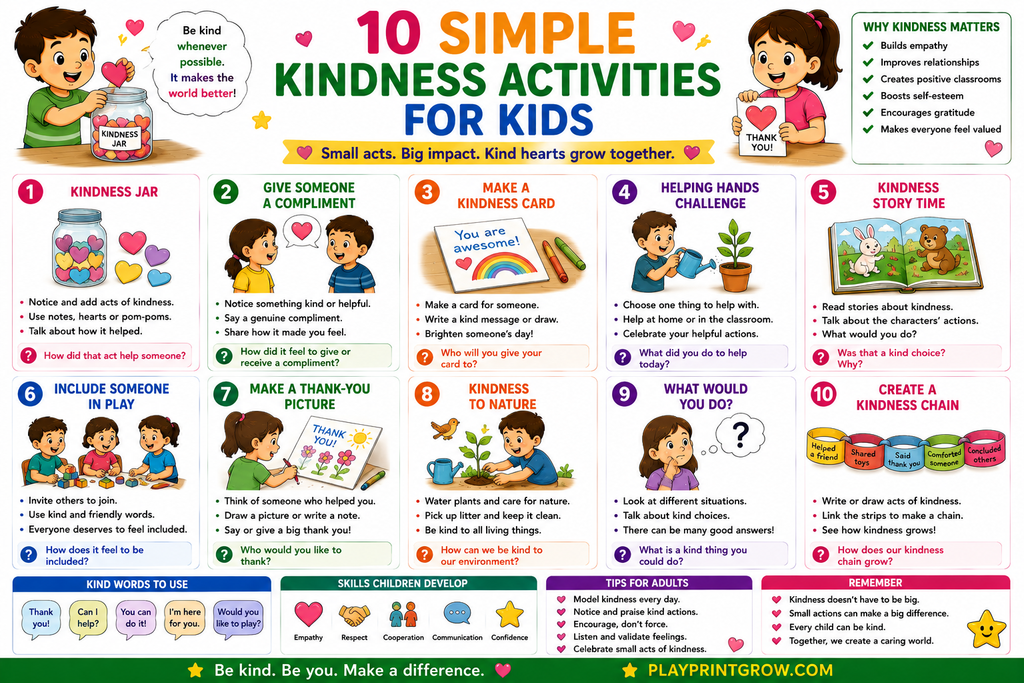
1. Kindness Jar
Find a jar or container and label it:
Our Kindness Jar
Whenever someone notices an act of kindness, add a paper heart, pom-pom or note to the jar.
Examples:
“Mia helped put the blocks away.”
“Sam invited someone to play.”
“Leo helped his sister find her shoes.”
Talk about the actions rather than turning the jar into a competition.
Ask:
“How did that help someone?”
The jar becomes a visual reminder that small acts of kindness happen throughout the day.
2. Give Someone a Compliment
Talk about what a genuine compliment means.
Instead of only focusing on appearance, encourage children to notice actions and qualities.
Try:
“You worked really hard on that.”
“You were helpful today.”
“I like how you included everyone.”
“You made me laugh.”
Children can practise giving one another compliments.
Ask:
“How did it feel when someone said something kind to you?”
This can support positive communication and help children notice strengths in others.
3. Make a Kindness Card
Provide paper, crayons and stickers.
Ask children to create a card for someone.
It could be for:
- Parent
- Grandparent
- Friend
- Teacher
- Neighbour
- Sibling
Older children can write a short message.
For example:
“Thank you for helping me.”
“I like playing with you.”
“You make me smile.”
Younger children can draw a picture instead.
The important part is thinking about another person while creating it.
4. Helping Hands Challenge
Ask children:
“What is one thing you could do to help someone today?”
Ideas might include:
- Put toys away
- Carry something
- Help set the table
- Hold the door
- Help a younger child
- Water a plant
- Pick up something someone dropped
At the end of the day, talk about what happened.
Ask:
“Who did you help?”
“What did you do?”
“How do you think it made things easier for them?”
Keep the focus on helping rather than earning a prize.
5. Kindness Story Time
Choose a story where characters help, share, include or care for someone else.
Pause while reading and ask:
“Was that a kind choice?”
“How do you think the character felt?”
“What else could they have done?”
“What would you do?”
Stories let children explore social situations without needing to talk directly about their own experiences.
You can also discuss moments when a character could have made a kinder choice.
6. Include Someone in Play
Talk about how it feels to be left out.
Practise simple phrases children can use:
“Would you like to play with us?”
“You can have a turn next.”
“Do you want to build with me?”
Turn it into role-play.
One person pretends to be playing while another asks to join.
Practise different responses.
This helps children develop language they can use during real social situations.
7. Make a Thank-You Picture
Ask children to think of someone who has helped them.
It might be:
- Family member
- Educator
- Friend
- Coach
- Doctor
- Delivery driver
- Community worker
Make a drawing or simple thank-you note.
Ask:
“What did this person do for you?”
“How could we let them know we appreciate it?”
This introduces gratitude in a concrete way.
8. Kindness to Nature
Kindness doesn’t need to apply only to people.
Talk about caring for animals and the environment.
Children can:
- Water plants
- Pick up litter with appropriate supervision
- Leave insects undisturbed
- Refill a bird-water container where appropriate
- Care for classroom plants
- Put rubbish in the bin
- Avoid damaging living plants
Ask:
“How can we be kind to our environment?”
This connects social-emotional learning with environmental responsibility.
9. What Would You Do?
Give children simple social scenarios.
For example:
“Someone dropped all their pencils. What could you do?”
“A child is sitting alone. What could you say?”
“Your friend lost a game and feels disappointed. What might help?”
“Someone doesn’t have enough blocks to finish their tower. What could you do?”
Let children suggest different possibilities.
There does not always need to be only one correct answer.
The activity encourages perspective-taking and problem-solving.
10. Create a Kindness Chain
Cut strips of coloured paper.
Each time someone notices or completes an act of kindness, write or draw it on a strip.
Examples:
Helped a friend
Shared the crayons
Said thank you
Comforted someone
Included someone
Join the strips together to make a paper chain.
Over time, children can see the chain grow.
You can say:
“Every link represents one way someone helped make our group a caring place.”
Talk About How Kindness Feels
Ask children to think about both sides of a kind action.
How does it feel when somebody helps you?
How does it feel when you help somebody?
Children might say:
Happy
Proud
Safe
Included
Cared for
They may also respond differently, and that’s okay.
The conversation helps connect actions with their impact on others.
Kindness Doesn’t Always Mean Sharing Everything
Children sometimes hear:
“You have to share because sharing is kind.”
But kindness can also involve respecting another person’s belongings and boundaries.
Instead of forcing immediate sharing, children can practise:
“I’m using this right now. You can have it when I’m finished.”
or:
“Would you like this other toy while you wait?”
This helps children learn both kindness and respectful communication.
Teach Kind Words
Practise useful phrases such as:
Please
Thank you
Can I help?
Are you okay?
Would you like to play?
You can have a turn next.
I’m sorry.
What can I do to help?
Children are more likely to use helpful language when they have heard and practised it before needing it in a difficult moment.
Notice Kindness Naturally
When you see kindness, describe what happened.
Instead of only saying:
“Good job!”
try:
“You noticed that she needed help carrying those blocks and you helped her.”
or:
“You moved over so your friend had somewhere to sit.”
This helps children understand exactly which behaviour was helpful.
Model Kindness
Children learn a lot by watching adults.
Model:
- Saying thank you
- Apologising
- Helping others
- Listening
- Waiting
- Speaking respectfully
- Caring for shared spaces
You might say:
“I accidentally interrupted you. I’m sorry. Please finish what you were saying.”
This shows children what respectful behaviour looks like in real situations.
Talk About Empathy
Empathy means trying to understand how another person may be feeling.
Keep it simple.
Ask:
“How do you think they might feel?”
Then:
“What could we do that might help?”
For example:
“She looks disappointed because her tower fell down. Maybe we could ask if she wants help rebuilding it.”
Avoid assuming exactly how another person feels. Children can learn to ask rather than guess.
Kindness Can Be Small
Children don’t need to perform grand acts.
Kindness might simply be:
- Smiling at someone
- Moving over to make space
- Returning something
- Waiting patiently
- Saying someone’s name correctly
- Asking before taking something
- Helping clean up
- Listening when someone speaks
Small everyday behaviours build positive relationships over time.
Skills Children Can Practise
Kindness activities can support:
- Empathy
- Communication
- Cooperation
- Perspective-taking
- Gratitude
- Friendship skills
- Problem-solving
- Listening
- Turn-taking
- Respect
- Emotional awareness
- Community connection
Keep Kindness Genuine
Try not to turn every kind action into a reward.
If children always receive stickers or prizes for helping, kindness can begin to feel like something done only to receive something back.
Instead, talk about the impact:
“You helped him find his hat. Now he can go outside with everyone.”
This helps children understand why the action mattered.
Keep Learning With PlayPrintGrow
Kindness develops through lots of small everyday interactions.
Children learn it when they see adults model respect, practise helpful language and have opportunities to notice how their actions affect others.
Make kindness something children experience and practise, not simply a rule they are told to follow.
Notice. Help. Include. Grow.