
Confidence grows when children have opportunities to try things, make choices, solve problems and notice their own progress.
It does not mean children need to feel brave or successful all the time.
A confident child can still feel nervous, frustrated or unsure. What matters is gradually developing the belief:
“I can try.”
“I can learn.”
“I can ask for help.”
“I can keep going.”
These simple confidence-building activities are suitable for children around 4–10 years old and can be adapted for home, preschool, childcare or school.
What Does Confidence Mean?
You can explain confidence simply:
“Confidence means believing that you can have a go, learn and handle challenges.”
Confidence is not about being the best.
It can look like:
- Trying something new
- Asking a question
- Speaking in front of others
- Making a choice
- Doing something independently
- Asking for help
- Trying again after a mistake
- Sharing an idea
- Celebrating progress
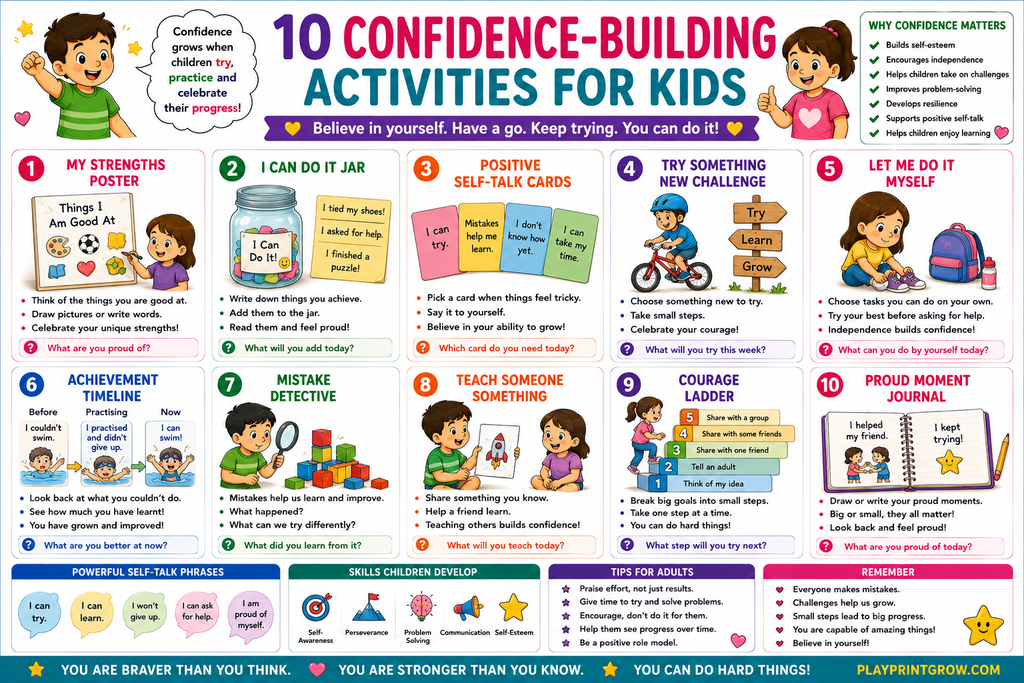
1. My Strengths Poster
Give children a sheet of paper and write:
Things I Am Good At
Help them think of their strengths.
Examples might include:
- Drawing
- Running
- Building
- Helping
- Making people laugh
- Looking after animals
- Trying hard
- Being a good listener
- Remembering things
- Sharing ideas
Children can draw pictures or write words.
Ask:
“What is something you are proud of?”
“What is something you have learned to do?”
Remind them that strengths are not only academic or sporting skills.
Kindness, patience and creativity are strengths too.
2. I Can Do It Jar
Create a jar labelled:
I Can Do It!
Whenever a child learns something, completes a challenge or does something independently, write it on a small piece of paper.
Examples:
“I tied my shoes.”
“I asked for help.”
“I finished a hard puzzle.”
“I tried swimming.”
“I spoke in front of the class.”
Read the notes occasionally.
This helps children notice how many things they have learned over time.
3. Positive Self-Talk Cards
Create simple cards with encouraging phrases.
Try:
I can try.
I can ask for help.
Mistakes help me learn.
I don’t know how yet.
I can take my time.
I am learning.
Choose one card before a challenging activity.
Instead of asking children to repeat phrases they do not believe, talk about when the statement might be useful.
For example:
“You haven’t done this before. Which card could help?”
4. Try Something New Challenge
Choose a small new experience.
It might be:
- Trying a new food
- Drawing something different
- Joining a new game
- Climbing a different part of the playground
- Learning a new craft
- Asking someone a question
- Trying a new puzzle
Afterwards, ask:
“How did you feel before you tried?”
“How did you feel afterwards?”
“What helped you give it a go?”
The goal is not to pressure children into uncomfortable situations.
Choose manageable challenges and allow them to say no.
5. Let Me Do It Myself
Choose everyday jobs children can complete independently.
Examples:
- Packing their bag
- Pouring water
- Putting shoes on
- Setting the table
- Choosing clothes
- Feeding a pet with supervision
- Putting toys away
- Preparing a simple snack
Adults can step in when needed, but try giving children time to attempt the task first.
You might say:
“Have a try and let me know if you need help.”
Completing meaningful tasks can help children develop confidence in their abilities.
6. Achievement Timeline
Talk about things the child could not do when they were younger but can do now.
Draw a simple timeline.
For example:
Then: I couldn’t ride a bike.
Practised: I learned to balance.
Now: I can ride.
Other examples might include:
- Writing their name
- Swimming
- Cutting with scissors
- Reading
- Dressing themselves
- Building difficult LEGO sets
This helps children see that abilities develop through time and practice.
7. Mistake Detective
Talk about mistakes as information.
Choose a simple task such as building a tower or completing a puzzle.
If something goes wrong, ask:
“What happened?”
“What did we learn?”
“What could we change?”
Turn children into Mistake Detectives who look for clues about how to improve.
For example:
“The tower fell because the bottom was narrow. What could make it stronger?”
This can help children become less afraid of getting things wrong.
8. Teach Someone Something
Invite children to teach another person something they know.
They might teach:
- How to draw a cat
- How to build a tower
- How to play a game
- How to make a paper plane
- How to count to ten
- How to care for a plant
Being the person with knowledge can help children notice their own skills.
Ask:
“What did you teach?”
“What helped you explain it?”
9. Courage Ladder
Choose something the child wants to become more comfortable doing.
Create several small steps.
For example, if speaking to a group feels difficult:
Step 1: Tell an adult your idea.
Step 2: Tell one friend.
Step 3: Tell two friends.
Step 4: Share with a small group.
Step 5: Share with the whole group if ready.
Each step should feel achievable.
Children can move at their own pace rather than being pushed to the top.
10. Proud Moment Journal
Create a simple journal called:
Things I’m Proud Of
Children can draw or write one thing whenever they feel proud.
It could be:
“I helped my friend.”
“I kept trying.”
“I made my own lunch.”
“I read a whole page.”
“I was nervous but I joined in.”
Encourage children to focus on effort and growth, not only achievements.
Praise Effort Specifically
Instead of saying only:
“You’re so clever!”
try describing what the child actually did.
For example:
“You kept trying different pieces until the puzzle worked.”
“You practised that word several times.”
“You asked for help when you needed it.”
Specific feedback helps children understand which actions contributed to their progress.
Use the Power of “Yet”
When a child says:
“I can’t do it.”
You might add:
“You can’t do it yet.”
Then ask:
“What could help you learn?”
The word yet reminds children that skills can develop over time.
Avoid using it to dismiss genuine frustration. Sometimes children also need a break or support.
Let Children Make Choices
Small choices can support independence and confidence.
Try:
“Would you like the blue paper or green paper?”
“Which activity would you like to start with?”
“Would you like to try by yourself first or together?”
Children do not need to make every decision, but regular opportunities to choose can help them develop confidence in their own thinking.
Don’t Rush to Rescue
When a child encounters a manageable problem, give them a little time before solving it for them.
Instead of immediately fixing it, ask:
“What have you tried?”
“What else could work?”
“Would you like a hint or some help?”
This supports problem-solving while also letting children know that help is available.
Talk About Progress
Confidence can grow when children notice improvement.
Compare:
“Last week you needed help cutting the shape. Today you did most of it by yourself.”
or:
“You used to stop after one try. Today you tried three different ways.”
Focus on progress rather than comparing children with one another.
Avoid Comparing Children
Statements such as:
“Look how quickly your brother did it.”
can make confidence dependent on being better than someone else.
Instead, compare the child with their own earlier progress.
Ask:
“What can you do now that used to be difficult?”
This keeps the focus on personal growth.
Confidence and Asking for Help
Confidence does not mean doing everything alone.
Knowing when to ask for help is also an important skill.
Teach phrases such as:
“Can you show me?”
“Can you help me get started?”
“I tried this, but I’m stuck.”
“Can we do the first part together?”
Children can learn that asking for support is part of solving a problem.
Skills Children Can Practise
Confidence-building activities can support:
- Independence
- Positive self-talk
- Problem-solving
- Resilience
- Decision-making
- Self-awareness
- Communication
- Persistence
- Growth mindset
- Emotional awareness
- Responsibility
- Willingness to try
- Pride in progress
Model Confidence Without Pretending Everything Is Easy
Adults can model realistic self-talk too.
For example:
“I’ve never done this before, so I’ll need to work it out.”
or:
“I made a mistake. I’ll try a different way.”
or:
“I’m a little nervous, but I’m still going to give it a try.”
This shows children that confidence can exist alongside uncertainty.
Keep Learning With PlayPrintGrow
Confidence develops through many small moments of trying, learning, choosing and succeeding.
Give children opportunities to do meaningful things for themselves, support them when they need help and celebrate the progress they make along the way.
They don’t need to believe:
“I can do everything.”
A much stronger message is:
“I can learn, try and grow.”
Try. Learn. Believe. Grow.