
Friendships give children opportunities to practise communication, cooperation, empathy, problem-solving and understanding other people’s feelings.
Young children are still learning how to join play, share space, take turns and work through disagreements.
Friendship skills develop gradually through repeated experiences rather than simply telling children to “be a good friend.”
These activities are suitable for children around 3–8 years old and can be used at home, preschool, childcare or early primary school.
What Makes a Good Friend?
Start by asking children:
“What do you think a good friend does?”
They might suggest:
- Plays together
- Listens
- Helps
- Shares sometimes
- Takes turns
- Uses kind words
- Includes others
- Says sorry
- Respects other people’s things
- Celebrates others
Explain that friends don’t always agree or want to do the same thing.
Friendship also involves learning how to communicate when things are difficult.
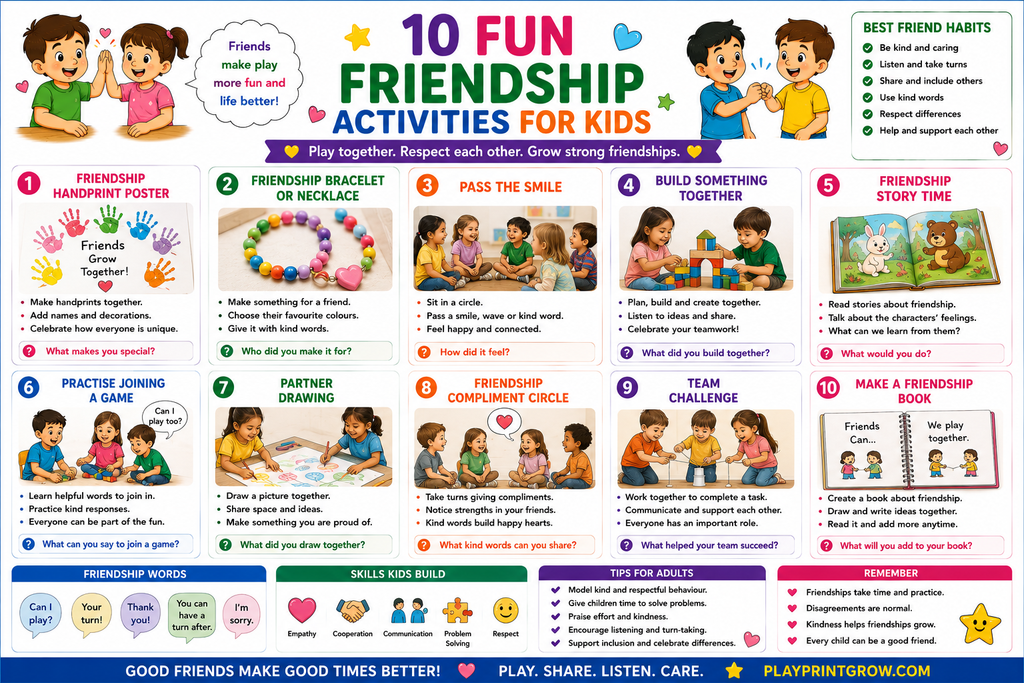
1. Friendship Handprint Poster
Give children paper and washable paint.
Each child makes a handprint.
Write their names underneath.
Add a heading such as:
“Friends Grow Together”
Talk about how every handprint looks different, just like every person in the group.
Ask:
“What makes each of us special?”
The finished poster can become a classroom or family friendship display.
2. Friendship Bracelet or Necklace
Provide large beads, pasta or other age-appropriate threading materials.
Children can create something for a friend.
Encourage them to think about the other person’s preferences.
Ask:
“What colour do you think your friend would like?”
“Why did you choose that one?”
The activity combines fine motor skills with thinking about another person.
Avoid making gift-giving compulsory. Children can also make one for themselves.
3. Pass the Smile
Sit in a circle.
One person smiles at the person beside them.
That child “passes” the smile to the next person.
Continue around the circle.
Try other friendly actions:
Wave
Thumbs up
High five
Funny face
Kind word
This simple activity encourages eye contact, attention and group connection without competition.
4. Build Something Together
Give two or more children blocks or construction materials.
Set a shared challenge:
“Can you build one tower together?”
or:
“Can you make a house big enough for three toy animals?”
Children need to discuss:
- What to build
- Which pieces to use
- Who will do each part
- What to change if it falls
Adults can support with questions instead of taking over.
Ask:
“How can you both use the blocks?”
“What idea could you try together?”
5. Friendship Story Time
Choose a book involving friendship, inclusion or cooperation.
Pause during the story and ask:
“What happened between the friends?”
“How do you think they felt?”
“What could they say?”
“What could they do differently?”
Stories help children think about social situations from a little distance.
You can also talk about moments when characters disagree.
Healthy friendships don’t require people to agree all the time.
6. Practise Joining a Game
Joining play can be difficult for young children.
Role-play simple phrases such as:
“Can I play too?”
“What are you building?”
“Can I help?”
“Can I be the shopkeeper?”
Also practise responses:
“Yes, you can help us build.”
or:
“We’re using these pieces right now, but you can use these ones.”
Role-play gives children useful words before they need them in a real situation.
7. Partner Drawing
Give two children one large sheet of paper.
Ask them to create a picture together.
They might draw:
- A garden
- A town
- An ocean
- A playground
- An imaginary world
Children need to share space and communicate about what they want to add.
Ask:
“Where could your friend draw?”
“How can both ideas fit into the picture?”
The goal isn’t a perfect drawing. It is practising cooperation.
8. Friendship Compliment Circle
Sit together in a small group.
Take turns saying something positive about another person.
Encourage compliments about actions and qualities.
Examples:
“You helped me today.”
“You make funny jokes.”
“You are good at building.”
“I like playing outside with you.”
Avoid forcing children to participate if they don’t feel comfortable.
Adults can model genuine compliments first.
9. Team Challenge
Create a challenge that requires children to work together.
Try:
Move five balls from one container to another together.
Build a bridge that holds a toy.
Carry a large box together.
Complete a simple puzzle as a team.
Afterwards, ask:
“What helped your team?”
“Did you have different ideas?”
“How did you decide what to do?”
This introduces teamwork and shared problem-solving.
10. Make a Friendship Book
Create a simple book together.
Each page can answer a prompt such as:
Friends Can…
Help each other
Friends Say…
Would you like to play?
Friends Can Feel…
Happy, sad, angry, excited or worried
When Friends Disagree…
We can talk, listen and find another idea
Children can draw pictures for each page.
Keep the book somewhere accessible and revisit it during social situations.
Practise Turn-Taking
Turn-taking is an important friendship skill, but young children may find waiting difficult.
Use short games where turns happen quickly.
Try:
- Rolling a ball
- Building one block at a time
- Simple board games
- Taking turns adding pieces to a puzzle
Use clear language:
“Your turn.”
“My turn.”
“Then your turn again.”
Visual cues can also help children understand when their turn is coming.
Sharing Doesn’t Mean Giving Everything Up
Children are often told:
“You need to share.”
But sharing can mean different things.
A child might say:
“I’m still using this. You can have it when I’m finished.”
or:
“You can use these blocks while I use these ones.”
Friendship also involves respecting boundaries and other people’s belongings.
Help Children Solve Small Conflicts
Disagreements are a normal part of friendship.
Instead of solving every disagreement immediately, help children practise simple steps.
Stop
Give everyone space to speak.
Say What Happened
“I was using the truck.”
Listen
Let the other child explain.
Think of Ideas
Take turns
Use another toy
Play together
Set a timer
Choose Something to Try
The solution doesn’t always need to make everyone completely happy, but it should be respectful and safe.
Teach Useful Friendship Phrases
Children often know what they want but don’t yet know how to say it.
Practise phrases such as:
“Can I play?”
“Can I have a turn when you’re finished?”
“Please stop. I don’t like that.”
“Can we do it together?”
“I’m still using this.”
“Are you okay?”
“Can I help?”
“I’m sorry.”
Having useful language available can make social situations easier to manage.
Talk About Personal Space
Friendship doesn’t mean children always need physical contact.
Teach children to notice and respect personal space.
They can ask:
“Can I give you a hug?”
A friend may say yes or no.
Both answers are okay.
This helps children understand that caring relationships also involve respecting boundaries.
Friends Can Like Different Things
One child may love dinosaurs while another loves drawing.
One may enjoy running while another prefers quiet play.
Talk about how friends can have different:
- Interests
- Ideas
- Feelings
- Families
- Abilities
- Preferences
Ask:
“What do you and your friend both like?”
Then:
“What do you like that is different?”
Differences don’t prevent friendship.
Notice Positive Friendship Moments
When you see helpful social behaviour, describe it clearly.
Instead of:
“Good sharing!”
try:
“You finished with the truck and remembered that Maya was waiting for a turn.”
Or:
“You noticed he didn’t have anywhere to sit and moved over.”
Specific feedback helps children understand what made the interaction positive.
Skills Children Can Practise
Friendship activities can support:
- Communication
- Cooperation
- Empathy
- Sharing
- Turn-taking
- Listening
- Problem-solving
- Perspective-taking
- Confidence
- Respecting boundaries
- Conflict resolution
- Teamwork
- Emotional awareness
Adults Can Model Friendship Skills Too
Children learn from how adults communicate.
Model:
Listening without interrupting
Asking before borrowing
Apologising when needed
Respecting someone’s answer
Helping others
Handling disagreements calmly
For example:
“I misunderstood what you meant. Thanks for explaining it to me.”
Seeing adults repair relationships is valuable social learning.
Keep Learning With PlayPrintGrow
Friendship skills grow through everyday moments—building together, waiting for a turn, joining a game, disagreeing, listening and trying again.
Give children useful language, opportunities to cooperate and support when social situations become difficult.
Friendships don’t have to be perfect to be meaningful.
Connect. Listen. Cooperate. Grow.