
Science for young children doesn’t need complicated equipment or difficult explanations.
Some of the best early science experiences happen when children can predict what might happen, test an idea and observe the result.
These easy science experiments use mostly everyday materials and are suitable for children around 3–8 years old with adult supervision.
Before You Begin
Encourage children to think like little scientists.
Before each experiment, ask:
“What do you think will happen?”
Afterwards, ask:
“What did you notice?”
“Was your prediction correct?”
“Why do you think that happened?”
The goal isn’t always to know the correct answer immediately. Asking questions, testing ideas and noticing changes are important parts of scientific thinking.
Safety First
Adults should supervise all experiments. Use child-safe materials, keep experiment materials away from mouths and eyes, and do not allow children to taste or drink anything used in an experiment.
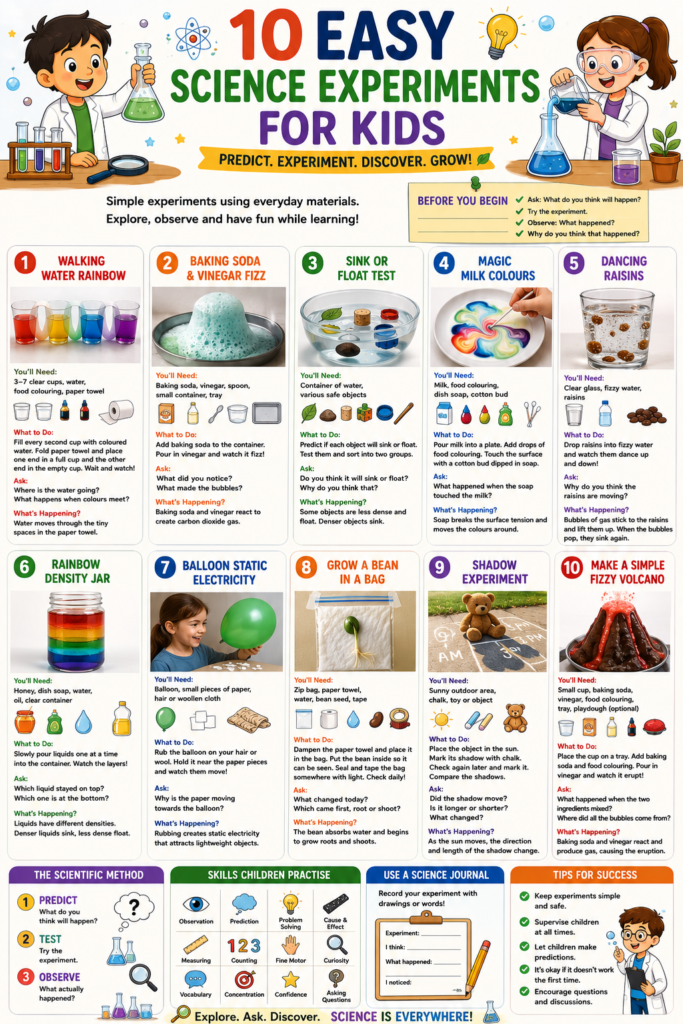
1. Walking Water Rainbow 🌈
This colourful experiment shows how water can travel through paper towel.
You’ll Need
- 3–7 clear cups
- Water
- Food colouring
- Paper towel
What to Do
Place the cups next to each other.
Fill every second cup about halfway with water.
Add different food colours to the water-filled cups.
Fold strips of paper towel and place one end in a cup with water and the other end in the empty cup beside it.
Wait and observe.
Over time, the coloured water will begin travelling through the paper towel and into the empty cups.
Ask
“Where is the water going?”
“What happens when two colours meet?”
What’s Happening?
Water can move through the tiny spaces in the paper towel. This process is related to capillary action.
2. Baking Soda and Vinegar Fizz 🫧
This classic experiment creates an exciting bubbly reaction.
You’ll Need
- Small container
- Baking soda
- Vinegar
- Spoon
- Tray
What to Do
Place the container on a tray.
Add a few spoonfuls of baking soda.
Slowly pour in some vinegar.
Watch what happens.
The mixture should quickly begin fizzing and bubbling.
Ask
“What did you notice?”
“Did the mixture stay the same?”
“What do you think made the bubbles?”
What’s Happening?
When baking soda and vinegar combine, they create a chemical reaction that produces carbon dioxide gas.
The gas forms the bubbles you can see.
3. Sink or Float Experiment 🚢
Which objects stay on top of water and which ones sink?
You’ll Need
- Container of shallow water
- Leaf
- Stone
- Plastic spoon
- Cork
- Toy
- Bottle cap
- Stick
What to Do
Choose one object.
Before putting it into the water, ask:
“Do you think it will sink or float?”
Test it.
Separate the objects into two groups:
SINK
and
FLOAT
Extend the Activity
Ask children whether a large object always sinks or whether a small object always floats.
They may discover that size alone doesn’t determine what happens.
4. Magic Milk Colours 🎨
Watch colours move and swirl across the surface of milk.
You’ll Need
- Shallow plate
- Milk
- Food colouring
- Dishwashing liquid
- Cotton bud
What to Do
Pour a small amount of milk onto the plate.
Add several drops of food colouring.
Dip a cotton bud into a little dishwashing liquid.
Touch the cotton bud gently to the surface of the milk.
Watch the colours move.
Ask
“What happened when the soap touched the milk?”
“Which direction did the colours move?”
What’s Happening?
Dishwashing liquid interacts with the fats and other molecules in the milk, causing movement that pushes the colours around.
5. Dancing Raisins 💃
Can raisins move up and down by themselves?
You’ll Need
- Clear glass
- Fizzy water
- A few raisins
What to Do
Fill the glass with fizzy water.
Drop several raisins into the glass.
Watch closely.
After a while, some raisins may rise towards the top and then fall again.
Ask
“Why do you think the raisins are moving?”
“What can you see attached to them?”
What’s Happening?
Tiny carbon dioxide bubbles attach to the raisins.
The bubbles help lift them upwards. When the bubbles pop at the surface, the raisins can fall again.
6. Rainbow Density Jar 🌈
Explore how some liquids can form layers.
You’ll Need
- Honey
- Dishwashing liquid
- Water
- Vegetable oil
- Clear container
What to Do
With adult help, slowly pour the liquids into the container one at a time.
Pour carefully so the layers aren’t mixed too much.
Watch where each liquid settles.
Ask
“Which liquid stayed at the bottom?”
“Which one stayed near the top?”
“Why didn’t they all stay in the same place?”
What’s Happening?
Different liquids can have different densities.
Denser liquids tend to settle underneath less-dense liquids.
7. Balloon Static Electricity 🎈
Can a balloon make tiny pieces of paper move without touching them?
You’ll Need
- Balloon
- Small pieces of paper
- Hair or a woollen cloth
What to Do
Blow up the balloon and tie it securely.
Rub the balloon gently against dry hair or wool.
Hold it close to the small pieces of paper without touching them.
Watch what happens.
You can also carefully hold the balloon near your hair.
Ask
“Why is the paper moving towards the balloon?”
What’s Happening?
Rubbing the balloon can create static electricity.
This electrical charge can attract lightweight objects.
8. Grow a Bean in a Bag 🌱
Watch a seed begin its journey into a plant.
You’ll Need
- Clear zip bag
- Paper towel
- Water
- Bean seed
- Tape
What to Do
Dampen the paper towel.
Place it inside the clear bag.
Put a bean between the paper towel and the side of the bag so it can be seen.
Seal the bag and place it somewhere with suitable light.
Check it every day.
Look For
- Seed swelling
- Root appearing
- Shoot growing
- First leaves
Ask
“What changed today?”
“Which appeared first—the root or the shoot?”
Children can draw what they see each day.
9. Shadow Experiment ☀️
Do shadows stay in the same place all day?
You’ll Need
- Sunny outdoor area
- Chalk
- A toy or upright object
What to Do
Place the object outside in the sunlight.
Use chalk to mark where its shadow falls.
Return later and check again.
Trace the new shadow.
Compare the two.
Ask
“Did the shadow move?”
“Is it longer or shorter now?”
“What changed?”
What’s Happening?
As Earth’s position relative to the Sun changes throughout the day, the direction and length of shadows can change too.
10. Make a Simple Fizzy Volcano 🌋
Create a small pretend volcanic eruption.
You’ll Need
- Small cup or bottle
- Tray
- Baking soda
- Vinegar
- Optional food colouring
- Optional playdough or sand
What to Do
Place the cup on a tray.
Build a volcano shape around it if you like.
Add baking soda to the cup.
Add a few drops of food colouring if desired.
Slowly pour in vinegar.
Watch the eruption.
Ask
“What happened when the two ingredients mixed?”
“Where did all the bubbles come from?”
What’s Happening?
Baking soda and vinegar react and produce carbon dioxide gas.
The bubbles push the liquid upwards, creating the pretend eruption.
Use the Predict → Test → Observe Method
You can use three simple steps with almost every children’s science activity.
1. Predict
Ask:
“What do you think will happen?”
2. Test
Let the child safely try the experiment.
3. Observe
Ask:
“What actually happened?”
Children don’t need to make the correct prediction. Changing their ideas after observing evidence is part of learning science.
Start a Little Scientist Journal
Older children can record their experiments.
A simple page might include:
Experiment: __________
I think: __________
What happened: __________
I noticed: __________
They can also draw pictures instead of writing.
Science Words to Introduce
Predict – what you think might happen
Observe – look carefully at what happens
Experiment – a test used to explore an idea
Float – stay on top of a liquid
Sink – move below the surface
Reaction – a change that happens when materials interact
Measure – find out how much, how long or how big something is
Children don’t need to memorise the definitions. Hearing these words during real activities helps them gradually understand them.
Skills Children Can Practise
- Observation
- Prediction
- Problem-solving
- Cause and effect
- Early scientific thinking
- Measuring
- Counting
- Vocabulary
- Concentration
- Curiosity
- Fine motor skills
- Confidence asking questions
Let Experiments Go Wrong
Not every experiment works perfectly every time.
That’s okay.
If something unexpected happens, ask:
“Why do you think that happened?”
“What could we change?”
“Should we try again?”
Trying again and changing one part of an experiment teaches children that science involves testing ideas rather than simply getting the expected result.
Keep Learning With PlayPrintGrow
Children are naturally curious about how things work.
A glass of water, a balloon, a seed or a few kitchen ingredients can create opportunities to explore surprisingly big scientific ideas.
Keep experiments simple, supervise carefully and give children plenty of opportunities to predict, investigate and ask questions.
Predict. Experiment. Discover. Grow.