
A simple ramp can introduce children to some surprisingly big science ideas.
With a piece of cardboard, a few blocks and a toy car or ball, children can begin exploring gravity, motion, speed, distance, friction and cause and effect.
These ramp experiments are suitable for children around 3–8 years old and can easily be adjusted depending on their age.
The most important part is to let children predict what they think will happen before testing their ideas.
What You’ll Need
You can use:
- Cardboard
- Wooden boards
- Books or blocks
- Toy cars
- Balls
- Toy vehicles
- Measuring tape
- Ruler
- Masking tape
- Fabric
- Bubble wrap
- Sandpaper
- Aluminium foil
- Paper
- Building blocks
Make sure ramps are stable and use lightweight toys that are safe for children.
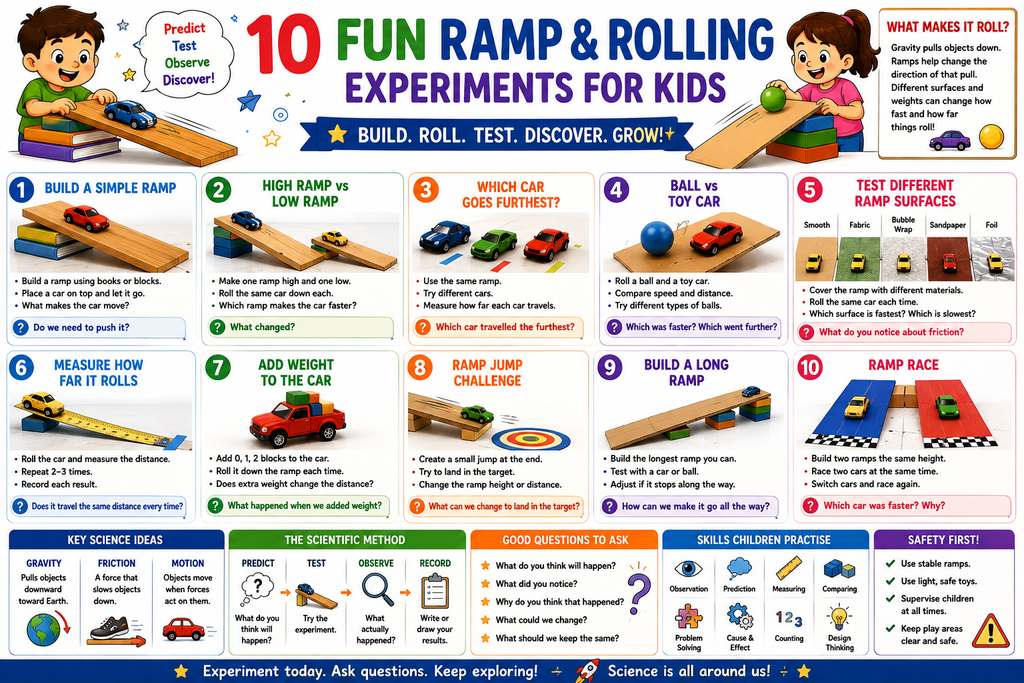
1. Build a Simple Ramp
Start with the easiest experiment.
Place one end of a piece of cardboard on a stack of books.
Put a toy car at the top.
Let it go without pushing.
Watch what happens.
Ask:
“What made the car move?”
“Did we need to push it?”
Explain simply that gravity pulls objects downward, helping the car move down the ramp.
Try several different toy cars.
Do they all move in exactly the same way?
2. High Ramp vs Low Ramp
Create two ramp heights.
For example:
Low ramp: one book
High ramp: four books
Roll the same car down each ramp.
Ask children to predict:
“Which ramp will make the car go faster?”
Then test it.
Children will usually notice that the steeper ramp makes the vehicle accelerate more quickly.
Ask:
“What changed?”
The car stayed the same. The ramp height changed.
This introduces the idea of changing one variable in an experiment.
3. Which Car Goes Furthest?
Choose several toy cars.
Use the same ramp for every test.
Release each car from the same starting point.
Mark where each one stops with masking tape.
Compare the distances.
Ask:
“Which car travelled the furthest?”
“Which stopped closest to the ramp?”
You can measure the distances with a ruler or measuring tape.
4. Ball vs Toy Car
Choose a ball and a toy car.
Place both at the top of the same ramp.
Release them separately.
Observe:
- Which moves faster?
- Which travels further?
- Which stops first?
Try different balls too.
For example:
Tennis ball
Ping-pong ball
Rubber ball
Children can compare how different shapes and materials affect movement.
5. Test Different Ramp Surfaces
Cover the ramp with different materials.
Try:
- Smooth cardboard
- Fabric
- Bubble wrap
- Sandpaper
- Aluminium foil
Use the same toy car each time.
Ask:
“Which surface will make the car go fastest?”
“Which surface will slow it down?”
Children may notice that rougher surfaces create more friction.
What’s Friction?
Friction is a force that can slow movement when two surfaces rub against each other.
Children don’t need to memorise the definition.
Let them experience the difference first.
6. Measure How Far It Rolls
Create one ramp and mark a starting line.
Release the toy car.
Measure the distance from the bottom of the ramp to where the car stops.
Record the result.
For example:
Test 1 – 85 cm
Test 2 – 92 cm
Test 3 – 88 cm
Ask:
“Did the car travel exactly the same distance every time?”
This introduces measuring and repeated testing.
7. Add Weight to the Car
Choose a toy vehicle that can safely carry small blocks or counters.
First, test the empty vehicle.
Then add one small block.
Test again.
Try adding another.
Ask:
“Does adding weight change how far the car travels?”
Children can record:
0 blocks
1 block
2 blocks
This is a good opportunity to compare predictions with actual results.
Keep the added objects securely positioned and age-appropriate.
8. Ramp Jump Challenge
Create a small gap or safe jump at the bottom of the ramp.
Use lightweight toy cars and keep the jump low.
Place a target on the floor.
Ask:
“Can we make the car land inside the target?”
Children can change:
- Ramp height
- Starting position
- Target distance
This becomes a simple engineering challenge.
Ask:
“What could we change to make the car travel further?”
9. Build a Long Ramp
Challenge children to build the longest working ramp they can.
Use:
- Cardboard
- Blocks
- Books
- Building pieces
Test whether a ball or toy car can travel all the way from the top to the bottom.
If it stops halfway, ask:
“Why do you think it stopped?”
“What could we change?”
Children may need to adjust the slope, joins or supports.
This activity encourages design thinking and problem-solving.
10. Create a Ramp Race
Build two ramps side by side.
Try to make them the same height and length.
Place one vehicle at the top of each ramp.
Count:
3, 2, 1, go!
Release them at the same time.
Ask:
“Which one reached the bottom first?”
Switch the cars between ramps and repeat.
This helps children investigate whether the result was caused by the car or the ramp.
Use Predict → Test → Observe
Ramp experiments work particularly well with the simple scientific method.
Predict
Ask:
“What do you think will happen?”
Test
Release the vehicle or ball.
Observe
Ask:
“What actually happened?”
Change Something
Ask:
“What should we change for our next test?”
This encourages children to think rather than simply watching the car roll.
Explore Gravity
Gravity is the force that pulls objects toward Earth.
You can demonstrate this simply.
Hold a ball above the floor.
Ask:
“What will happen when I let go?”
Release it.
The ball falls.
On a ramp, gravity pulls the car downward too, but the ramp changes the direction of its movement.
Explore Friction
Compare a toy car rolling across:
Smooth floor
and
Carpet
Ask:
“Where does it travel further?”
The car will often slow more quickly on carpet because there is greater friction.
Then test similar surfaces on the ramp.
Explore Speed
You don’t need a stopwatch to introduce speed.
Ask children:
“Which one moved faster?”
“Which one reached the bottom first?”
Older children can use a timer to compare how long different vehicles take to travel down the same ramp.
Make a Simple Results Chart
Older children can record their investigations.
| Test | Prediction | Result |
|---|---|---|
| High ramp | Car goes further | 120 cm |
| Low ramp | Car goes shorter | 75 cm |
| Fabric surface | Slower | Slower |
| Smooth surface | Faster | Faster |
Younger children can draw pictures instead.
Ask Good STEM Questions
Try questions such as:
“What do you think will happen?”
“Why did this car go further?”
“What could we change?”
“How can we make it faster?”
“How can we slow it down?”
“What should we keep the same?”
Questions like these encourage children to investigate relationships between cause and effect.
Turn It Into an Engineering Challenge
Give children a problem rather than instructions.
For example:
“Can you build a ramp that makes the car travel one metre?”
or:
“Can you build a ramp that makes the car stop inside this box?”
Allow children to build, test, change and try again.
There doesn’t need to be one correct design.
Skills Children Can Practise
Ramp and rolling activities can support:
- Prediction
- Observation
- Early physics
- Understanding motion
- Gravity
- Friction
- Measuring
- Comparing
- Counting
- Problem-solving
- Engineering thinking
- Cause and effect
- Concentration
- Cooperation
Encourage Repeated Testing
Science experiments are more useful when children can try them more than once.
If one car travels further, repeat the test.
Ask:
“Did the same thing happen again?”
If not, discuss why.
Maybe someone pushed the car accidentally.
Maybe the starting point changed.
Maybe the ramp moved.
Children begin to understand that fair experiments require some things to stay the same.
Keep Learning With PlayPrintGrow
Ramp activities turn familiar toys into simple science equipment.
Children can experiment with height, surfaces, weight and different vehicles while beginning to understand how forces affect movement.
Build a ramp, make a prediction and see where the investigation takes you.
Build. Roll. Test. Discover. Grow.