
Magnets can seem almost magical to young children.
A magnet can move an object without touching it, attract some materials while ignoring others and even push another magnet away.
These simple magnet activities for kids give children opportunities to predict, test, sort, investigate and discover how magnetic force works.
They are suitable for children around 3–8 years old with close adult supervision.
Safety First
Use large, child-safe magnets designed for supervised educational play.
Small or high-powered magnets can be extremely dangerous if swallowed. Keep magnets away from babies and children who may put objects in their mouths, and store all magnets securely after the activity.
Also keep magnets away from items that may be affected by them, such as some electronic devices and magnetic cards.
What You’ll Need
Depending on the activity, you can use:
- Large child-safe magnets
- Magnetic wand
- Paper clips
- Metal spoons
- Coins
- Bottle caps
- Wooden blocks
- Plastic toys
- Fabric
- Cardboard
- Aluminium foil
- Toy cars
- String
- Cups or containers
- Paper and pencil
You don’t need everything at once. Start with one magnet and a collection of safe everyday objects.
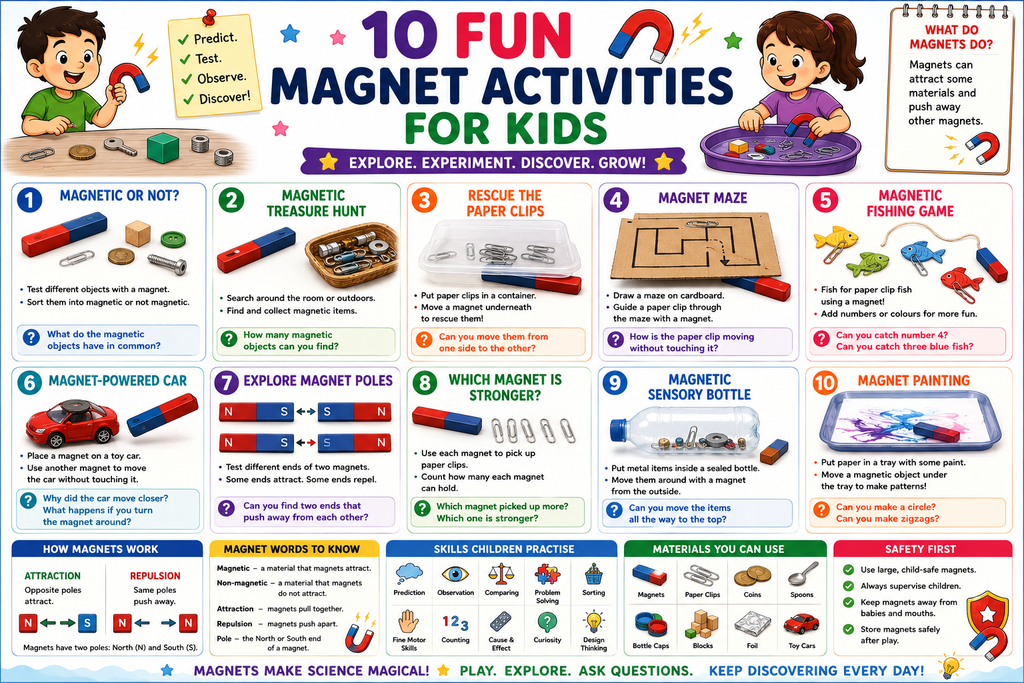
1. Magnetic or Not?
Collect several objects made from different materials.
Try:
- Paper clip
- Wooden block
- Plastic spoon
- Metal spoon
- Fabric
- Cardboard
- Bottle cap
- Coin
- Toy
Before testing each object, ask:
“Do you think the magnet will pick this up?”
Create two groups:
MAGNETIC
and
NOT MAGNETIC
Let children test each object and sort it into the correct group.
Ask
“What do the magnetic objects have in common?”
Children may begin noticing that magnets attract certain metals but not every material.
2. Magnetic Treasure Hunt
Give children a magnetic wand or large magnet.
Search around a safe play area for objects that attract the magnet.
Try looking near:
- Tables
- Toy shelves
- Craft materials
- Outdoor areas
- Construction sets
Instead of attaching the magnet directly to unknown objects, supervise closely and choose a prepared collection when possible.
Ask:
“How many magnetic objects can you find?”
Children can draw or list their discoveries.
3. Rescue the Paper Clips
Place several paper clips inside a shallow plastic container.
Move a magnet underneath the container.
Children can make the paper clips travel without touching them directly.
Try creating a simple story:
“The paper clips are trapped. Can your magnet rescue them?”
Ask:
“Can you move them from one side to the other?”
This demonstrates that magnetic force can act through some materials.
4. Magnet Maze
Draw a simple maze on a piece of cardboard.
Place a paper clip or small magnetic object on top.
Hold a magnet underneath the cardboard.
Move the magnet and guide the object through the maze.
Start with a simple path.
Older children can create their own maze with more turns.
Ask
“How is the paper clip moving when we aren’t touching it?”
This is a great activity for hand-eye coordination and problem-solving too.
5. Magnetic Fishing Game
Create pretend fish from paper or cardstock.
Attach a paper clip to each fish.
Make a fishing rod using:
- Stick or craft rod
- String
- Large child-safe magnet
Children lower the magnet towards the fish and try to catch one.
Add numbers or colours to the fish.
You can ask:
“Can you catch number 4?”
“Can you catch three blue fish?”
This combines STEM play with early maths.
6. Magnet-Powered Car
Place a small magnet on or inside a lightweight toy car where it is secure and cannot come loose.
Use another magnet to try moving the car without touching it.
Experiment with both ends of the magnet.
The car may sometimes move towards the second magnet and sometimes move away.
Ask
“Why did the car come closer?”
“What happened when we turned the magnet around?”
This introduces the ideas of attraction and repulsion.
7. Explore Magnet Poles
Use two large bar magnets designed for children.
Bring one end of each magnet slowly together.
Sometimes they attract.
Turn one magnet around.
They may push apart.
Explain simply:
Magnets have two ends called poles.
Opposite poles attract each other.
Matching poles repel each other.
Let children carefully explore the different combinations.
Ask
“Can you find two ends that push away from each other?”
8. Which Magnet Is Stronger?
If you have several safe magnets, compare them.
Place paper clips on a table.
Use each magnet to see how many paper clips it can pick up.
For example:
Magnet A → 4 paper clips
Magnet B → 7 paper clips
Ask:
“Which magnet picked up more?”
“Which one seems stronger?”
Children can record the results using numbers or drawings.
9. Magnetic Sensory Bottle
Place a few large magnetic items inside a clear, securely sealed container.
For example, you might use suitable metal pieces that are too large to be swallowed and cannot escape the container.
Use a magnet outside the bottle to move the objects around.
Children can explore moving them:
Up
Down
Left
Right
Ask:
“Can you move the object all the way to the top?”
Make sure the container is securely closed and used only under supervision.
10. Magnet Painting
Place a sheet of paper inside a shallow tray.
Add a small amount of washable paint and a safe magnetic object.
Move a magnet underneath the tray to move the object through the paint.
As it travels, it creates lines and patterns.
Children can experiment with:
- Straight lines
- Curves
- Circles
- Zigzags
Ask
“Can you make the object move without touching it?”
This combines science with art.
What Materials Do Magnets Attract?
Young children may assume magnets attract all metal objects.
But magnets mainly attract materials containing certain metals such as iron and steel.
Some metallic-looking objects may not be attracted.
This makes a good investigation.
Try asking:
“It looks like metal. Do you think the magnet will attract it?”
Then test it.
Science becomes more interesting when the result isn’t always obvious.
Introduce Attraction and Repulsion
Two useful science words are:
Attraction – when magnets pull towards each other or towards a magnetic material.
Repulsion – when two magnet poles push away from each other.
Let children experience both effects before expecting them to remember the vocabulary.
They can feel the invisible force pushing between the magnets.
Can Magnetism Work Through Materials?
Try placing a paper clip on:
- Paper
- Cardboard
- Thin plastic
- Fabric
Hold the magnet underneath.
Does it still move?
Children may discover that magnetic force can work through some non-magnetic materials.
Ask:
“Which material made it hardest to move the paper clip?”
Use Predict → Test → Observe
Before every investigation, ask children to make a prediction.
Predict
“Will the magnet attract this?”
Test
Let them safely try it.
Observe
Ask:
“What happened?”
Then compare the result with the original prediction.
A wrong prediction is not a failure. It gives the child something new to think about.
Make a Magnet Science Chart
Older children can record what they discover.
| Object | Prediction | Magnetic? |
|---|---|---|
| Paper clip | Yes | Yes |
| Wooden block | No | No |
| Plastic spoon | No | No |
| Steel spoon | Yes | Yes |
Children who are not writing yet can use pictures or stickers instead.
Skills Children Can Practise
Magnet activities can support:
- Observation
- Prediction
- Sorting
- Comparing
- Early scientific thinking
- Cause and effect
- Problem-solving
- Hand-eye coordination
- Fine motor skills
- Counting
- Vocabulary
- Curiosity
- Design thinking
Ask Open-Ended Questions
Try questions such as:
“Why do you think this object moved?”
“What happens if we turn the magnet around?”
“Can the magnet move it through cardboard?”
“Which magnet seems stronger?”
“What could we test next?”
Allow children time to investigate before giving an explanation.
Keep Learning With PlayPrintGrow
Magnets allow children to explore forces they cannot see but can clearly observe.
With just a few safe magnets and everyday objects, children can sort materials, move objects, solve challenges and begin discovering ideas about attraction and repulsion.
Let them predict first, test their ideas and keep asking questions.
Attract. Test. Discover. Grow.